
Inside the Trayus Academy, Meetra confronted Darth Sion. Physical defeat alone could not kill him because rage, pain, and the dark side held his shattered body together. Meetra instead undermined the meaning through which Sion sustained himself. He finally released his grip on life and died.
3951 BBY · Legends · Historical research
SION LETS GO
Events and source limitations
Within the Trayus Academy, Meetra confronted Darth Sion, whose broken body endured through rage, agony and the dark side. Repeated combat alone was insufficient to end him. In the light-side encounter Meetra persuaded Sion to release his dependence on that suffering, and he finally died. The turning point was not the discovery of a physical weapon that ignored his powers but a shift in his willingness to sustain them.
People, institutions and consequences
Sion’s identity had become organized around never-ending pain. His bodily condition was also a claim about what made a Sith strong: the capacity to convert suffering into dominance. Meetra’s challenge undermined that claim by showing that his persistence served an authority and worldview that had harmed him. The episode is a rare confrontation resolved by changing self-understanding as well as winning combat.
Sources: Knights of the Old Republic II, Darth Sion encounters in the Trayus Academy. Explore source transcript or chronology →. The article distinguishes fixed game events, Legends light-side continuity, player-variable choices and editorial analysis.
Pain is an institution of the self
Sion organizes identity around the belief that endurance through suffering proves power.
His body and ideology reinforce one another.
Defeat requires changing interpretation
Meetra cannot simply inflict enough damage.
Sion dies only when he no longer understands continued suffering as victory.
Anthropological assessment
Sion's death shows identity sustained through narrative as much as material condition.
People can endure extreme costs when those costs symbolize status, meaning, or moral worth inside a worldview.
Sion's final defeat
Darth Sion had survived bodily destruction through dark-side power and a conviction that pain proved strength. During the final Malachor campaign, Meetra's confrontation challenged more than his combat abilities. She forced him to confront the dependence on suffering and on Darth Traya that had held his identity together. The established light-side Legends outcome presents his death after he stops maintaining that destructive form of existence.
The scene is therefore not interchangeable with a normal lightsaber victory. Sion's suffering became a social and religious argument about power, while Meetra's challenge rejected the belief that survival at any price establishes moral legitimacy. The personal outcome also contributes to the collapse of the Sith Triumvirate, but his death and Darth Traya's later defeat remain separate incidents.
Was physical damage by itself enough to kill Sion?
No. His continued survival depended on dark-side will, and the encounter ends when that commitment is finally released.
Primary source: the Legends game, novel or sourcebook cited below. Historical events are distinguished from analysis, chronology estimates and branch-dependent gameplay.
Interactive historical judgment · 3951 BBY
Interpret this historical record
Answer both questions. Get corrections, an explanation and a score to distinguish what the sources show from interpretation.
Legends · 3951 BBY · Event source and interpretation
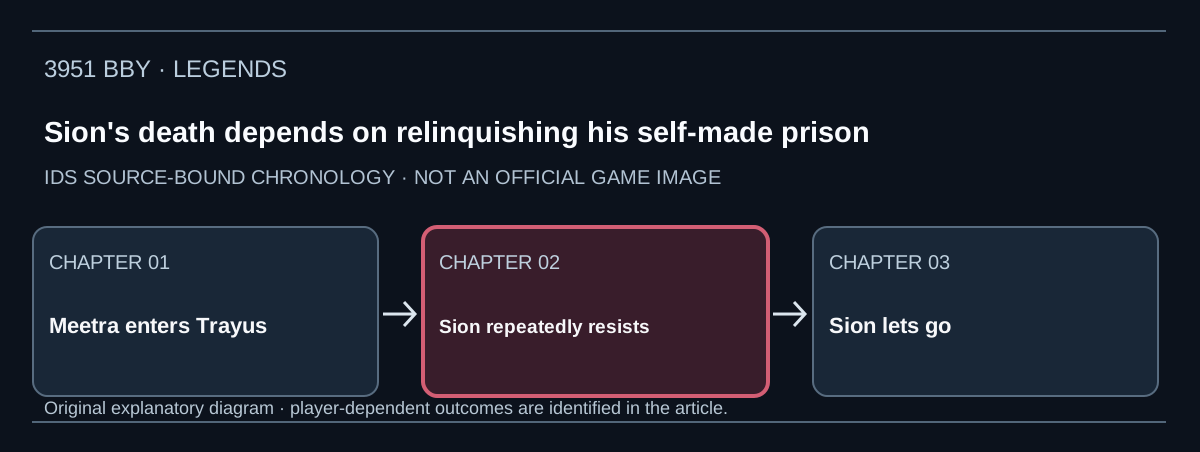
Sion's death depends on relinquishing his self-made prison
The body has become a political instrument
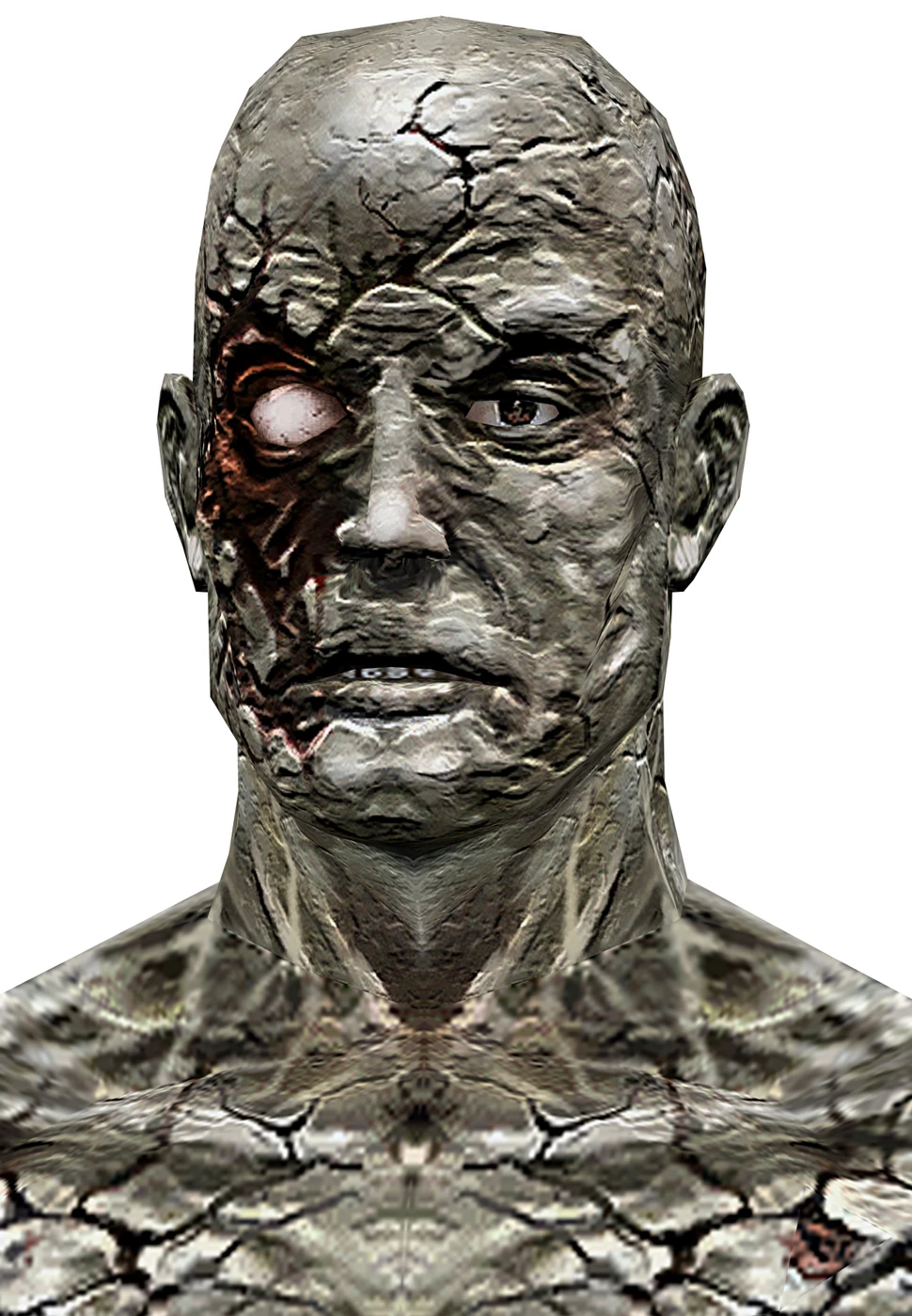
Darth Sion's ruined physical form embodies a life sustained by extreme pain, rage and commitment to the dark side. He had survived injuries that would ordinarily be fatal, making repeated physical blows inadequate to end the encounter. This is a specific fictional Force phenomenon, not an illustration of how real human bodies function. In the Sith Triumvirate, Sion had exercised power through fear and relentless pursuit of Jedi survivors. The final meeting with Meetra puts those habits against someone who understands suffering differently.
Victory turns on changing his account of himself
Meetra's conversation with Sion challenges the belief that continued rage is his only form of strength. His attachment to Kreia's judgment and his hatred of weakness become vulnerabilities. The central story depicts him ultimately choosing to release the hold through which he has remained alive. The player's precise dialogue may vary, but simply saying Sion was killed by the first successful blow would erase the unusual mechanism on which the narrative depends.
Pain, identity and authority are not interchangeable
An anthropological reading can consider how an institution turns endurance into a value and how an individual internalizes that demand. Sion's refusal to die is represented as power in one system and bondage in another. The game does not imply every Sith experiences pain as he did or that a single persuasive sentence would produce the same effect in other characters. This event comes before Meetra's final reckoning with Kreia and must be kept distinct from Malachor's later physical destruction.
Test your historical judgment: Would a single conventional saber wound necessarily kill Sion?
Analysis: No. The game's confrontation establishes that he continues through pain and dark-side will. Meetra must break the beliefs sustaining him rather than only attack his body.
Publication basis: Lucasfilm: KOTOR II support and story. Original game content establishes the story; promotional pages do not verify all branch-specific scene details or exact chronological dates. Continue this historical sequence →
Sources and further reading
- Knights of the Old Republic II: The Sith Lords.