
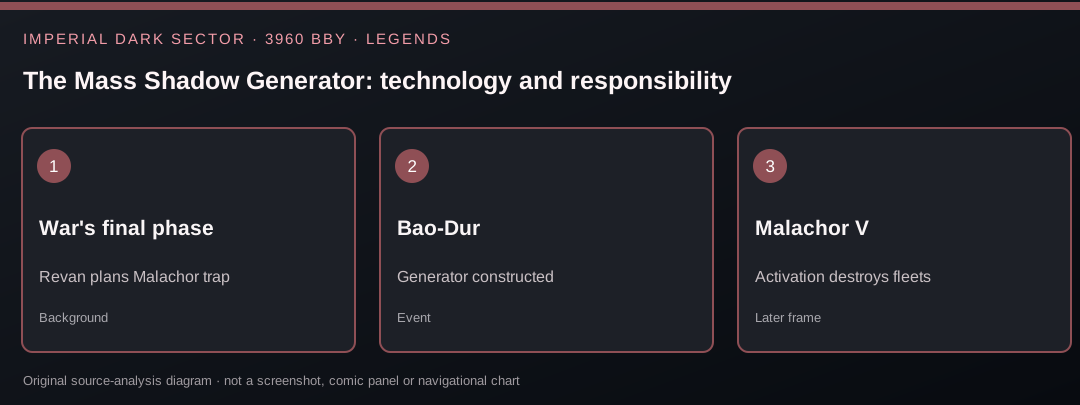
In 3960 BBY, Bao-Dur completed the Mass Shadow Generator under Revan's direction. The device was designed to manipulate the immense gravitational mass shadow of Malachor V. Revan intended to lure the Mandalorian fleet into range and end the war in one decisive operation.
3960 BBY · Legends · Source analysis
THE MASS SHADOW GENERATOR: source and society
Historical evidence and chronology
Before the climax at Malachor V, the Zabrak technician Bao-Dur designed and constructed a mass-shadow weapon under Revan's direction. It was intended to use an extraordinary gravitational effect to destroy vessels within the weapon's range. The generator was not independently invented by Meetra Surik during the battle, and its construction must be separated from its later activation. Accounts in the games connect both Bao-Dur and Surik to the decision's long aftermath.
Institutions, people and material consequences
An engineered device is not politically neutral once officials decide where, when and against whom to use it. Revan's military authority provided the strategic purpose; Bao-Dur supplied the technical design, while Surik was given command responsibility in the KOTOR II telling. Bao-Dur's later regret demonstrates how technical expertise and moral responsibility can persist beyond the person issuing commands.
Research trail: Knights of the Old Republic II – The Sith Lords; Mass Shadow Generator Legends sources. Further source and chronology notes →. IDS interpretations are editorial analysis. The locally hosted illustration is original conceptual art, not a comic scan or an exact battlefield photograph.
A technical solution to political exhaustion
The Republic had endured years of invasion and catastrophic losses.
A weapon capable of ending the war in one action became thinkable because conventional victory had been so costly.
Bao-Dur becomes responsible for a weapon he does not fully control
The engineer designed the device, but command authority over its use belonged to Revan and Meetra Surik.
Technical authorship and political responsibility were distributed across different people.
Anthropological assessment
The generator raises a classic question about weapons design: how responsibility is divided between inventors, commanders, and operators.
Large systems of violence depend on specialized labor even when no single participant controls the whole decision.
The Old Republic / connected history
How an engineered weapon became a political decision
Bao-Dur designed the Mass Shadow Generator as Revan prepared for the decisive confrontation with the Mandalorians. In the story of Knights of the Old Republic II, the engineer later describes the device and carries the memory of what it did. The system was meant to use the gravitational characteristics of Malachor V on a scale that ordinary weapons could not match. The available sources establish a fictional mass-shadow effect, not an engineering specification that can responsibly be reconstructed as real physics.
The division of responsibility is crucial. Bao-Dur possessed the knowledge needed to build the system; Revan selected the military strategy; Meetra Surik exercised the operational role associated with its eventual activation. These were not interchangeable forms of authority. The technicians who make a weapon possible may understand its mechanism without controlling the political objectives for which it is used. Similarly, a commander may order a strike without personally experiencing the material processes or human effects.
An intended end to a prolonged war
Mandalorian attacks had exhausted Republic defenders and devastated many worlds. A weapon promising a single decisive outcome could appear attractive under those conditions. The promise of shortening war, however, did not remove the moral obligation to ask whom the weapon would kill, including the Republic forces drawn into the battle.
The engineer's memory after the battle
Bao-Dur's later responses reveal that a device can continue to shape its designer's identity long after deployment. The generator is part of his biography and of Meetra's severance from the Force. Its creation should therefore be treated as a historically significant decision distinct from its subsequent activation.
Does designing a weapon automatically give its engineer final command over its use?
No. Bao-Dur's technical role and the command decisions made by Revan and Meetra were distinct, although each contributed to the final catastrophe.
Sources and dating: Knights of the Old Republic II: The Sith Lords; Bao-Dur and Meetra dialogue. This is Legends, not current Canon. This account separates established plot from retrospective historical interpretation; no unshown conversations, casualties, or troop movements have been invented.
Historical judgment · 3960 BBY
Interpret the source evidence
Choose an answer to each question. The assessment explains the correct answer and any error, rather than only displaying a score.
3960 BBY · Legends · original-source review
The Mass Shadow Generator: technology and responsibility
What the sources establish
Bao-Dur constructed the Mass Shadow Generator, which was deployed as part of Revan's plan to destroy the Mandalorian fleet near Malachor V in 3960 BBY. The resulting catastrophe destroyed ships and reshaped the world. Bao-Dur's later recollections emphasize that the device remained a personal source of guilt.
Power, identity, and society
Engineering decisions become moral and political decisions when they shape the scale of harm. Bao-Dur's work was embedded in a command hierarchy, and the consequences affected both enemy and Republic forces. His later suffering does not remove the role of military leadership in deciding to use the device.
Evidence limits
Different KOTOR II dialogue paths provide perspectives on the decision. A technical-looking schematic cannot be treated as a canonical circuit diagram or reliable gravitational physics. The event precedes later manifestations of Malachor V and the Jedi Exile's own loss.
Historical check: Was Bao-Dur the sole political decision-maker who ordered the generator's use?
Explanation: No. He engineered the weapon within Revan's broader military strategy; responsibility is distributed across roles and decisions.
Sources and further reading
- Knights of the Old Republic II: The Sith Lords.