
- Date
- 3960 BBY
- Immediate trigger
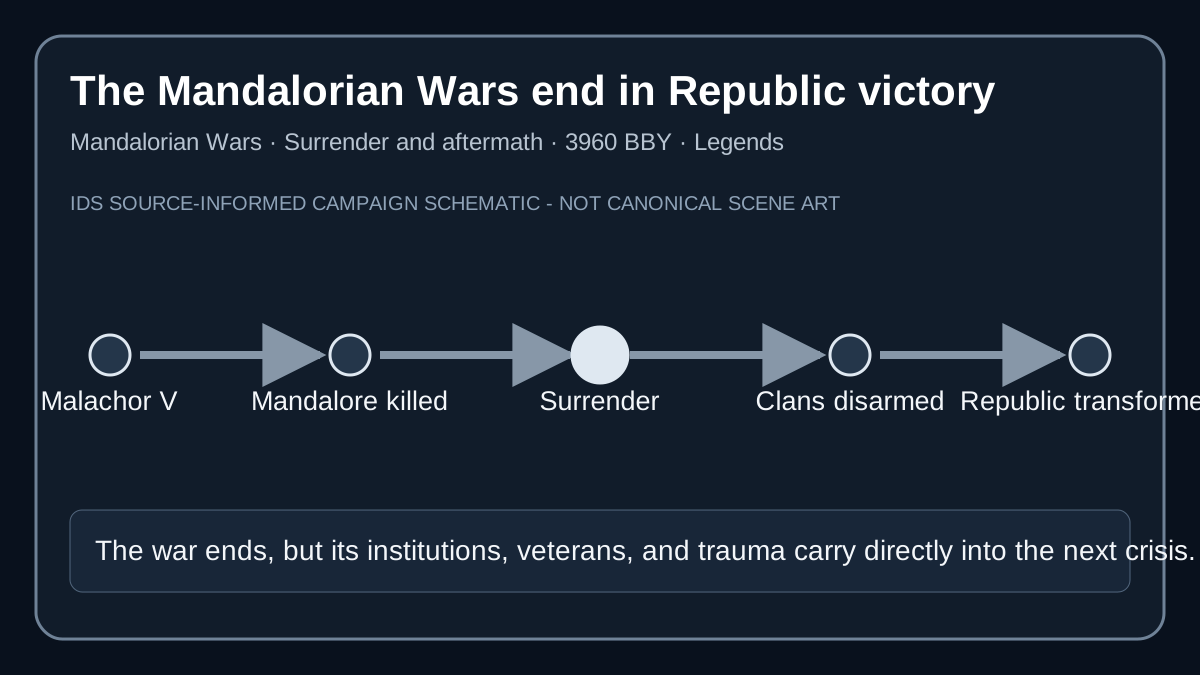
- Malachor V
- Mandalorian leader
- Mandalore the Ultimate killed
- Outcome
- Unconditional surrender
- Long-term result
- Clans fragment / Jedi Civil War follows
Historical narrative and evidence
The Mandalorian Wars ended in 3960 BBY after the catastrophe at Malachor V and the death of Mandalore the Ultimate. Surviving Mandalorian forces surrendered, and the Republic emerged as the military victor. The formal end of the conflict, however, did not restore the galaxy to its prewar condition. The war had transformed the Mandalorians, the Jedi, the Republic armed forces, and many of the people who had fought for them.
3960 BBY · Legends · Historical interpretation
MANDALORIAN WARS END
Story evidence, dates and limitations
After Revan killed Mandalore the Ultimate and the Mass Shadow Generator devastated the fleets at Malachor V, surviving Mandalorian forces surrendered in 3960 BBY. Revan deprived the defeated clans of their symbolic leader by concealing Mandalore's Mask. The military result ended a war that had expanded from distant Outer Rim raids into a conflict threatening the Republic's Core. It did not settle disputes within the Jedi or restore the lives and institutions destroyed during the campaigns.
Social history and consequences
Ending hostilities is not the same thing as ending a war's effects. The Mandalorian clans lost a central figure and a mechanism for unifying leadership, while the Republic inherited damaged trade routes, wounded soldiers and political disputes over Revan's methods. The next great danger emerged from within the victorious military: some personnel and Jedi transferred their loyalty to Revan and Malak. The archive treats defeat, demobilization, memory and political succession as related but distinct processes.
Research trail: Knights of the Old Republic I–II; The Essential Guide to Warfare; Mandalorian Wars ending. Read chronological source references →. Original edition page citations remain to be checked. The event banner is original symbolic IDS art and is not an authentic screenshot.
The surviving Neo-Crusaders surrender
With their central fleet shattered and Mandalore the Ultimate dead, organized Mandalorian resistance could no longer continue on the same scale. Surviving forces transmitted surrender and were disarmed.
Revan also took Mandalore's mask and concealed it. Because the mask served as an important symbol of legitimate Mandalorian succession, removing it made rapid reunification of the clans more difficult.
The clans fragment
Without a recognized Mandalore and without the military structure that had united them, many survivors dispersed. Some returned to clan life, some became mercenaries, and others struggled with the loss of the political project that had organized years of conquest.
The fragmentation mattered because the Republic had not merely defeated an army. The end of the war disrupted a system of leadership, identity, and collective purpose.
The Republic survives, but its institutions are altered
The Republic had endured years of invasion through mass mobilization and increasingly centralized military command. Revan's authority, the growth of veteran networks, and the normalization of severe wartime measures did not vanish when the Mandalorians surrendered.
The Jedi were also divided. Some had stayed outside the war, some had followed Revan, and many who fought returned with experiences that separated them from the Council's authority and from the people they had been before the conflict.
Victory immediately opens into another crisis
Revan and Malak soon left known Republic space to investigate the hidden Sith influence behind the Mandalorian invasion. Their journey, encounter with the Sith Emperor, and later return as Darth Revan and Darth Malak transformed much of the military force built during the Mandalorian Wars into the foundation of the Jedi Civil War.
The gap between the two conflicts is therefore politically narrow. The Republic defeated one enemy, but the personnel, ships, loyalties, and command structures created by that victory were soon redirected against it.
Anthropological assessment
The end of the Mandalorian Wars shows why military victory and social recovery are different historical categories. A government can defeat an external enemy while remaining saturated with the institutions, traumas, weapons, and habits created by the war.
It also demonstrates how defeated societies survive through fragmentation. The Mandalorian state project collapsed, but Mandalorian identities, clans, veterans, symbols, and memories persisted. The surrender ended one political formation, not the culture itself.
For the Republic, the deeper lesson is that emergency power leaves residues. Wartime command structures and personal loyalties did not disappear when peace was declared. They became resources available for the next conflict.
Evidence check
What is firmly established?
The date or range, continuity, broad combatants, outcome, and campaign placement are included only where the cited sources support them.
What has IDS deliberately not invented?
Unnamed commanders, exact force sizes, casualty totals, tactical phases, dialogue, and civilian experiences remain unknown unless a cited source establishes them.
Why use a schematic?
The visual is an original IDS reconstruction used where verified event-specific artwork is unavailable or rights status is unclear. It is labeled so it cannot be mistaken for canonical scene art.
Source judgment · 3960 BBY
Test your historical interpretation
Choose your answers. The assessment shows corrections, a source-based explanation and a score.
3960 BBY · Legends · Late-war source audit
The war ends, but its institutions and wounds remain
What the chronology establishes
Following Revan's victory and the catastrophe at Malachor V in 3960 BBY, Mandalore the Ultimate was dead and the surviving Mandalorian forces surrendered or fragmented. Revan concealed the Mask of Mandalore, disrupting a symbol around which a successor might unite the clans. The Republic emerged as the military winner, while its armed forces, Jedi relationships and transport infrastructure had been profoundly altered. The Jedi Civil War began in 3959 BBY, illustrating how quickly a new conflict emerged from the preceding one.
Anthropological analysis
The end of battlefield operations is not the same as reconciliation. Mandalorian society lost central leadership and faced fragmentation, while the Republic inherited an army shaped by loyalty to Revan and practices developed over years of total war. Survivors of Malachor carried physical, social and spiritual consequences into ordinary life. Objects also mattered: concealing Mandalore's Mask affected succession and shared identity across dispersed clans. This helps explain why later recovery of the mask by Canderous Ordo could have political significance long after the fighting ended.
Limits and dating
The 3960 BBY conclusion is separate from the events at Malachor in 3951 BBY and from the 3959–3956 BBY Jedi Civil War. Defeat did not imply extinction of every Mandalorian clan or individual.
Test your historical interpretation: Did the death of Mandalore the Ultimate end Mandalorian existence?
Explanation and correction: No. The central war ended and the clans fragmented, but Mandalorians survived and later reorganized.
Source: Knights of the Old Republic I–II; The Essential Guide to Warfare; The Old Republic: Revan. Explore original-source leads ↗. Printed-page checks are pending.
Sources and further reading
- Star Wars: Knights of the Old Republic II: The Sith Lords (2004), veteran testimony and postwar consequences.
- Drew Karpyshyn, The Old Republic: Revan (2011), Revan's postwar actions and Mandalorian succession context.
- The Essential Atlas (2009), war chronology.
- The Essential Guide to Warfare (2012), surrender and military aftermath.
Legends · historical source review
Victory accompanied by the destruction of Malachor V
At Malachor V, Revan defeats Mandalore the Ultimate. The Mass Shadow Generator is activated during the battle, devastating Mandalorian and Republic forces and tearing apart the planet. The weapon's use is narrated differently in several Legends works: Knights of the Old Republic II assigns an important operational role to the future Jedi Exile and Bao-Dur, while Gnost-Dural's Galactic History attributes ultimate responsibility to Revan.
Both accounts agree that a catastrophic measure contributed to the Mandalorian defeat and left survivors and participants marked by the event. The deaths among Republic forces prevent the battle from being classified as an unqualified victory with no political or ethical consequences. Surviving Mandalorian clans lose their central leader but do not cease to possess collective traditions or members. The former comrades Revan and Malak pursue a different mission afterward, ultimately leading into the next war rather than continuing this one indefinitely.
Historical judgment: Accounts of who ordered or activated the Generator differ; attribute each source. Publisher's related original account →. The analysis of political institutions is IDS interpretation, not game dialogue. Day-level event dates and player-defined decisions are not asserted.