Original IDS symbolic visual, not a literal scene from the books. Author research notes →
In 4896 BBY, Nida Korsin died after ruling the Lost Tribe of Sith for seventy-nine years. She had taken power in 4975 BBY after the death of her father Yaru, the defeat of Seelah and Jariad Korsin's coup, and the suppression of Adari Vaal's Keshiri uprising.
A seventy-nine-year reign is not a complete political record
Nida emerged as the Grand Lord of the Lost Tribe during the 4975 BBY crisis, when the Keshiri uprising and internal Sith rivalries challenged Yaru Korsin. Her accession followed the collapse of both those challenges. John Jackson Miller’s notes on Lost Tribe of the Sith: Purgatory explain that a later story, Pantheon, established a seventy-nine-year reign, which makes 4896 BBY an approximate end date.
That duration alone does not describe a peaceful or equitable society. The first generation of Sith rulers had seized authority over native Keshiri communities and had recently eliminated much of their own Red Sith population. The source does not support inventing decades of named reforms, bureaucratic decrees or uniform political consent under Nida. What it does establish is a long continuity of the Grand Lord’s office after the founding generation.
From emergency command to institutional tradition
Yaru Korsin first led a stranded Sith crew after the Omen crashed on Kesh. His successor was his daughter, and the family struggle that made Nida Grand Lord became the origin of a long dynastic narrative. By the end of her reign, many residents would have been born after the shipwreck and the first crisis, giving later generations inherited accounts rather than direct memories of those foundational events.
The importance of a succession history is not limited to the ruler’s personal life. Titles, hereditary privileges and control of political narratives become resources through which an institution reproduces authority over time. The events of the uprising and the purge remain relevant because later elites could portray the survival of their own office as proof that its original claims were legitimate. The story does not show what each Keshiri community remembered or believed about those claims.
Anthropological assessment
Nida’s reign provides a clear example of the difference between the duration of a regime and the evidence for life inside it. A seventy-nine-year span gives researchers a chronological frame, but not automatic knowledge of its laws, household arrangements, violence, everyday ritual or economic exchanges. The available narrative places greater weight on the ruling family than on the population it governed.
Political stability, when viewed from the palace, may mean that one officeholder kept power. For the Keshiri, it could involve very different experiences of mobility, work, religion and imposed authority. The best anthropological question is not whether Nida deserves a simple label of good or bad ruler, but whose continuity this date records and whose experiences the record leaves absent.
Hidden Sith & Lost Tribe / Legends research
A reign long enough to transform crash survivors into a dynasty
Nida Korsin died in 4896 BBY after ruling Kesh's Lost Tribe of Sith for seventy-nine years. Her career began in an isolated population created by the Omen crash and marked by conflicts among its earliest leaders. The circumstances of her accession were violent: her father Yaru died amid a family coup and a simultaneous attempt by Keshiri opponents to challenge Sith rule. By the time of her death, these events had become part of an inherited political history rather than immediate memories for many people living under her authority.
The source record provides relatively little detail about the ordinary administration of her long reign. That absence should be acknowledged rather than replaced with invented laws, campaigns or biographies. What can be observed is the broad change in the Tribe's social position. It had gone from an emergency community of shipwrecked personnel to a hereditary ruling order tied to Kesh's land, inhabitants and religious institutions. The experiences of the native Keshiri remained distinct from the internal story the Sith ruling family told about itself.
How exceptional rule becomes ordinary government
Decades of survival allow titles, privileges and institutions created during a crisis to acquire an appearance of normality. People born long afterward may inherit them without knowing the original disputes that made them possible.
Royal history is not the history of all inhabitants
An account of Nida's long stability describes the rulers' continuity. It does not establish equal treatment, safety or consent among the Keshiri population that had endured conquest and exclusion.
Do the source stories describe seventy-nine years of detailed public policy by Nida?
No. The length of her reign is established, while the surviving narrative is considerably richer about the political violence near her accession.
Research sources: John Jackson Miller, Lost Tribe of the Sith; Lost Tribe historical chronology. Source-sparse events remain bounded by the available evidence. Political interpretation is not invented eyewitness history.
c. 4896 BBY · Legends · Source comparison
What the dates reveal about dynastic power
- 4975 BBY
Nida takes control following the death of her father Yaru and the simultaneous conflict involving Sith plotters and Keshiri opponents of Sith rule, as depicted in Savior.
- Seventy-nine years
Pantheon identifies the span of Nida’s rule, an author-confirmed chronological fact. Surviving stories do not narrate each year.
- c. 4896 BBY
Subtracting the reported reign length yields an approximate endpoint. Her death closes a reign, not the full history of the Lost Tribe or its relationship with Keshiri communities.
Did the author publish a seventy-nine-year account of Nida’s government?
No. John Jackson Miller’s notes on Purgatory explicitly refer to the reign length established in Pantheon. An elapsed period does not supply missing episodes or policies.
Author source: John Jackson Miller’s Purgatory commentary, referring to the later Pantheon chronology. Read alongside the Savior notes for Nida’s accession.
Legends · Source study · 5000–4896 BBY
The meaning and limits of a seventy-nine-year reign
From 4975 to 4896 BBY, Nida Korsin held the title of Grand Lord. The length of her reign demonstrates the institutional durability of the Lost Tribe after the first generation of stranded Sith, but it does not establish that all Keshiri subjects supported her or that every political decision is known. Dynastic succession describes formal authority. It cannot substitute for a history of household labor, local customs and negotiation between rulers and the communities they dominated.
The distinction between an early emergency settlement and an inherited political order is central to this period. Nida did not inherit a functioning galactic navy or the resources of the original Sith Empire. Her government ruled within an isolated planetary environment, separated from events at Dromund Kaas. A chronological account can responsibly identify her tenure from the Lost Tribe sequence without inventing a year-by-year list of decrees. Miller's later stories and notes link this early dynasty to institutions and legends remembered by later generations.
Connected histories and boundaries
Source trail: Author / book source. These establish a licensed fictional narrative; historical interpretation of migration, governance, colonization or destruction is IDS analysis. No unrecorded casualty figures or spoken orders are claimed.
Why this article stays separate from nearby events
The Omen castaways founded an isolated political order on Kesh, not Vitiate's Empire at Dromund Kaas. Even events in the same year, such as the indigenous uprising and the Korsin family struggle, had different people, stakes and outcomes.
Historical judgment · Legends
Test your historical judgment
Answer both questions and receive scored corrections explaining what the source material actually supports.
4896 BBY · Legends · Historical evidence
A lengthy reign transforms a crash-survivor hierarchy into tradition
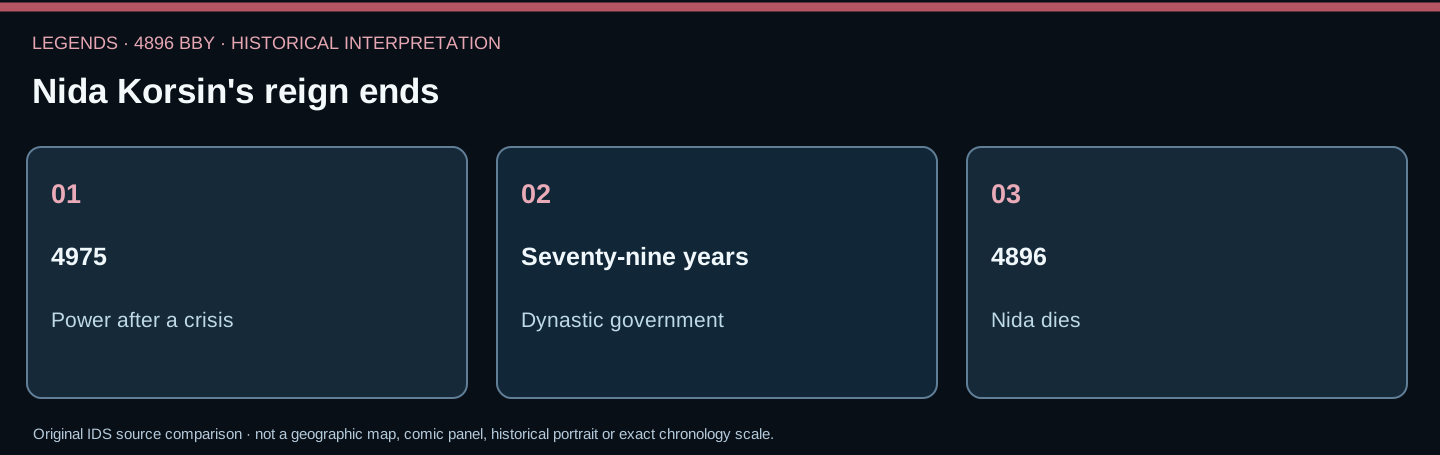
Nida Korsin's accession followed the violent crisis involving Adari Vaal's Keshiri opposition and the competing ambitions within the Korsin family. A seventy-nine-year reign meant that a leadership system created under exceptional circumstances could become familiar to generations born after the original shipwreck.
The 4896 BBY death date and length of the reign are documented in the author commentary accompanying John Jackson Miller's Lost Tribe of the Sith. The resulting arithmetic does not supply detailed yearly chronicles of taxation, settlement policy or personal religious observance. It is therefore possible to discuss institutional continuity without fabricating an unrecorded court history.
The Keshiri community's position under the Lost Tribe should not be erased by a ruler-centered account. A long reign records stability for an occupying dynasty, not necessarily consent from all subjects. IDS's visual explicitly contrasts the succession crisis, the duration of government and the ruler's death.
Historical judgment: Does a seventy-nine-year reign prove that Keshiri opposition disappeared throughout Nida's rule?
Explanation: No. The span of a reign does not independently document the opinions or resistance of every subject.
Read a related historical dossier → · Complete timeline →
Primary story or reference family: John Jackson Miller, Lost Tribe of the Sith: Purgatory commentary. Explanations distinguish source-reported facts from editorial inference; original editions require page-level proofing where only summaries are available.
Sources and further reading
- John Jackson Miller, Lost Tribe of the Sith: Purgatory author notes (dates Nida’s reign using Pantheon).
- John Jackson Miller, Savior author notes, political succession.
- Nida Korsin, Wookieepedia