
Bao-Dur is a Republic war veteran whose technical genius helped destroy Malachor V. Years later, the Zabrak engineer contributes to rebuilding Telos and joins the Jedi Exile aboard the Ebon Hawk. His life joins the engineering of war to the work of repairing its consequences.
Biography
Bao-Dur is an Iridonian Zabrak whose experience in the Mandalorian Wars was shaped by attacks on his people's colonies. He entered Republic service as a technical specialist and contributed to the weapons and systems used against Mandalorian forces. He called the Jedi Exile 'General' because they had served in the same military campaign, a relationship that continued long after the fighting ended.
During the decisive battle at Malachor V, Bao-Dur designed the Mass Shadow Generator. When the weapon was activated, it brought devastating destruction to the battlefield and altered the planet. He survived the war, but his role in creating the device gave him a reason to question what his technical achievements had accomplished. He later turned toward repairing a damaged world rather than building another weapon.
In Knights of the Old Republic II: The Sith Lords, the Exile encounters him on Telos, where he has been helping with the planet's restoration. He joins the Ebon Hawk crew and becomes the engineer whose knowledge of machinery, shields, and droids supports the search for surviving Jedi. His skill is practical, but his memories of Malachor are central to his conversations with the Exile.
Relationships & belonging
Bao-Dur's use of the title 'General' keeps an earlier command relationship alive. He speaks to the Exile with loyalty and respect, but both carry a history in which orders and technical work produced catastrophic results. The relationship joins military hierarchy to shared responsibility: the person giving the order and the engineer who made it possible cannot be understood separately.
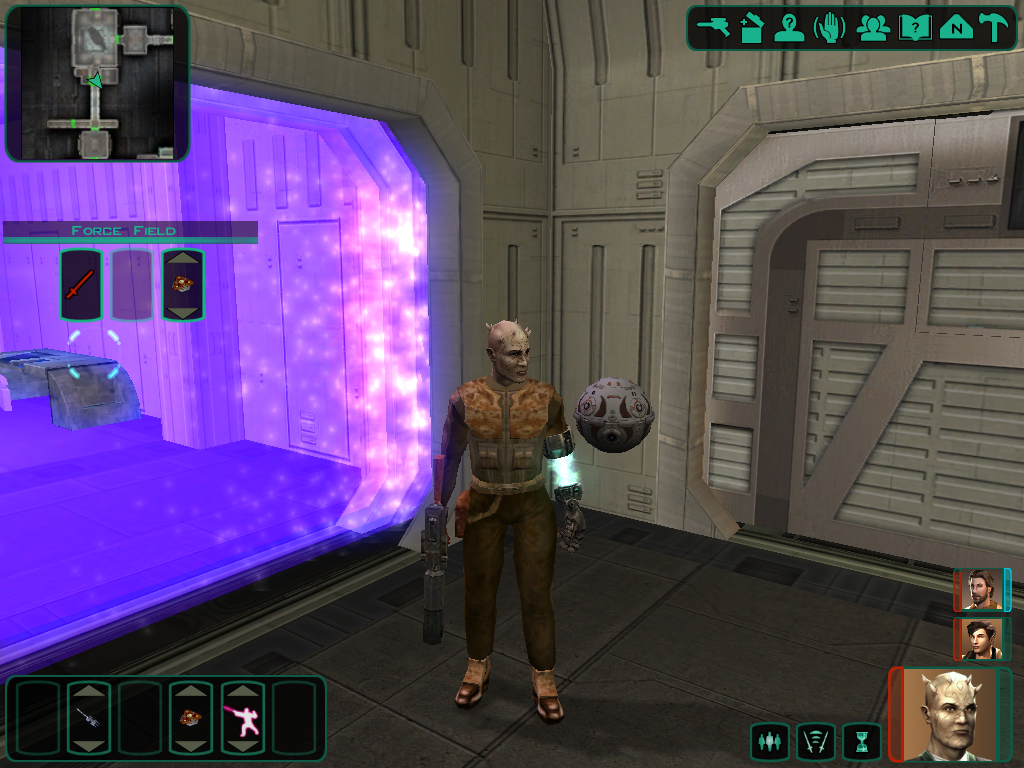
His floating remote droid provides a very different relationship. Bao-Dur built it when he was young, and it remains his companion through years of repairs and travel. The remote has tools for delicate modifications and helps him work on machinery. Their exchanges also provide moments of warmth and humor that do not depend on the military history dominating much of his life.
Bao-Dur has difficulty with the Mandalorian identity represented by Canderous Ordo, later Mandalore the Preserver. The hostility is rooted in war and attacks on Iridonian communities, not merely in a difference of opinion. When members of formerly opposed groups travel together, cooperation does not mean that their histories of loss or aggression disappear.
Identity & social position
Bao-Dur is a Zabrak identified by small cranial horns, but the game does not reduce him to species appearance. His status as a veteran engineer, displaced participant in a disastrous campaign, and restoration worker matters more to his decisions than any single label. The story distinguishes his cultural background from his personal experiences with Mandalorian violence.
He wears a mechanical prosthetic arm made to replace an arm lost during the wars. The device restores useful capacity and gives him particular abilities in the field. His mechanical fist can break through energy shields, allowing the player to pass barriers that other companions cannot readily disable. The prosthesis is a working tool as well as a visible record of injury.
His identity also includes the tension between designer and repairer. A specialist who helped create a terrible weapon later applies similar knowledge to ecological and infrastructural recovery. That movement does not erase his part in Malachor's destruction, but it changes how his labor affects the communities around him.
Institutions & power
The Republic war effort could employ Bao-Dur's engineering because military institutions need experts who build weapons, maintain equipment, and solve practical problems. The Mass Shadow Generator demonstrates how a chain of command can turn specialized technical skill into an instrument of mass destruction. A device's successful operation cannot, by itself, establish that its use was justified.
On Telos, restoration efforts offer a contrasting use of institutional power. Workers attempt to rebuild life after the devastation of the Jedi Civil War, while competing organizations contest resources and control. Bao-Dur's work there places him within a broader social project dependent on engineering, ecological knowledge, and sustained material support.
The Ebon Hawk crew is smaller and less formal than an army. Bao-Dur follows the Exile's leadership but contributes expertise no Jedi title can replace. His importance to the group emerges from repairs, technical judgments, and the ability to get others past physical obstacles.
Beliefs & worldview
Bao-Dur's commitment to restoring Telos is an action that communicates his values. It is not a speech that makes his old actions harmless. Restoration requires labor over time, while the casualties of Malachor cannot simply be recovered. His decision to repair instead of destroy creates a moral direction without promising complete absolution.
His anger toward Mandalorians complicates this orientation. War produced losses that remain difficult for him to forgive. A person devoted to rebuilding can still carry hostility toward those associated with earlier violence; the game allows both responses to exist within the same character.
With sufficient influence, the player can train Bao-Dur to develop his Force sensitivity and become a Jedi Guardian. This possible path is shaped by dialogue and choices. His distinctive contribution remains technical work, whether or not the player develops that optional new role.
Material life
The Mass Shadow Generator is the most consequential object Bao-Dur designed. It connects engineers, military planners, operators, and victims across a single event. The altered landscape of Malachor V continues to record its use after the original armies have vanished. Treating the catastrophe only as a Force phenomenon would conceal the decisions involved in building and activating the weapon.
His replacement arm demonstrates another kind of technology: a device that compensates for a lost capacity and supports both work and combat. Bao-Dur's knowledge of machinery also makes him valuable in repair, computer access, and shield removal. These are ordinary technical actions that can decide whether the Ebon Hawk crew is able to continue.
The remote is a small object with an unusually long personal history. At Malachor V, the droid can be directed toward the generator's remaining engine cores while G0-T0 attempts to interfere. A conflict over the fate of a planet is carried out through technical systems and the small machines that operate them.
Historical significance
Bao-Dur connects the end of the Mandalorian Wars with the era of repair following the Jedi Civil War. He shows that a major historical disaster involves more than commanders and Force-users: engineers and other specialists make the military technology possible, and communities live with its consequences long after the battle.
His work on Telos illustrates the difference between defeating an enemy and restoring a society. Habitable land, infrastructure, and local institutions take years of attention. The story uses reconstruction as a continuing process rather than a quick conclusion to military conflict.
The remote's involvement in Malachor's final sequence returns Bao-Dur's invention to the center of the narrative. Different machines can follow competing instructions about whether to preserve or destroy what remains. The history of the weapon continues through later decisions about its use.
Anthropological assessment
Bao-Dur offers a study of technical responsibility. He made something that succeeded according to a narrow battlefield objective and failed disastrously according to the wider interests of living populations. Engineering knowledge does not carry a single political purpose; institutions decide how it is commissioned and used.
His move toward planetary restoration distinguishes repair from erasure. Rebuilding Telos can help people return to ordinary life, but it cannot reverse the deaths at Malachor. The meaning of the work depends on whose needs it serves, who provides resources, and how communities are involved in decisions about recovery.
The prosthetic arm and the remote show smaller forms of technological mediation. One device restores a bodily capability; another sustains a relationship and performs specialized work. Together with the Mass Shadow Generator, they reveal how machines acquire social significance from the lives of those who make, operate, and depend on them.
Collecting this Character
Bao-Dur's short cranial horns and mechanical arm help distinguish him in game-related artwork and collectibles. Compare names and editions with the licensed source when identifying a specific item.
Material fandom · Collector reference
Collecting this Character
Explore related Star Wars media
Browse Star Wars books and collectibles related to this character.
Search Amazon for Bao-Dur ↗As an Amazon Associate I earn from qualifying purchases. Check the product, maker and edition before buying; searches may include unrelated items.
Sources and continuity
Story details derive from Knights of the Old Republic II: The Sith Lords (Legends). The option to train Bao-Dur as a Jedi depends on player choices. The anthropological interpretation is editorial analysis.
- Obsidian Entertainment: KOTOR II
- Bao-Dur in The Sith Lords: dialogue and companion details
- GameBanshee: Bao-Dur character and gameplay
- MobyGames: Original KOTOR II Bao-Dur screenshot
- Bao-Dur: Legends character history
Game character portrait: GameBanshee. In-game screenshot: MobyGames.