

- Year
- 5 BBY
- Continuity
- Canon
- World
- Aldhani
Dating and evidence: Dates are drawn from Canon stories and official references. Older and younger episodes within the same numbered year need not occur in the precise sequence suggested by listing order; source continuity governs. Images of later character appearances are identified.
A garrison behind a cultural spectacle
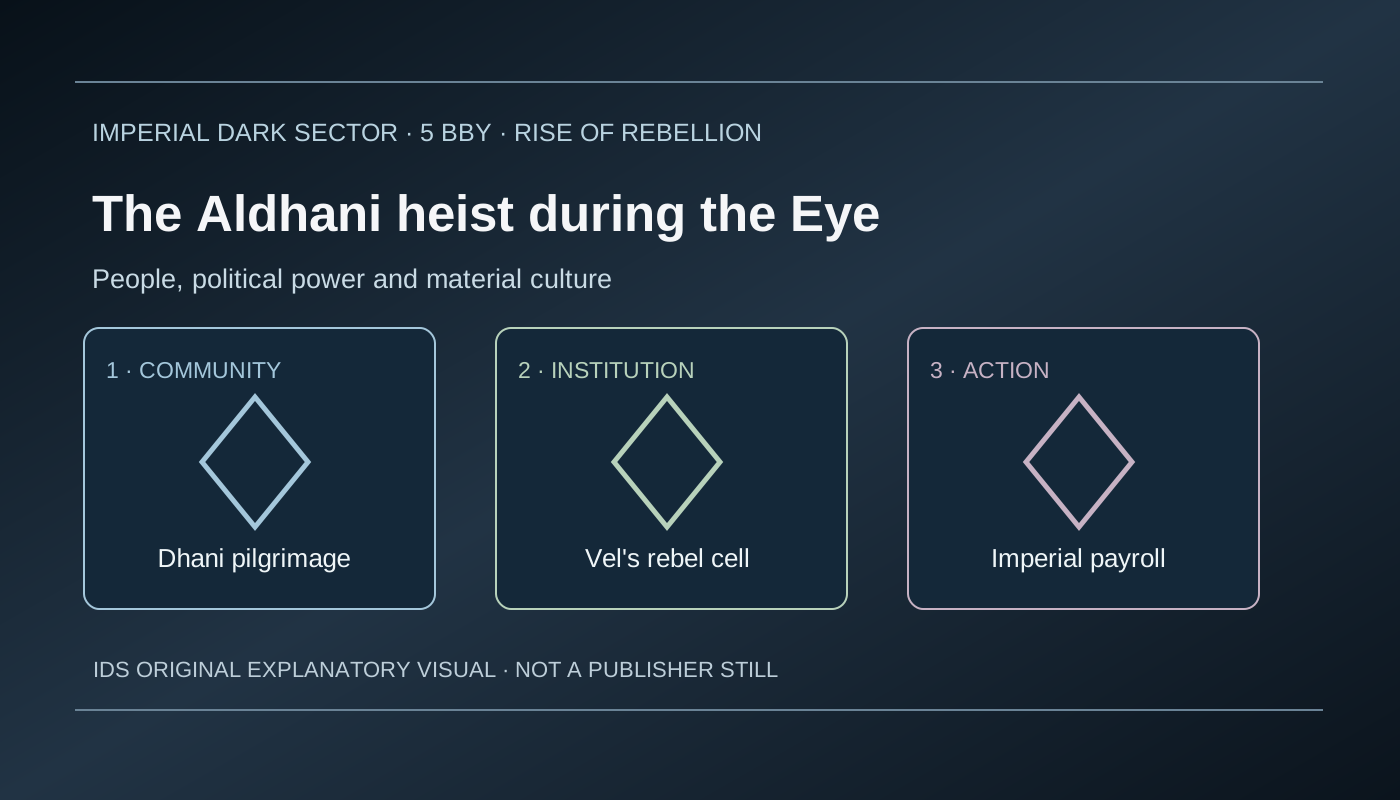
Vel Sartha's small rebel team spent months preparing to rob an Imperial payroll vault on Aldhani. The mission was scheduled around the Eye, a rare celestial event also central to the traditions of the indigenous Dhani people.
Imperial restrictions on indigenous life
The Empire had appropriated local spaces and supervised the Dhani pilgrimage and festival for its own security needs. Its officers treated the event as a logistical inconvenience, while the rebels exploited the ceremonial gathering to move toward the garrison.
A successful theft at grave cost
The team escaped with approximately 80 million credits, but several members died. Cassian survived and discovered that Arvel Skeen hoped to take the money for himself, forcing another violent confrontation before he escaped.
Anthropological assessment
The heist is not solely a theft of currency. It intersects with colonial control over indigenous ceremony and with the moral compromises of clandestine financing. Karis Nemik's political reflections offer a different explanation for resistance than profit alone.
Interactive history lab
Was the Eye merely a made-up visual effect with no Dhani cultural meaning?
No. It was an actual local event central to Dhani traditions and the timing of the heist.
Select a research lens to compare the story's historical, institutional, and cultural significance.
Canon / Reign of the Empire · Andor
A sacred celestial event becomes cover for resistance
The Eye of Aldhani was part of the Dhani people's ceremonial calendar, not an entertainment invented by the Empire or the rebels. Imperial occupation had changed the way people could gather and travel for the pilgrimage, with officials attempting to manage the event around their own security and colonial settlement projects. Vel Sartha's cell planned to exploit the predictable movement of pilgrims and the extraordinary celestial display to penetrate an Imperial payroll facility. The decision did not make Dhani culture merely a tool for outsiders. The ceremony retained its local meanings even as military forces and insurgents used the same landscape for different purposes.
The operation involved disguises, carefully timed movements, control of communications and coercion of Commandant Jayhold Beehaz and his family. The group removed approximately 80 million credits from the vault, but the escape cost the lives of members of the cell. Cassian discovered afterward that Arvel Skeen hoped to appropriate the money for himself rather than continue the rebel mission. The theft is therefore neither a clean financial transaction nor a simple story of heroic purity. Luthen's broader objective was to force the Empire into a more openly repressive response, anticipating that its policies would expose the nature of Imperial rule to more citizens.
Occupation of ceremonial geography
The Dhani festival illustrates how an occupying state can restrict the paths, gatherings and ritual practices through which a society maintains identity. The Imperial commander's treatment of the event showed both contempt and a desire to control people. The rebels' reliance on the pilgrimage highlights how cultural knowledge can have strategic value without belonging to military planners.
Financing resistance changes its moral burdens
A clandestine movement needs money, transport and the loyalty of people who may barely know one another. The payroll heist supplied resources but placed hostages and civilians in danger and exposed mistrust within the team. The cost should remain visible beside the dramatic escape.
Was the Eye merely an invented visual distraction without Dhani significance?
No. It was a rare celestial event deeply linked to an indigenous Dhani pilgrimage that Imperial authorities had restricted and instrumentalized.
Primary screen and published guide: Andor S1 E6 'The Eye'; official StarWars.com episode guide. Source events and player-independent chronology are distinguished from IDS institutional interpretation. This is Canon. No invented dialogue or unsupported personnel totals.
Sources and further reading
Andor, The Eye; StarWars.com official episode guide. Source and chronological background →.
Canon · 5 BBY · Emerging resistance
The Aldhani heist during the Eye: narrative and historical method
What the source tells us
Vel Sartha's team prepared a raid on an Imperial garrison payroll vault while the celestial phenomenon known as the Eye drew local Dhani people to their traditional observance. Cassian participated under the name Clem. The operation took roughly 80 million Imperial credits, but its success came with loss of life and prompted harsher state punishment across the galaxy. The Dhani festival was not created by the rebels and did not exist solely as camouflage.
Anthropological interpretation
The episode connects Indigenous cultural practice with an occupying power's efforts to control gatherings and sacred geography. The Empire exploited local traditions to marginalize Dhani communities while treating the garrison's treasury as secure administrative infrastructure. The rebels used the spectacle tactically, but that decision was not equivalent to ownership of Dhani ritual life.
Source and chronology distinction
This event occurs in the 5 BBY Canon chronology. The original television shows premiered much later in the real world. Andor season-one episodes and the early Rebels story follow separate resistance groups with different leadership; treat local traditions as distinct from the later unified alliance.
Test your historical judgment
Both questions include scoring, corrections and a source explanation.