
With the Sith blockade still active, Canderous Ordo proposed stealing Davik Kang's freighter, the Ebon Hawk. T3-M4 helped the group gain access needed for the escape. Revan, Bastila, Carth, Mission, Zaalbar, Canderous, and T3-M4 seized the ship and fled the planet as the Sith fleet moved into bombardment formation.
3956 BBY · Legends · Historical evidence
THE EBON HAWK ESCAPES
Events, sources and uncertainties
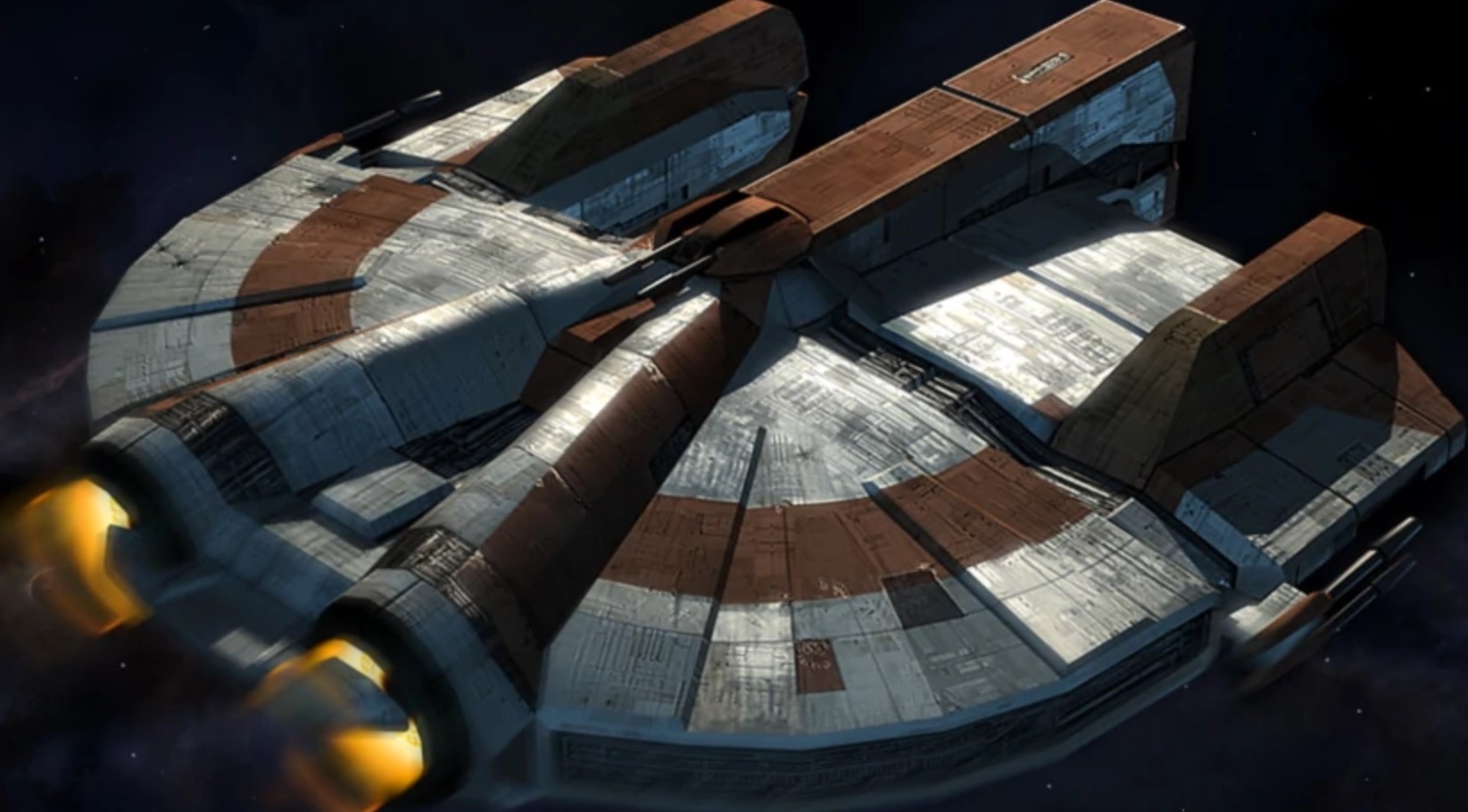
Revan's companions secured Davik Kang's ship, the Ebon Hawk, after obtaining access through T3-M4 and contacts made during the Taris mission. The crew included Bastila Shan, Carth Onasi, Canderous Ordo, Mission Vao, Zaalbar and T3-M4. It fled while Malak prepared his orbital attack. The main acquisition and escape are fixed elements of the Legends story, but the exact composition of every earlier optional exploration party can vary by player choice.
Anthropological analysis
The Ebon Hawk demonstrates how a vehicle can acquire a new social identity when its passengers and purpose change. An underworld vessel became the mobile institution linking soldiers, Jedi, droids, former Mandalorians and street survivors. Cooperation depended on practical trust among people whose backgrounds and loyalties were far from identical. The ship's departure saved an unusually diverse group while leaving the fate of most Taris residents unresolved.
Source trail: Knights of the Old Republic (2003), Davik's Estate and Escape from Taris. Read source and reference context →. The new hero is conceptual IDS artwork, not documentary evidence; exact print pages and game dialogue timings require final verification.
A criminal vessel becomes a historical vehicle
The Ebon Hawk moved from Exchange property into the center of Republic and Jedi history.
Objects change political meaning when ownership and use change.
Escape requires a mixed social coalition
Jedi, Republic military personnel, street survivors, a Wookiee exile, a Mandalorian veteran, and droids cooperate.
The group is held together by practical dependence before shared identity.
Anthropological assessment
The Ebon Hawk crew demonstrates coalition formation through crisis.
People with incompatible backgrounds can form durable groups when shared risk creates trust faster than institutions would normally permit.
How the escape was organized
Revan’s party did not simply board an abandoned ship. The Ebon Hawk belonged to Exchange boss Davik Kang, whose organization controlled access to the freighter and the hangar. Canderous Ordo’s plan relied on knowing how that criminal infrastructure operated. T3-M4’s slicing capabilities helped the group bypass obstacles that the Republic’s surviving troops could not have overcome by force alone. The escape joins three stories that are often separated: Bastila’s rescue, the crew’s decision to cooperate, and the Sith destruction of Taris.
Davik’s hangar was a contested space when the Sith bombardment began. Calo Nord survived the episode and later returned as a bounty hunter working against Revan. The ship departed before the worst bombardment, leaving much of the urban population behind. Consequently, the successful escape of central characters must never be presented as the evacuation of the city.
A ship with a changed political purpose
The freighter had been part of an underworld commercial network. After the escape it became a mobile home, transport hub, and base for people seeking the Star Forge. The same cargo holds, hyperdrive and internal compartments supported fundamentally different projects. Its history illustrates how control of technology and transport can shift from organized crime to a wartime coalition without altering the object itself.
Who actually made the mission possible?
No single social group possessed all the skills needed to leave Taris. Carth contributed Republic military experience. Bastila supplied Jedi knowledge and carried the burden of Malak’s pursuit. Mission and Zaalbar understood life beyond the Upper City’s privileged districts. Canderous knew criminal routes and Mandalorian tactics, while T3-M4 worked with security systems. Their partnership crossed lines that divided the planet before the invasion.
Interpretation: what changed beyond the battle?
The group’s escape is a useful case study in emergency cooperation. Class, species, military background, and prior political loyalty usually limit access to powerful institutions. On Taris, those divisions briefly mattered less than the immediate need for shelter and transport. This does not mean the passengers instantly agreed about morality or galactic government. Trust developed through shared problems and repeated acts of dependence after they left.
The event also demonstrates the difference between the history of a famous crew and the history of a conquered world. The personal story continues aboard the Ebon Hawk, while most residents of Taris have no comparable exit. An archival account needs both perspectives.
Was the Ebon Hawk already a Republic warship?
No. Davik Kang’s freighter was taken from the Exchange’s criminal organization. Its later significance comes from the people and political purposes it carried, not from a prior Republic military designation.
Evidence boundary: This reconstruction reads the original Legends game or comic alongside its existing cited chronology. It distinguishes directly depicted events, later continuity and anthropological interpretation. Illustrations of later appearances are not presented as images of a character's creation or a battle not pictured.
Interactive source interpretation · 3956 BBY
Test your historical judgment
Choose both answers and receive detailed source-based explanations, corrections, and a score.
Sources and further reading
- Star Wars: Knights of the Old Republic.