

- World
- Kesh
- Birth name
- Iliana Merko
- Born
- 3024 BBY
- Later title
- Grand Consort
- Later faction
- Sisters of Seelah
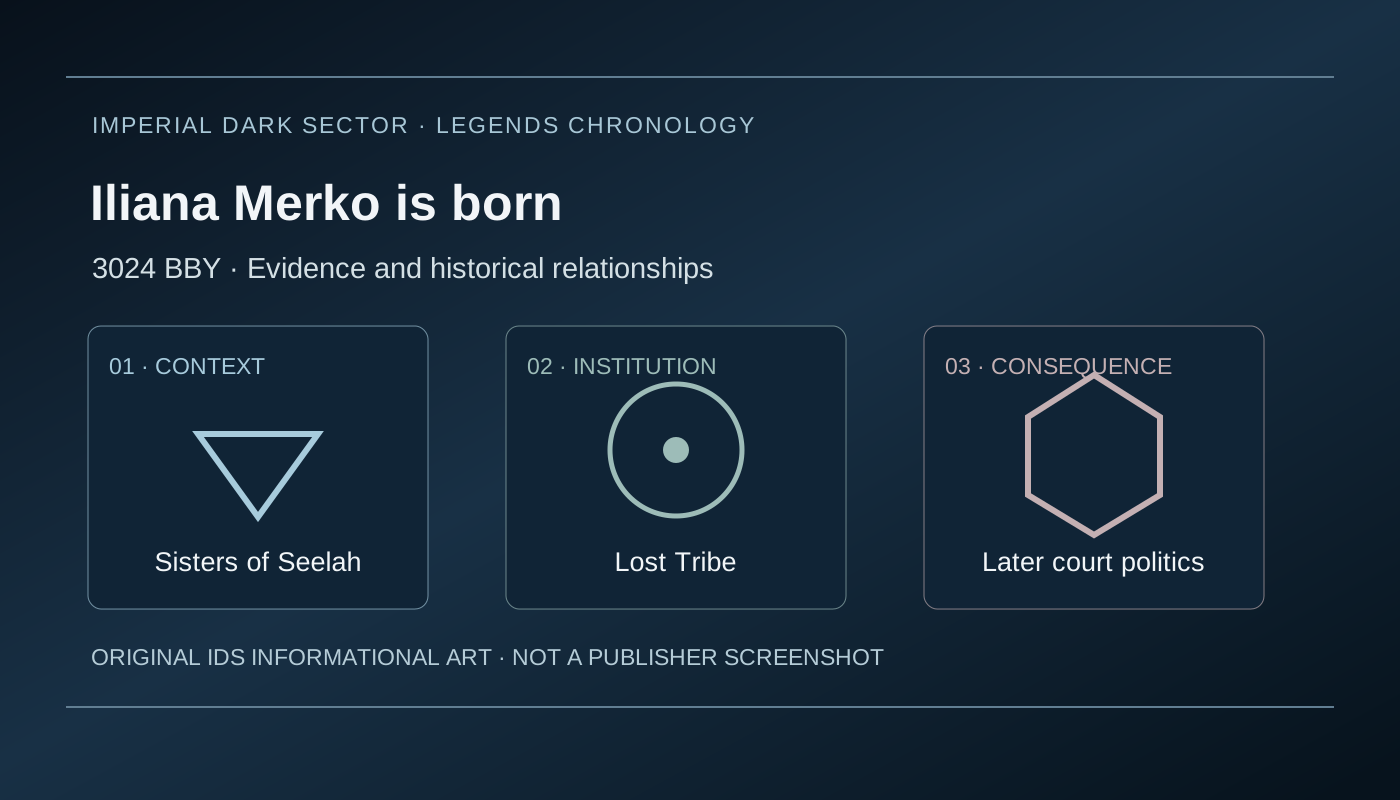
In 3024 BBY, Iliana Merko was born on Kesh into the isolated Lost Tribe of Sith. Her childhood fell within the long political deterioration later labeled the Time of the Rot. As an adult she became leader of the Sisters of Seelah, a faction that challenged the Tribe's official founder narrative, and then became Grand Consort after marrying Varner Hilts. She later commanded Tribal forces during the 2974 BBY rebellion of Remulus Dreypa.
Born inside a society already arguing about its past
The Lost Tribe had been isolated on Kesh for nearly two thousand years. The descendants of the Omen survivors no longer lived as temporary castaways; they possessed cities, ranks, rituals, archives, and inherited inequalities.
Iliana would later exploit precisely those historical arguments, elevating Seelah Korsin against the official founder tradition.
The Time of the Rot shaped the political generation that followed
By Iliana's lifetime, factional rivalry and institutional decay had become ordinary features of elite politics.
Her later willingness to seize the capitol and pressure Caretaker Varner Hilts emerged from a political culture already accustomed to status competition and revisionist claims.
Her later marriage did not end her independent power
Iliana married Hilts in 3000 BBY after the Great Crisis, but she remained a powerful actor. She became Grand Consort and later directed Lost Tribe forces against Dreypa.
This matters because dynastic language can hide women's continued military and factional agency.
Event sequence
Iliana Merko is born.
She becomes involved in the Great Crisis and marries Varner Hilts.
She serves as Grand Consort.
Iliana commands forces during Dreypa's rebellion.
Explore this entry
Was Iliana born into the ruling household?
No. She rose later through factional politics and her alliance with Varner Hilts.
Why is her birth a separate timeline entry?
She becomes one of the most consequential political and military actors on Kesh during the next fifty years.
Were the Sisters of Seelah already ruling Kesh?
No. Iliana later led the faction; her birth is not the faction's founding.
Anthropological assessment
Iliana's biography shows how political generations are formed before their members acquire office. A child can inherit a crisis as normality and later act through assumptions created by that environment.
Her later founder politics also demonstrates that history is a political resource. Choosing which ancestor deserves honor can organize factions as effectively as economic or military interests.
Sources and further reading
- John Jackson Miller, Lost Tribe of the Sith: Pantheon, Secrets, and Spiral.
- Iliana Hilts — Wookieepedia.
3024 BBY · Legends · Evidence and political anthropology
Iliana Merko is born: what the historical record supports
Source-constrained historical account
Iliana Merko's birth precedes her role in factional intrigue and her eventual association with Varner Hilts. She is important because the Sisters of Seelah sought to influence the political interpretation of the Lost Tribe's founding story. A biography should not treat her later ambitions as known facts about her upbringing unless the source actually narrates those years.
Institutions, beliefs and material life
Dynastic and ceremonial institutions can make family names into sources of political legitimacy. Merko's later actions help illustrate those processes, but this entry's date records her birth, not the founding of the Sisters or the start of their confrontation with Hilts. The novel cover is a contextual publication image.
Chronology and evidence limitations
Dates in this early Legends era are from fictional reference chronologies, sometimes approximate. A later person's accomplishments cannot be read into a record of their birth. IDS distinguishes events recorded in original books or reference titles from analysis of their social implications. A source illustration or cover may portray an era rather than the precise dated event.
The original published narrative and reference bibliography are recorded below; secondary online reference links are research aids and not interchangeable with primary novel pages or guide citations.
Test your historical judgment
Answer both questions. Your result explains the source-based distinction, including any corrections.