
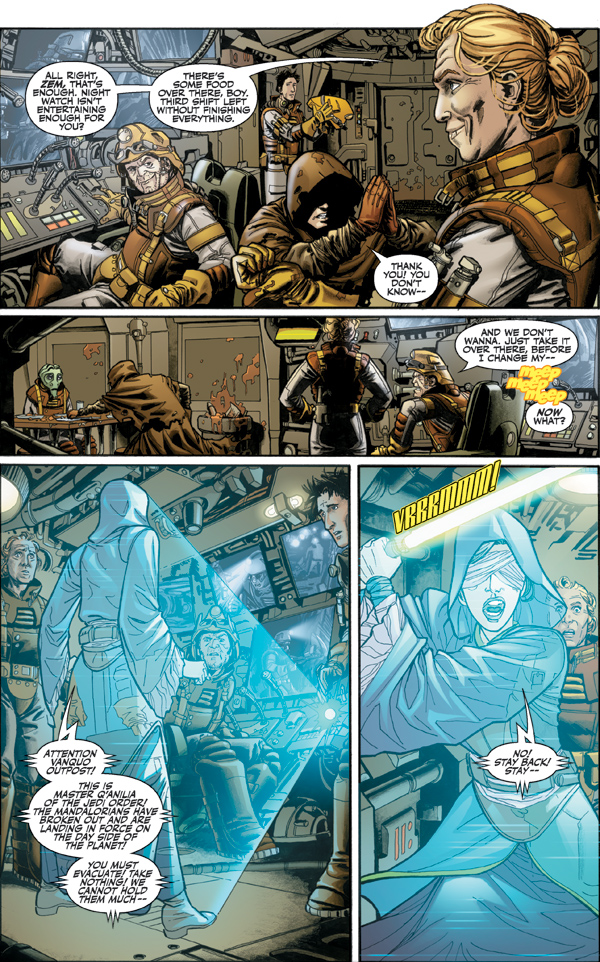
Across 3964 BBY, Suurja and Flashpoint became recurring battle zones in the Taris theater. Republic and Mandalorian forces fought a series of engagements on Suurja without decisive resolution. The Mandalorians captured Flashpoint Station, and a group of Revanchist Jedi including Alek was ambushed and imprisoned there. These linked actions showed that the eight-month frontier stalemate had ended.
Four named battles and an ambush make Suurja one of the most contested 3964 BBY worlds.
Revanchist volunteers encounter the war directly and are captured.
Flashpoint provides a strategic station and prison site.
Why Suurja kept being fought over
Suurja lay in the active defensive zone around Taris. Neither side could easily ignore it because control affected movement through the surrounding theater.
Repeated battles indicate a contested front rather than a single clean conquest.
Flashpoint Station falls
The Mandalorians captured the research station after breaking the earlier stalemate.
Control of the station provided logistics, intelligence value, and a secure place to imprison captured Jedi.
The Revanchists arrive
Revan's movement consisted of Jedi who believed the Council's refusal to intervene was morally untenable.
Alek and other volunteers reached Suurja before the movement had become a formal Republic command force.
Explore the event
First Battle of Suurja
Republic and Mandalorian forces fought for control of the world during the developing Taris theater. The engagement did not settle the front.
Second and Third Battles of Suurja
The repeated fighting shows the planet changing hands or remaining contested through successive operations rather than one decisive battle.
Fourth Battle of Suurja
The fourth named engagement continued the stalemate as the broader Mandalorian breakthrough developed elsewhere.
Ambush on Suurja
After Revan departed to investigate other fronts, Rohlan Dyre's Mandalorian shock troops ambushed Revanchist Jedi. Alek and others were captured.
Battle of Flashpoint Station
The captured Jedi were taken to Mandalorian-held Flashpoint Station, making the facility a focal point in the next stage of the campaign.
Anthropological assessment
The Suurja campaign illustrates the lived reality hidden by arrows on a strategic map. A 'front line' can mean repeated occupation, evacuation, rebuilding, and combat on the same communities.
The Revanchists also show how moral disagreement inside a religious institution can become direct military participation before the institution itself changes policy.
Test your historical judgment
Answer both to receive a score, specific corrections, and a research takeaway.
Legends · historical source review
A frontier operation takes on political meaning
Suurja and Flashpoint belong to the local conflicts surrounding Republic resistance to Mandalorian pressure in the Taris region. Accounts spanning several engagements should not be collapsed into a single battle with an invented casualty figure. The fighting created military narratives that different commanders could cite to justify either continued caution or wider mobilization. Events in the Knights of the Old Republic comic continuity add perspectives of travelers and Jedi outside ordinary field headquarters.
The name of a battlefield can become shorthand for a longer sequence of incidents. Such shorthand risks erasing distinctions between an initial clash, subsequent troop movement, and the experiences of civilians whose routes are interrupted. This is a useful example of how archives select units of history: a campaign may be dated to a year while individual incidents lack day-level certainty. The conflict preceded the full Mandalorian Onslaught, although the long war's boundaries are not consistently labeled across every publication.
Historical judgment: The events at Suurja and Flashpoint are a campaign sequence. Publisher's related original account →. Publisher stories establish the main plot; social-institutional interpretations are IDS analysis. Exact day-level chronology is not asserted.
Sources and further reading
- Star Wars: Knights of the Old Republic 7–8.
- Knights of the Old Republic Campaign Guide.