
Bo-Katan’s history is inseparable from Mandalore’s political fracture. She began as a member of Death Watch, a militant group that opposed her sister Duchess Satine’s pacifist government. That early allegiance matters because Bo-Katan is not introduced as a finished hero. She starts with a willingness to use force for a vision of Mandalorian identity and must later confront the consequences of letting outside powers use that vision.

Clan Kryze and the political division of Mandalore
Bo-Katan Kryze belongs to a prominent Mandalorian family whose members disagree sharply about the future of their world. Her sister, Duchess Satine Kryze, leads a pacifist government that seeks stability after generations of conflict. Bo-Katan instead joins the militant Death Watch, which calls for the revival of Mandalore's warrior traditions. The difference is political, not evidence that the sisters belong to unrelated cultures.
Bo-Katan's early allegiance matters because her later position as leader does not arise from an uninterrupted record of wise decisions. She initially supports efforts to overthrow the existing government through force. The experience demonstrates how competing interpretations of tradition can become powerful tools in struggles over who is entitled to rule.
Death Watch, Pre Vizsla, and a dangerous alliance
Serving alongside Pre Vizsla, Bo-Katan participates in Death Watch operations intended to restore warrior rule. The movement uses recognizable armor, clan loyalties, and stories about Mandalore's past to justify its campaign. Those signs can inspire members, but they cannot by themselves prove that the movement's goals represent the wishes of every Mandalorian.
When Vizsla allies with Darth Maul and Savage Opress, Bo-Katan questions the partnership. Maul's network of criminal organizations helps destabilize Mandalore and create conditions for Death Watch to present itself as a savior. The plan succeeds in removing Satine, but it also brings a new struggle over who controls the forces that carried out the coup.
Maul's takeover and the loss of Satine
After Maul kills Vizsla in combat, Bo-Katan refuses to accept the Sith as Mandalore's rightful leader. She breaks with his followers and helps free Satine from captivity. Maul subsequently kills the duchess, leaving Bo-Katan to confront the death of her sister and the consequences of the movement she helped strengthen.
Bo-Katan organizes the Nite Owls against Maul's loyalists. Her resistance is important, but it does not erase her earlier involvement with Death Watch. The political problem is how a person who contributed to destabilizing the government can help create a new order without denying responsibility for the events that came before.
The Siege of Mandalore and the end of the Republic
Bo-Katan seeks assistance from Ahsoka Tano and Republic forces to remove Maul. The resulting Siege of Mandalore takes place as the Republic is about to become the Empire. Capturing Maul does not establish a lasting political settlement. Instead, Mandalore moves into another period of outside interference, as Palpatine's regime expands control over the galaxy.
The transition also exposes the limits of a victory defined only by defeating one ruler. Mandalorian factions retain different loyalties, and the institutions needed to govern a divided society cannot be restored simply through the removal of Maul's military leadership.
The Darksaber and competing forms of legitimacy
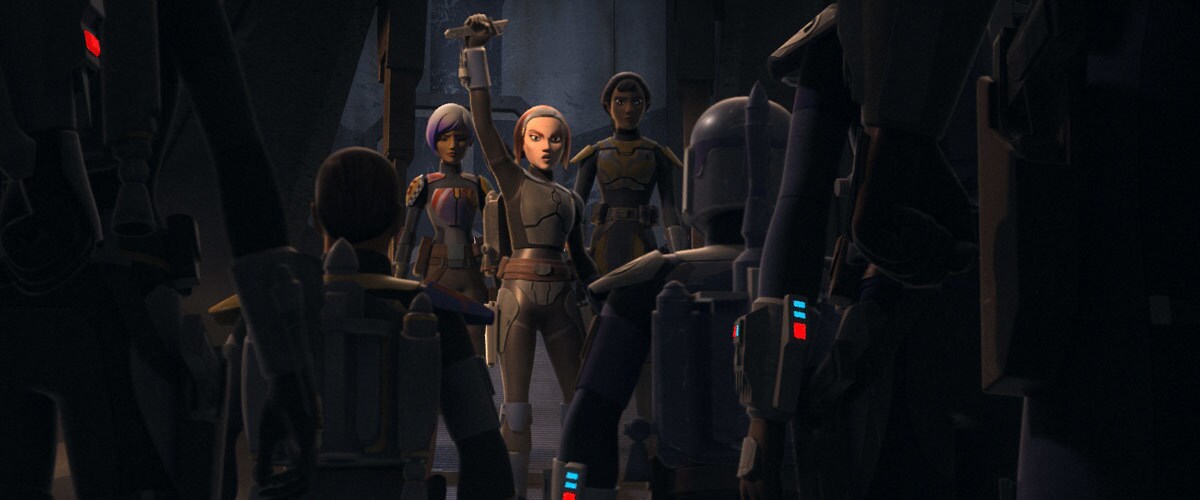
During the era of rebellion, Sabine Wren helps Bo-Katan challenge Imperial control of Mandalore and offers her the Darksaber. The weapon is associated with Mandalorian leadership and with a history of contested succession. Accepting it gives Bo-Katan a powerful public symbol, but the legitimacy of her position still depends on clans willing to cooperate.
Her leadership becomes another target of Imperial violence. The Great Purge devastates Mandalore and disperses much of its population, leaving survivors with memories of destroyed homes, damaged institutions, and disagreements about how the disaster could have been prevented. The destruction makes possession of a ceremonial weapon insufficient to guarantee unity.
Meeting Din Djarin after the Empire's fall
During the New Republic era, Bo-Katan operates with Mandalorian allies including Koska Reeves and Axe Woves. On Trask she encounters Din Djarin and Grogu. Din's commitment to the Children of the Watch differs from Bo-Katan's customs, especially the rule governing removal of the helmet. Their disagreement reveals how displaced communities can preserve several competing definitions of membership.
Bo-Katan joins the mission against Moff Gideon's cruiser with the goal of reclaiming the Darksaber. Din defeats Gideon and inadvertently obtains the blade under Mandalorian customs, frustrating her plans. Bo-Katan cannot simply take it without confronting the rules through which other people recognize leadership. The episode turns a military success into a crisis of political legitimacy.
Return to Mandalore and the Living Waters
Din's journey to the Living Waters beneath Mandalore brings Bo-Katan back to a homeland she has struggled to recover. She helps him survive dangers in the ruined mines and witnesses a living Mythosaur beneath the water. The sight has personal meaning because the creature is closely connected to Mandalorian history and expectations about collective renewal.
Bo-Katan's experience with Din and the Armorer gradually changes her relationship to groups whose practices she previously dismissed. She does not abandon her own history, but learns to cooperate across old divisions. The ability to remove or retain a helmet becomes less important than the willingness to protect others and help rebuild a shared home.
Reunification and the recovery of the Great Forge
Bo-Katan receives renewed recognition as leader and works to bring together groups of Mandalorians who followed different routes through exile. Din's explanation of the Darksaber's passage through combat helps resolve the immediate dispute surrounding its transfer. More important, the emerging alliance depends on people accepting joint responsibilities after decades of conflict.
On Mandalore, Bo-Katan and her allies confront Moff Gideon's forces. The struggle takes place amid Imperial installations and the remnants of Mandalorian industry. Gideon uses beskar and Mandalorian resources to support his own military program. The attempt to reclaim the Great Forge therefore involves both physical territory and a means of restoring collective production and cultural continuity.
Armor, the Mythosaur, and the public signs of leadership
Bo-Katan's armor, inherited through her family, records affiliation and continuity across several political periods. Mandalorian equipment is not simply a costume associated with combat. It requires skilled craft, carries clan identities, and makes membership legible to other Mandalorians. The Darksaber functions differently, as a symbol whose authority depends on stories about succession and public recognition.
The Mythosaur adds another layer of meaning. A creature associated with legendary Mandalorian history becomes part of contemporary arguments about whether the people can renew their society. Yet seeing the creature does not itself construct homes, produce equipment, reconcile factions, or establish fair government. Those tasks require sustained cooperation.
Anthropological assessment: political repair after complicity
Bo-Katan's biography shows how leadership can be transformed by experience, loss, and the recognition of past errors. She helped a militant movement destabilize her sister's government, rejected Maul's takeover, resisted Imperial domination, and later tried to unite survivors whose beliefs about Mandalorian identity differed. These phases form one political history rather than separate versions of a flawless hero.
Mandalore's reconstruction also distinguishes symbolism from the institutions that make collective life possible. Weapons, armor, clan banners, and ritual sites communicate shared history, but they become politically effective only when people agree to work together. Bo-Katan's later authority emerges through military competence, cooperation across factions, and a willingness to assume responsibility for the community's future.
Lucasfilm Databank: Bo-Katan Kryze ↗
Collector note: Bo-Katan cards appeal to Clone Wars, Rebels, and The Mandalorian collectors. Darksaber imagery, helmet portraits, and cards showing her with other Mandalorians tend to carry strong narrative identity.
Material fandom · Collector reference
Collecting this Character
View the Bo-Katan Kryze collecting page: reviewed cards, figures, Funko and other formats
Explore related Star Wars media
Browse Star Wars books and collectibles related to this character.
Search Amazon for Bo-Katan Kryze ↗As an Amazon Associate I earn from qualifying purchases. Check the product, maker and edition before buying; searches may include unrelated items.