
Mira survives war, displacement, and forced service before becoming one of Nar Shaddaa's most capable bounty hunters. Her skill at finding people is shaped by the experience of having lost a family and a home. Unlike many of her competitors, she generally refuses contracts requiring murder.
How recruitment changes with your decisions
A light-side or neutral Exile meets Mira as the potential Nar Shaddaa companion. In a strongly dark-side playthrough, Hanharr takes that companion role. Mira's possible conversion to Jedi Sentinel requires relationship development and additional player actions.
Biography
Mira's early history begins during the Mandalorian Wars. She was taken captive when young and made to serve Mandalorian forces, first carrying supplies and then learning to fight and track. The Mandalorians became the unit in which she learned to survive, even though that association began without her consent. The defeat at Malachor V left her without the soldiers she had known as a substitute family.
After the war, she joined the displaced people arriving on Nar Shaddaa. She turned the skills acquired in captivity into work as a bounty hunter, finding individuals among the crowded streets and competing criminal organizations. She became known for tracking targets alive rather than taking ordinary assassination contracts. The distinction is important: her livelihood depends on the bounty economy, but she places limits on what she will do for money.
In Knights of the Old Republic II, she enters the struggle over the bounty on the Jedi Exile. Her encounters with Visquis, the Jekk'Jekk Tarr, and rival hunters lead her into the Exile's story. Whether she becomes a companion depends on the player's alignment: neutral or light-side paths lead to Mira, while strongly dark-side paths instead recruit Hanharr.
Relationships & belonging
Hanharr is Mira's most dangerous rival. Their hostility grew after she saved his life. Hanharr interpreted the act through a personal understanding of Wookiee life debt that made gratitude intolerable and turned the relationship into a violent obsession. Mira regards him as a threat who repeatedly returns rather than as an ally bound by an honorable obligation.
The Exile can become a new source of trust. Conversations aboard the Ebon Hawk allow Mira to discuss Mandalorian captivity, the loss of her earlier family, and the way she senses where strangers belong in a crowd. With sufficient influence she may receive Jedi Sentinel training, but the player must earn that development; it is not guaranteed in every version of the story.
Her relationship to Nar Shaddaa is also deeply ambivalent. The moon is an exploitative place full of debt, fugitives, and criminal power, yet it provided her work, a streetwise community, and an imperfect substitute for a lost home. Her reputation as a hunter comes from knowing those social networks.
Identity & social position
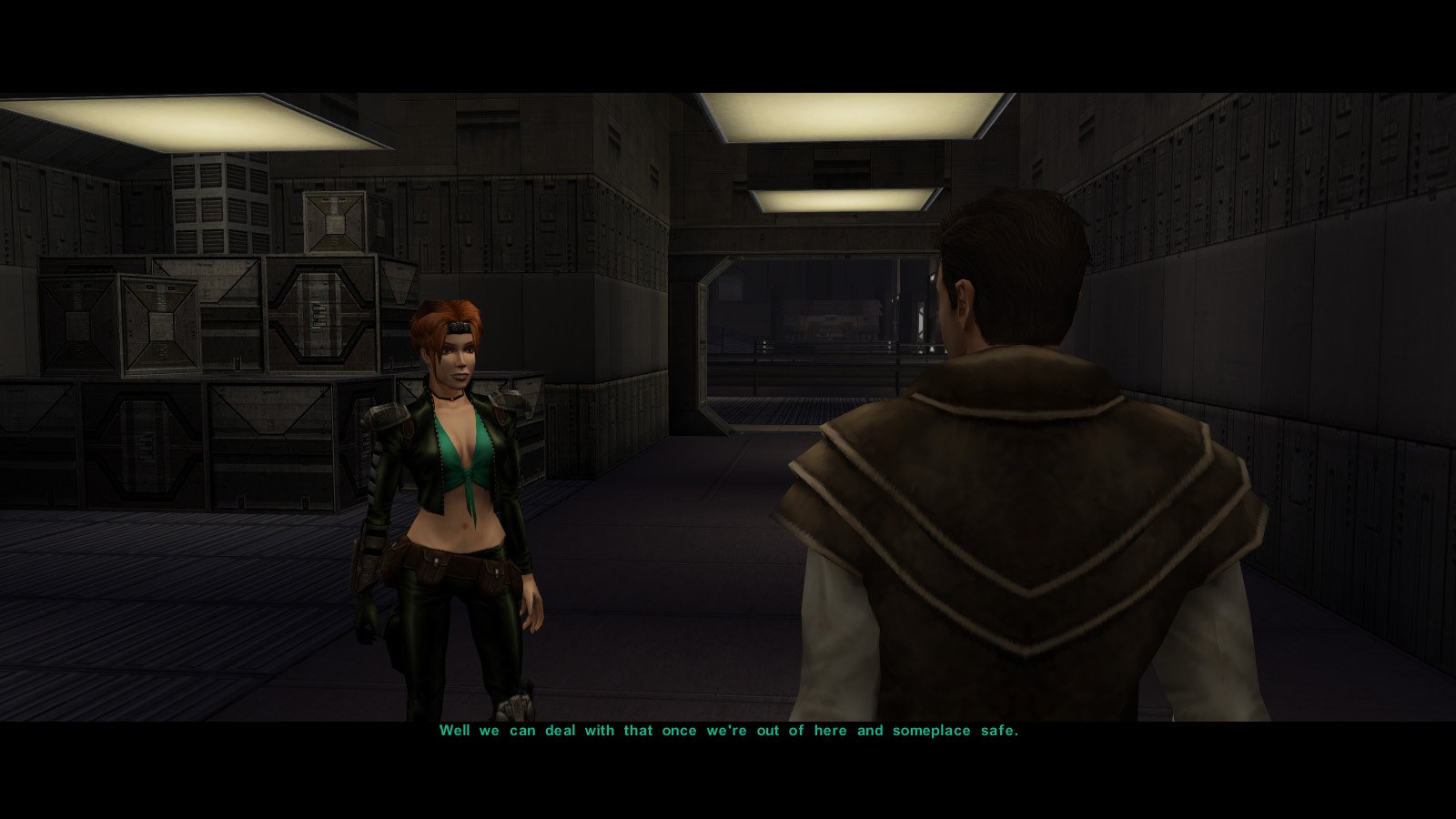
Mira is a human woman often identified by her red hair, cropped jacket, and equipment. Her public identity is that of an experienced scout and bounty hunter, but the work conceals her history as a displaced child forced into a war. She treats competence and independence as ways to avoid returning to vulnerability.
She resists being defined solely as a killer. The ability to catch a target alive differentiates her from hunters who see death as the simplest completion of a contract. Her restraint does not make the bounty trade harmless, but it gives her a moral boundary she is willing to defend in a dangerous occupation.
Institutions & power
Mira's life crosses three unequal institutions: the Mandalorian war machine, the refugee economy of Nar Shaddaa, and the Exchange's criminal network. The first made a captive child perform military work. The second offered survival in the absence of a stable family or state support. The third helped determine which people could be hunted for profit.
The Exile's arrival disrupts these arrangements. Mira can refuse to leave the bounty with Visquis and can later join a crew whose interests go beyond collecting payment. Her story shows how labor acquired through coercion can be sold within new systems without the effects of that coercion disappearing.
The game's conditional recruitment is itself meaningful. Mira's place in the group depends on the Exile's accumulated decisions. She and Hanharr should not be presented as simultaneous standard companions because their rivalry structures two different outcomes.
Beliefs & worldview
Mira's reluctance to kill is partly practical and partly ethical. Bringing a person back alive can be more difficult than a lethal contract, yet she treats the difference as important. It allows her to profit from tracking while refusing the identity of someone who kills simply because a buyer asks.
She is skeptical of grand moral claims from Jedi, Sith, and bounty hunters alike. Her conversations about Nar Shaddaa emphasize experience, movement, and an intuition for people who seem lost. In describing how she finds targets, she reveals a sensitivity to belonging that contrasts with the exploitative nature of her profession.
Material life
Mira's wrist-mounted rocket launcher is distinctive equipment. It can fire disabling darts as well as more destructive ammunition, giving her methods suitable for capturing targets rather than always killing them. Her clothing and protection are built for movement through cramped streets and hazardous environments.
Nar Shaddaa's docks, refugee spaces, and Jekk'Jekk Tarr are working environments that shape her techniques. Crowds provide concealment but also patterns she can learn to read. She survives by navigating the city's movement of people and money.
The Ebon Hawk offers another material setting. Moving between worlds with the Exile requires Mira to use her skills in a group whose goals cannot be reduced to collecting a bounty. She can become both a scout and an interlocutor about what war did to the people who survived it.
Historical significance
Mira offers the perspective of a displaced child whose life was reorganized by the Mandalorian Wars. The defeat at Malachor V did not restore her family or give her a peaceful home. She found survival in the informal economy of a refugee-filled moon.
Her rivalry with Hanharr is a study in the violent consequences of an obligation interpreted as a curse. Her optional Force training creates another possible future, but the main importance of her story lies in the ways war produces skills, dislocation, and new forms of work.
She belongs to the Legends account of The Sith Lords. Not every playthrough recruits her, and the game does not require that her later Jedi training occur.
Anthropological assessment
Mira's biography connects coerced military labor to the economy of postwar displacement. The Mandalorians give her skills without giving her the ability to refuse service. Nar Shaddaa later offers money for those same skills. The transition from forced recruitment to paid work changes her circumstances, but it does not remove the history that made her employable.
Her understanding of tracking is also a way of reading social life. She describes recognizing people who do not fit the flow of a neighborhood. The ability makes her commercially valuable, while her own displacement gives the concept of belonging unusual emotional force.
The life-debt conflict with Hanharr shows that obligation can be interpreted in radically different ways. A practice intended to produce lasting gratitude becomes, in his hands, a reason for persecution. Mira's refusal to embrace that interpretation makes her struggle about the meaning of social bonds as much as physical survival.
Collecting this Character
Mira appears in The Sith Lords and game-derived art. Identify a specific collectible by licensed manufacturer, title, and edition rather than assuming any similar costume or character model is official.
Material fandom · Collector reference
Collecting this Character
Explore related Star Wars media
Browse Star Wars books and collectibles related to this character.
Search Amazon for Mira ↗As an Amazon Associate I earn from qualifying purchases. Check the product, maker and edition before buying; searches may include unrelated items.
Sources and continuity
The biography follows the Legends game and its optional companion conversations. Player alignment can alter recruitment and outcomes; the analysis is editorial interpretation rather than additional story.
- GameBanshee: Mira NPC, equipment and role
- StrategyWiki: Mira's Nar Shaddaa dialogue
- TheForce.Net: contemporary LucasArts Mira profile reporting
- Obsidian Entertainment: The Sith Lords
Character portrait: GameBanshee. Scene screenshot credited above.