First comic
April 12, 1977Before the movie opened
Marvel's Star Wars #1 reached readers more than a month before A New Hope opened on May 25. The cover is dated July 1977, which is why databases sometimes show a different date.
Official history ↗Collecting · Publishing history · Comic archive
Start here if Star Wars comics are new to you. This archive explains who published them, how the numbering works, what Canon and Legends mean, why variants are confusing, and which series shaped nearly fifty years of Star Wars storytelling.
First comic
April 12, 1977Marvel's Star Wars #1 reached readers more than a month before A New Hope opened on May 25. The cover is dated July 1977, which is why databases sometimes show a different date.
Official history ↗Original Marvel run
107The original U.S. Marvel series ran through Star Wars #107 in 1986. Annuals and later reprints are separate objects, which is one reason comic totals require clear counting rules.
Marvel #107 ↗Archive rule
NO FAKE TOTALThere is no useful single number unless we decide whether variants, reprints, annuals, manga, graphic novels, international editions, and collected editions count separately. IDS will publish an exact total only after those rules are normalized.
Comics 101
Most comic-book confusion comes from words that sound interchangeable but describe different physical objects.
One individual comic book, such as Darth Vader #3.
The run the issue belongs to. There are several different series all called Star Wars or Darth Vader, so the year matters.
A numbered series designed to continue until the publisher concludes or cancels it.
A planned run with a fixed endpoint, such as five or six issues.
A standalone single issue rather than part of a continuing numbered run.
A special issue published separately from the normal monthly numbering.
Several consecutive issues that tell one connected story inside a larger series.
A book that collects several previously released individual issues into one volume.
A much larger collected edition that may contain dozens of issues or multiple series.
The same interior issue sold with a different cover. Variants are separate collectibles, not automatically separate stories.
If an issue sells out, a publisher can print it again. A second printing is still the same issue but may have a different cover or market value.
Collector shorthand for an issue considered notable because of a debut, major event, creator, scarcity, cover, or other collecting significance.
Publishing history
The license has moved and split over time. The publisher name on the cover is one of the first things to check when identifying a Star Wars comic.
Marvel publishes the first series. Issues #1–6 adapt the first film, then the comic develops original stories while the movie saga is still unfolding.
Dark Empire helps restart Star Wars comics in 1991. Dark Horse then builds an enormous Expanded Universe catalog, including Tales of the Jedi, Republic, KOTOR, Legacy, and more.
Lucasfilm reorganizes the old Expanded Universe under the Legends label. That does not make the older comics disappear; it changes how they relate to the new continuity.
Major new canon comics return to Marvel, beginning with Star Wars, Darth Vader, and character miniseries such as Princess Leia.
IDW launches Star Wars Adventures, a monthly all-ages series with stories from across the saga.
Dark Horse returns for new all-ages comics and graphic novels while Marvel continues its own Star Wars line. Today, more than one publisher can release Star Wars comics at the same time.
The biggest distinction
Both belong to Star Wars publishing history. The label tells you which continuity the story belongs to, not whether the comic is "real" as a collectible.
Most new story comics published under Lucasfilm's post-2014 continuity. Modern Marvel series, current Dark Horse all-ages titles, and much of the High Republic publishing program live here.
Most pre-2014 Expanded Universe comics are now labeled Legends. This includes much of the classic Dark Horse catalog and the original Marvel adventures beyond the film adaptations.
Important: a character can exist in both. Naga Sadow is recognized in current canon, while the detailed Golden Age of the Sith biography on his IDS page comes primarily from Legends comics.
How often were they released?
The original Marvel title behaved like a normal ongoing comic: a regularly numbered series, generally released on a monthly schedule, with occasional annuals and special publications.
Several series can run at once. A single month can include a flagship Star Wars issue, a Darth Vader issue, a character miniseries, a High Republic title, and a Dark Horse all-ages book.
You do not need to collect "all Star Wars comics." You can collect one series, one character, one era, one publisher, first appearances, favorite cover artists, or only collected editions.
IDS Comic Archive · Research build
Browse more than a century of indexed Star Wars series and series families with complete numbered-run maps where verified, plus key issues, first appearances, collected editions, variant notes, and direct character links.
No seeded comic records match those filters yet.
Private browser tracker
Mark comics you own or want, record grades and notes, and add personal entries. Your selections are saved only in this browser and are not visible to other visitors.
Use this for any comic you want to track that IDS has not indexed yet. This personal entry stays only in your browser and is not shared with other visitors.
This is your private collection tracker. Owned, wanted, grade, notes, and personal entries are stored locally in this browser. They are not uploaded to IDS and other visitors cannot see them. Character names in the series archive link directly into the IDS Character Archive.
Real-world examples
These are a useful way to learn the difference between a single issue and a collected edition.
Your Maul comic is one individual issue from Marvel's five-issue canon miniseries. It was released June 21, 2017. The copy in your photo is the regular Cover A by Rafael Albuquerque. Cullen Bunn wrote it, Luke Ross drew it, and Nolan Woodard colored it. The barcode ending 00411 identifies issue #4, cover/printing code 1/1.
Collector lesson: if you wanted the complete story as original singles, you would collect issues #1 through #5. Variants of #4 are alternate covers of this same interior issue.
Marvel series reference ↗Your large Vader book appears to be Marvel's oversized 2024 Treasury Edition, not one numbered comic issue. It collects Darth Vader — Black, White & Red (2023) #1–4 into one book. Marvel lists the Treasury Edition as published January 3, 2024; its ISBN is 978-1-302-95214-3.
Collector lesson: owning this book gives you the stories from all four issues in reading form, but collectors still distinguish the Treasury Edition from owning the four original 2023 single issues.
Marvel Treasury Edition ↗Why the total keeps growing
Star Wars comics branch by character, faction, era, adaptation, event, and audience. That branching is why "How many Star Wars comics are there?" is harder than it sounds.
Darth Vader, Doctor Aphra, Poe Dameron, Princess Leia, Maul, Thrawn, Mace Windu, and many more.
Tales of the Jedi, Knights of the Old Republic, The High Republic, Legacy, and other books built around a historical period.
X-Wing Rogue Squadron, Bounty Hunters, TIE Fighter, and similar books follow organizations rather than one central hero.
Films and television stories can be adapted into comic form, creating collectible publications even when the story originated on screen.
Star Wars Tales, Star Wars Adventures, and Hyperspace Stories can move across characters and eras from issue to issue.
Large stories can spread across several ongoing series and special issues, so reading order and collecting order are not always identical.
Scale
Enough that the answer depends on what you count.
By 2015, Marvel's digital library alone was already advertising more than 500 older Star Wars Legends issues. The High Republic publishing initiative later produced 139 comic-book issues in four years by itself. Add the modern Marvel canon era, IDW's all-ages books, Dark Horse's return, one-shots, annuals, manga, adaptations, and new 2025–2026 series and the franchise is now on the order of a thousand or more individual comic issues.
IDS will not turn that into a false precision number. Our future total will state exactly what is included: U.S. single issues, annuals, specials, one-shots, manga, reprints, variants, collected editions, and international editions will each be counted by an explicit rule.
High Republic publishing count ↗Where to start
You do not need to read the entire comic history in publication order. These paths group the archive by the characters and periods most likely to matter to a Star Wars fan or collector.
Start with Darth Maul (2000) for Legends, then move to canon with Son of Dathomir, Darth Maul (2017), Black, White & Red, and Shadow of Maul. Your 2017 #4 belongs directly in this path.
The three major modern runs each cover a different period: Darth Vader (2015) after A New Hope, Dark Lord of the Sith (2017) after Revenge of the Sith, and Darth Vader (2020) after The Empire Strikes Back. Black, White & Red is an anthology companion.
Use Tales of the Jedi for Exar Kun, Naga Sadow, and early Sith history, then Knights of the Old Republic, The Old Republic, Knight Errant, and Dawn of the Jedi.
Follow Doctor Aphra, Bounty Hunters, War of the Bounty Hunters, Crimson Reign, and Hidden Empire for the criminal side of the galaxy and the major Qi'ra storyline.
Battle of Jakku closes the Galactic Civil War. Marvel's Star Wars (2025) then moves Luke, Leia, and Han into the early New Republic, while Doctor Aphra: Chaos Agent brings Aphra into the same period.
A strong sampler is Dark Empire, X-Wing Rogue Squadron, Republic, Knights of the Old Republic, and Legacy. Together they show why the Dark Horse period remains important even after the 2014 continuity reset.
Current archive · 2026
The comic archive now includes the major 2025–2026 additions instead of stopping with older Marvel and Dark Horse material.
Marvel launched Star Wars: Shadow of Maul on March 4, 2026. The five-issue series is now indexed beside Maul's earlier comic runs.
Marvel's 2026 Rogue One character one-shots include new Cassian Andor, Jyn Erso, and Saw Gerrera stories. They are grouped as a one-shot program in the archive.
Star Wars: Jar Jar #1 arrived February 11, 2026, co-written by Ahmed Best and Marc Guggenheim and guest-starring Kelleran Beq.
Dark Horse returned to the High Republic with The High Republic Adventures — Pathfinders, following Republic Pathfinders investigating the death of a Jedi Master.
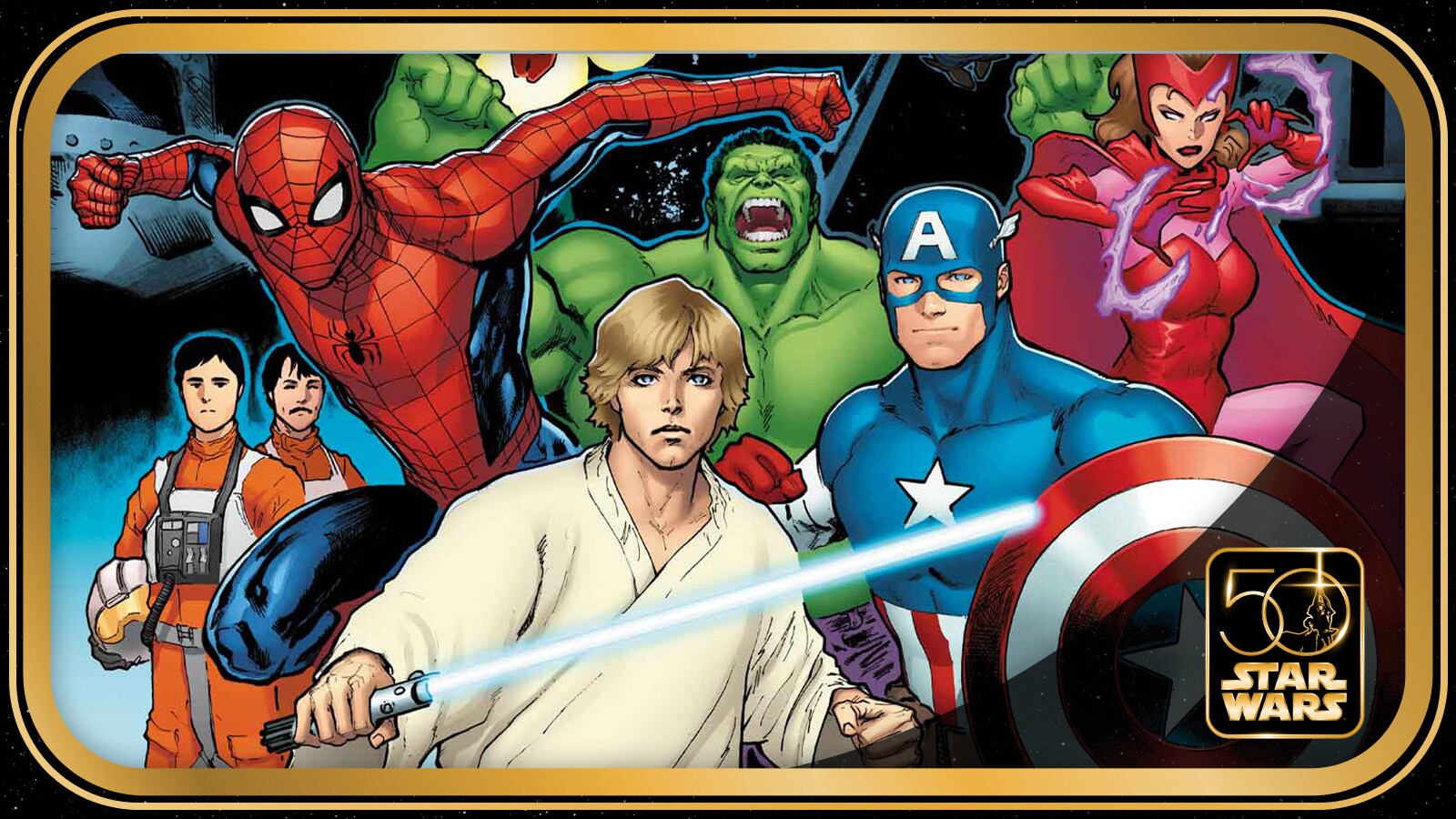
Lucasfilm and Marvel announced the five-issue Star Wars/Marvel: Hope Assembles crossover in August 2026. Issue #1 is scheduled for January 2027, so IDS lists it as an announced crossover rather than a 2026 release.
Star Wars (2025), Legacy of Vader, Jedi Knights, Doctor Aphra: Chaos Agent, Boba Fett — Black, White & Red, and Hunt for the Falcon are all now represented.
Connected IDS archive
Character pages now include a Comic appearances link. It opens this archive with that character already searched, connecting lore research directly to collecting.
Research method
Phase 1 prioritizes series identity, continuity, publisher, era, and verified milestone issues. The next expansion can normalize every individual issue, then add cover variants and collected editions as separate object types instead of mixing them into one inflated number.