
Revan, Meetra, Scourge, and T3-M4 infiltrated the Imperial Citadel during the chaos following the Dark Council purge. Revan confronted Vitiate while Meetra and Scourge fought the Imperial Guard. When they joined the throne-room battle, Scourge received a Force vision showing a different future Jedi defeating the Emperor. Believing Revan and Meetra would fail, Scourge stabbed Meetra. Vitiate destroyed T3-M4 and overwhelmed Revan.
Legends · 3950 BBY · Source-led interpretation
THE EMPEROR ASSASSINATION
Documented chronology and evidence limits
After freeing Revan, Meetra and Scourge joined him and T3-M4 in an assault on the Sith Emperor's Citadel. The purge had thrown the capital into disorder, but the throne room was still heavily defended. The Jedi and Scourge fought through Imperial Guards and confronted Vitiate. Scourge perceived a Force vision of a future champion defeating the Emperor and decided that Revan and Meetra would not succeed. He killed Meetra, while Vitiate destroyed T3-M4 and subdued Revan. The 2011 novel establishes this outcome; the later Hero of Tython story provides context for how Scourge interpreted the vision.
Anthropology: institutions and everyday consequences
The attack raises a problem of leadership and foreknowledge. Scourge treated his own prophetic interpretation as more authoritative than the alliance he had just joined, choosing a future possibility over obligations to living companions. Meetra's death followed an extended campaign to free someone who had previously commanded her during the Mandalorian Wars. The tactical outcome did not reveal the hidden Empire to ordinary Republic institutions. Vitiate's ability to preserve secrecy after an attempted assassination shows how the regulation of information can sustain a powerful regime.
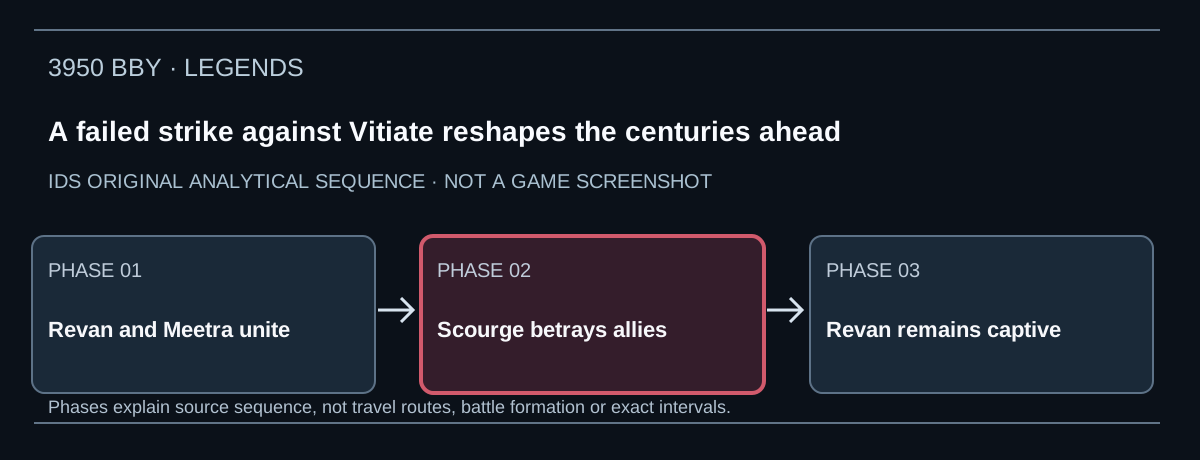
See the three-step historical sequence
- The allies reach the Emperor's Citadel
- Scourge turns against Meetra after his vision
- T3-M4 and Meetra die; Revan is captured
Research trail: The Old Republic: Revan (2011), Imperial Citadel final confrontation; SWTOR Scourge history. Read supporting chronology and source details →. The linked reference aids verification; the original novel or guidebook remains the primary narrative source. The local illustration is symbolic original art, not an accurate screenshot.
Prophecy overrides present alliance
Scourge chooses a future possibility over the people fighting beside him.
His action transforms interpretation of the future into immediate lethal force.
Meetra dies after finding the person she came to rescue
Her mission succeeds at freeing Revan from Nyriss but fails at removing Vitiate.
The rescue and assassination goals therefore have opposite outcomes.
Vitiate remains hidden from the Republic
The failed strike does not reveal the Empire publicly.
The state retains strategic surprise for centuries.
Anthropological assessment
The attack shows the political danger of treating visions as privileged evidence.
Scourge makes an irreversible decision because he assigns more authority to a possible future than to relationships and evidence available in the present.
A failed assassination changes centuries of history
Revan’s escape from imprisonment made an attempt against the Sith Emperor possible. The mission combined Revan, Meetra Surik, Scourge and T3-M4, each of whom brought a different relationship to Sith rule and the Republic. The group entered the Imperial Citadel during the political instability following a purge of the Dark Council. The objective was narrow: remove Vitiate before his concealed empire could openly return to war against the Republic. The stakes were broad because success could have changed the military future of entire generations.
The attempt ended in a betrayal at the critical moment. Scourge interpreted a Force vision as showing that a different Jedi would defeat the Emperor in the future. He killed Meetra, undermining the immediate effort. Vitiate destroyed T3-M4 and overcame Revan, who remained imprisoned and later became entangled in the Emperor's plans.
Prophecy is not a completed historical fact
The decisive question is how a vision changes action. Scourge acted as though an image of future victory proved the current alliance must fail. That interpretation may be intelligible to the character, but it did not make the outcome inevitable to anyone else present. The chronology should retain the difference between an experienced vision and events independently observed after the battle.
A hidden empire gains time
The failed mission left the Sith Emperor in power and did not expose the Imperial state to the Republic. Concealment, intelligence and the ability to prepare resources remained strategic advantages. Thus the result mattered as much for what did not happen publicly as for the people killed or captured in the chamber.
Interpretation: what changed beyond the battle?
This confrontation is described in Drew Karpyshyn's novel The Old Republic: Revan, a prose source rather than a player-selectable game ending. Its central dilemma concerns loyalty and authority over knowledge. Scourge placed private interpretation of a future vision above the immediate obligation owed to companions risking their lives beside him.
The consequences show why leadership histories matter without reducing an empire to one individual. Vitiate’s survival preserved an institutional project sustained by secrecy and coercion. Meetra’s death ended an individual quest but did not disclose the broader threat to ordinary citizens of the Republic. Her story thus belongs to the history of absent knowledge as well as the history of sacrifice.
Did Scourge have proof in 3950 BBY that killing Meetra was necessary?
No independently verified proof available to the other participants. The novel presents his decision as an interpretation of a Force vision. Later events give that decision a narrative meaning, but do not make it an uncontested moral obligation.
Evidence boundary: This reconstruction reads the original Legends game or comic alongside its existing cited chronology. It distinguishes directly depicted events, later continuity and anthropological interpretation. Illustrations of later appearances are not presented as images of a character's creation or a battle not pictured.
Historical judgment · 3950 BBY
Test your source judgment
Answer both questions. Get a scored explanation and corrections so the test teaches, rather than merely records, your choices.
Original-source investigation: Revan's failed strike: what the publisher does and does not verify
The Revan novel, first published in 2011, is the key original narrative for Revan's later pursuit of the hidden Sith Emperor and the involvement of Meetra Surik and Lord Scourge. The official publisher description confirms Revan's lost memories, his fear of a threat outside known Republic space and his search for what he had encountered beyond the Outer Rim. It does not disclose the entire final confrontation.
The novel's release date and the book's reprint ISBN are publishing facts, not the in-universe 3950 BBY date. The names, betrayal, deaths and outcome of the assassination attempt must be attributed to the novel chapters, not to a short catalog abstract. Institutionally, an alliance built against a more powerful sovereign can collapse when its participants disagree over the consequences of replacing that ruler.
Follow the sources: Drew Karpyshyn's Revan, original published novel · SWTOR Galactic History reference. Publisher overviews and in-universe narrators do not replace original game scenes, chapters or comic panels.
3950 BBY · Legends · Narrative vs. later chronology
A failed strike against Vitiate reshapes the centuries ahead
An alliance organized around one vulnerable moment
Revan, Meetra Surik, T3-M4 and Lord Scourge moved against the hidden Sith Emperor Vitiate. They hoped that turmoil within the Emperor's own ruling structure would provide an opportunity to strike. The narrative belongs to Drew Karpyshyn's Revan novel, not a repeatable quest from KOTOR II. Participants did not share identical commitments: the Jedi wanted to prevent an enormous danger to the Republic, while Scourge's judgment was affected by visions and his estimation of how the Emperor might eventually be defeated.
The betrayal changes the result inside the throne room
During the confrontation Scourge turned against his companions. Meetra was killed, Revan was overcome and the Emperor survived. The outcome is not a victory merely because Revan and Meetra reached their target. Nor did it amount to the Republic's discovery of the hidden imperial state in any practical public sense. Scourge remained within the Sith structure, which gave him a role in the events that would develop long after the failed operation.
The historical costs lie in the future as well as the present
Revan's life was sustained in captivity for centuries, while Meetra's death ended her immediate campaign against Vitiate. The failed assassination helps explain why the hidden Sith Empire survived to threaten the later Republic, but it should not be described as the sole cause of every subsequent war. The book's publisher summary identifies Revan's attempt to prevent a concealed danger; detailed claims about betrayal and aftermath require the full novel. That limitation must remain explicit in the bibliography.
Check your historical interpretation: Did this operation overthrow Vitiate and expose the hidden Empire to the Republic?
Explanation: No. Meetra died, Revan was taken captive, and Vitiate remained in power. Scourge's betrayal decisively changed the attempt's outcome.
Primary work: Random House Worlds: The Old Republic — Revan. Official publisher information confirms the work's scope; detailed scenes and dates belong to the full game or novel, with later Legends chronology identified separately. Continue this timeline sequence →
Sources and further reading
- Drew Karpyshyn, The Old Republic: Revan.
- Star Wars: The Old Republic Encyclopedia.