
After the failed assassination attempt, Vitiate kept Revan alive rather than executing him. Revan was transferred to the Maelstrom Prison, where machinery and Sith techniques sustained him for more than three centuries. Scourge persuaded the Emperor that his betrayal had been loyal service. Vitiate rewarded him with an immortality ritual and appointed him Emperor's Wrath, the ruler's personal enforcer.
Legends · 3950 BBY · Source-led interpretation
THE MAELSTROM CAPTIVE
Documented chronology and evidence limits
Vitiate chose not to execute Revan after the failed attack. Instead the Emperor sent him to a specially constructed prison station inside the dangerous Maelstrom Nebula, where machinery and Sith alchemy kept him alive in suspended imprisonment for more than three hundred years. Revan resisted mental domination and attempted to slow the Emperor's plans through their Force connection. Scourge, whose apparent betrayal had saved the Emperor, received an extended-life transformation and the title Emperor's Wrath. This transformation did not make him an ordinary Jedi or resolve his private belief about a future champion.
Anthropology: institutions and everyday consequences
The prison was an institution designed to extract value from an enemy over centuries rather than administer a finite sentence. The captive's continued existence provided the ruler with information and Force power, while his location was hidden from broader political scrutiny. The Emperor's Wrath was another institution grounded in personal rather than public authority: Scourge derived rank directly from Vitiate. Both arrangements show how authoritarian rule can organize bodies and loyalties as strategic resources.
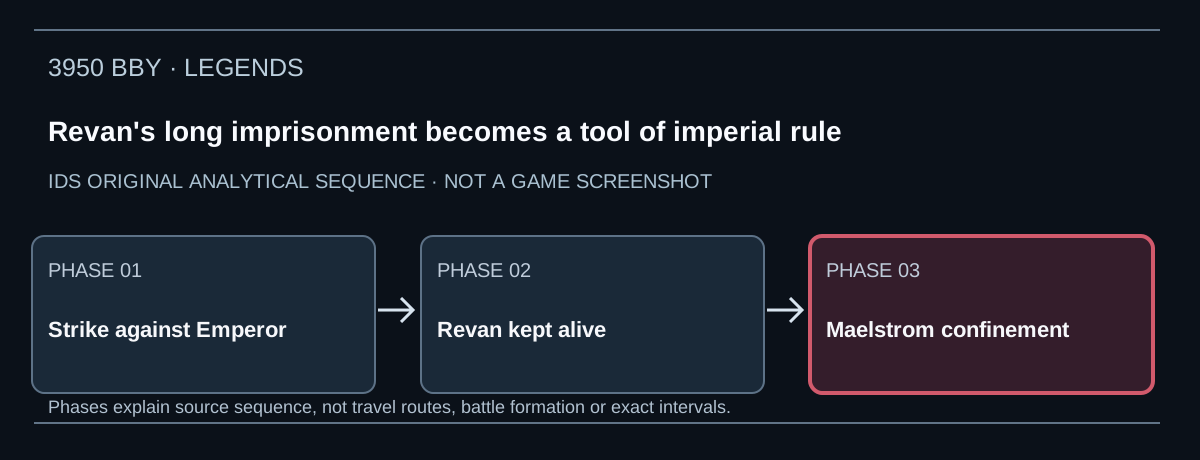
See the three-step historical sequence
- Revan is transferred to a hidden nebula station
- The Emperor exploits the Force link during captivity
- Scourge gains the office of Emperor's Wrath
Research trail: The Old Republic: Revan (2011); Star Wars: The Old Republic, Maelstrom Prison flashpoint. Read supporting chronology and source details →. The linked reference aids verification; the original novel or guidebook remains the primary narrative source. The local illustration is symbolic original art, not an accurate screenshot.
A prisoner becomes a long-term strategic resource
Vitiate can probe Revan's mind while keeping him physically contained.
Revan in turn attempts to influence the Emperor's thinking over the centuries.
Scourge converts betrayal into office
His interpretation of prophecy gains institutional reward.
The new title binds him more tightly to the Emperor while he privately waits for the Jedi from his vision.
Anthropological assessment
Maelstrom Prison turns captivity into an enduring political relationship rather than a temporary punishment.
Scourge's promotion shows how authoritarian systems can reward apparent loyalty even when the act being rewarded was originally motivated by a private agenda.
Captivity becomes a centuries-long instrument of rule
After the failed attempt against Vitiate, Revan was kept alive in Maelstrom Prison. His incarceration extended far beyond the year of the battle, turning a single prisoner into a strategic and psychological resource over generations. Scourge, by contrast, was rewarded as the Emperor's Wrath after convincing the ruler that his betrayal had served Imperial interests.
The two outcomes reveal different forms of control. Revan's isolation denied him ordinary ties and the ability to act publicly, even as his knowledge continued to matter to the Emperor. Scourge's new office offered apparent power while binding his survival and status to personal service. The prison and the title both stabilized the ruler's dominance through different mechanisms. Their consequences reach into the era of the later Great Galactic War and should not be confused with events immediately visible to the Republic in 3950 BBY.
Did Revan's story end with his imprisonment?
No. His detention lasted for centuries and becomes significant again during the later Old Republic MMO-era storyline.
Primary source: the Legends game, novel or sourcebook cited below. Historical events are distinguished from analysis, chronology estimates and branch-dependent gameplay.
Historical judgment · 3950 BBY
Test your source judgment
Answer both questions. Get a scored explanation and corrections so the test teaches, rather than merely records, your choices.
3950 BBY · Legends · Narrative vs. later chronology
Revan's long imprisonment becomes a tool of imperial rule
Two captors, two phases of imprisonment
Revan's capture by Nyriss around 3954 BBY begins an earlier period of coercive detention. The failed operation against Vitiate in 3950 BBY leads to a substantially different fate: direct captivity in the hidden Sith Emperor's system. Lord Scourge played a decisive part in the outcome, and the Emperor chose not to kill the captive outright. The timeline must not collapse Nyriss's political imprisonment, Revan's later confrontation with Vitiate and his centuries-long Maelstrom imprisonment into one event.
Captivity as control over information
In the later account, technologies and Sith methods prolong Revan's life during imprisonment. The Emperor could use the prisoner's knowledge and presence while restricting his freedom, creating a strategic problem that endured across many lifetimes of ordinary Republic citizens. Those centuries connect the 3950 BBY conspiracy to the era experienced by players of Star Wars: The Old Republic. The publishing synopsis establishes Revan's pursuit of a hidden threat; the specifics of the Maelstrom rescue are supplied by the later MMORPG mission.
A long interval is not empty chronology
Between the Republic of Revan's era and the later crisis, governments, commanders and generations changed. Revan's continued existence must not be taken to imply that he participated directly in each event of those intervening centuries. An anthropological reading of his fate focuses on enforced isolation, preservation of identity and the political use of prisoners. It does not turn an unseen three-hundred-year period into invented diary entries or undocumented communications with allies.
Check your historical interpretation: Did Revan's imprisonment end after only the four years spent in Nyriss's captivity?
Explanation: No. His later captivity under the Sith Emperor extended for centuries. It is a different period from the detention beginning at Nathema.
Primary work: Random House Worlds: Revan novel. Official publisher information confirms the work's scope; detailed scenes and dates belong to the full game or novel, with later Legends chronology identified separately. Continue this timeline sequence →
Sources and further reading
- Drew Karpyshyn, The Old Republic: Revan.
- Star Wars: The Old Republic, Maelstrom Prison.