
In 3952 BBY, Atris secretly called many of the remaining Jedi to Katarr, a Miraluka colony, hoping the concentration of Force-users would draw their hidden enemy into the open. Darth Nihilus responded. His Force hunger consumed the Jedi and the planet's population, killing effectively all life on Katarr. The Miraluka Visas Marr survived and was taken by Nihilus as his apprentice.
3952 BBY · Legends · Source review
THE KATARR CONCLAVE: source evidence and social context
Chronology and documented limits
In 3952 BBY, surviving Jedi assembled on Katarr, home to Miraluka communities, in a meeting connected to Atris’s efforts to draw out the hidden Sith. Darth Nihilus came to the planet and drained life on a catastrophic scale. Most of the remaining Jedi who had attended were killed, as were effectively all inhabitants. Visas Marr survived and was taken by Nihilus. This was neither an orbital bombardment by the Ravager nor an ordinary conventional invasion; the central attack was his supernatural Force hunger.
Institutions, beliefs and material consequences
A deliberate concentration of valuable targets also exposed the host population to catastrophic risk. Katarr's Miraluka residents were not merely a backdrop for Jedi strategy, and their destruction was not a chosen sacrifice. Visas' survival became a witness to an erased society. The event demonstrates how an institutional security plan can endanger others when threats and consequences are misunderstood.
Source trail: Knights of the Old Republic II; Star Wars Tales #24, ‘Unseen, Unheard’; Katarr Legends histories. Explore related source references →. This interpretation distinguishes evidence from inference; the illustration is a concept diagram rather than original game art.
A trap exposes the people hosting it
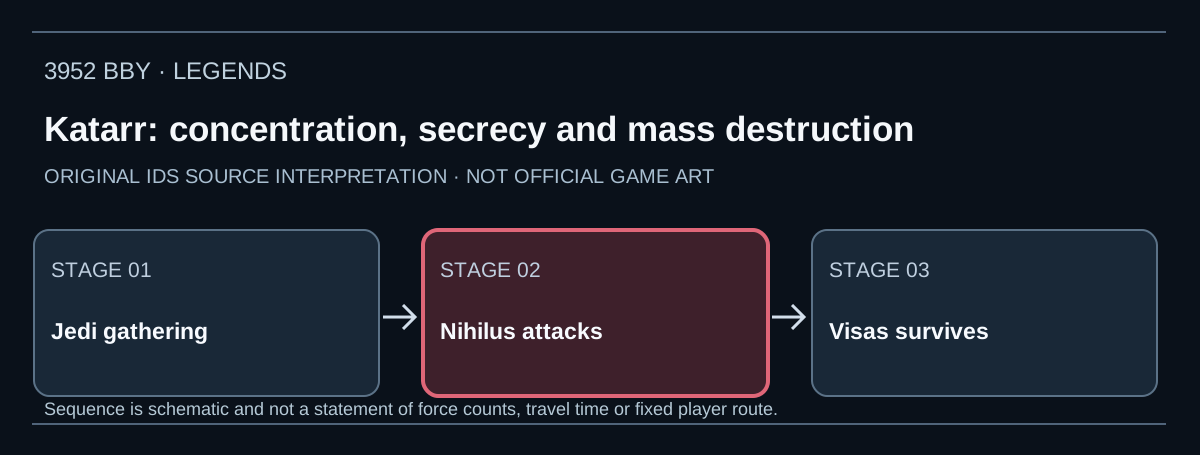
Atris's strategy used the Jedi gathering as bait but placed the Miraluka population inside the risk environment.
Security decisions by an elite institution had catastrophic consequences for civilians.
Nihilus destroys a world through hunger rather than conquest
The attack sought Force energy rather than territory, taxation, or political surrender.
Katarr ceased to be a functioning society without becoming an occupied possession.
Visas survives and is incorporated into the attacker's household
Nihilus takes the lone known survivor as an apprentice.
Survival therefore immediately becomes a new relation of domination.
Anthropological assessment
Katarr raises the ethics of using civilian space as strategic bait.
It also shows violence that seeks consumption rather than rule, making ordinary political concepts such as occupation or surrender almost irrelevant.
The danger of concentrating Force-sensitive people
Katarr was home to a Miraluka population whose relationship with the Force formed a distinctive part of the world's society. After years of losses, Jedi leaders sought a way to identify the Sith power hunting the surviving Order. Their meeting on Katarr brought together individuals who were already vulnerable because of that connection. The gathering itself became a signal that Darth Nihilus could detect.
Nihilus attacks through the Force
The destruction was not presented as a conventional bombardment that could be reconstructed from the movements of fleets and ground armies. Nihilus consumed life through the Force on a planetary scale, killing the Jedi at the conclave and devastating the resident population. The event explains why surviving Jedi later avoided public assemblies and why the Sith threat was difficult to meet with conventional military methods.
Visas Marr preserves testimony
Visas Marr's survival is part of the original story, not a contradiction of the devastation. Nihilus spared her, took her aboard his ship and eventually made her his servant. She later became a companion of Meetra Surik, providing the narrative with a survivor who could describe a catastrophe that otherwise left almost no direct witnesses. Her perspective must not be treated as a complete census or a fully neutral military report.
Atris and the failed plan to reveal the enemy
Later dialogue complicates the decisions that led to the meeting. Atris played a role in drawing the Sith toward the Jedi and sought to expose their location. Her strategy depended on the belief that bringing hidden opponents into view would make them easier to defeat. Katarr instead revealed the danger of treating other people as bait. The later confrontation with Atris on Telos should be read in the light of that institutional failure.
Anthropological extension: destruction of a community
The killing of the Miraluka population matters independently of the deaths of the Jedi. Katarr was not merely an assembly point for an order. It was an inhabited society with its own relations, knowledge, beliefs and generational continuity. By classifying the planet primarily as a cluster of Force-sensitive targets, Nihilus erased the distinction between the political actions of visiting Jedi and the people who lived there. The destruction exemplifies how attacks aimed at a strategic category can eliminate entire communities caught within it.
Check the historical evidence
Which parts belong to established Legends continuity?
The event and its outcome are recorded in the cited original game or official reference material. When an RPG offers branching dialogue or endings, this article identifies the outcome used in the subsequent Legends chronology.
What does the illustration show?
The diagram is an original IDS sequence summary. It does not depict a screenshot, official character likeness, ship design or exact map coordinates. Verifying a suitable event-specific publisher illustration is a separate editorial task.
Historical judgment · 3952 BBY
Interpret the Dark Wars evidence
Choose two interpretations. Receive a score and a correction explaining the historical evidence rather than just repeating your selections.
Original-source investigation: Katarr: destruction of a conclave and the wider population
The meeting on Katarr brings surviving Jedi together, and Darth Nihilus destroys the gathering and the surrounding population. Visas Marr survives, but her survival does not make the catastrophe less significant for Miraluka and other inhabitants. The game later reveals the circumstances through characters and records, so the event should be placed at the time of the attack, not when the player hears a report.
A storefront or support page does not verify precise casualty totals or imply that the inhabitants acted as a single collective faction. Those details require the original game dialogue and source guides. The political interpretation concerns concentration of leaders and knowledge in a single location, and the way a catastrophic attack can be used to intimidate a scattered community. These are analyses, not invented motivations attributed to ordinary victims.
Follow the sources: KOTOR II primary game record · Original KOTOR game context. Publisher overviews and in-universe narrators do not replace original game scenes, chapters or comic panels.
Legends · 3952 BBY · Primary story and historical judgment
Katarr: concentration, secrecy and mass destruction
An attempt to locate a hidden enemy
At the time of the Katarr Conclave, surviving Jedi had become difficult to locate, while the threat hunting them remained poorly understood. Atris's role in drawing them to Katarr was part of an attempt to force their enemies into the open. The world was not uninhabited: the Miraluka formed a society there independent of the visiting Jedi. Any account describing Katarr as just an empty meeting hall for the Order erases the people who bore most of the catastrophe's consequences.
An attack that bypassed normal battle
Darth Nihilus used his hunger for the Force to devastate the planet and the Jedi gathering. This is a distinctive fantasy mechanism within KOTOR II, not a biological epidemic or conventional orbital bombardment. The Sith Lord's method could eliminate individuals and destroy a community without taking its capital, signing a surrender or establishing a government. A timeline should not invent a troop deployment plan or terrestrial engagement to make this event resemble other military episodes.
One survivor carries an asymmetric memory
Visas Marr survived and was drawn into Nihilus's service. Her survival matters because subsequent testimony and choices expose the long psychological consequences of the catastrophe. A survivor's proximity to the destroyer is not evidence of consent to his acts. Later she confronts a different path through Meetra. The exact toll and all inhabitants' experience cannot be reconstructed from an aggregate claim that a world died; the primary story supports the scale of ruin, not a detailed census of every Miraluka settlement.
Test your historical judgment: Did Nihilus destroy Katarr merely by arriving with a conventional invasion fleet?
Analysis: No. His attack depended on his catastrophic ability to drain life through the Force. The event was not the ordinary conquest of an inhabited world.
Publication basis: Lucasfilm: devastated Jedi Order context. Official overviews identify the title, branching structure and larger conflict, not a transcript of every optional mission. Related chronology →
Sources and further reading
- Lucasfilm's official KOTOR game overview (series context; original game dialogue remains the primary narrative evidence).
- Knights of the Old Republic II: The Sith Lords.
- Knights of the Old Republic Campaign Guide.