
As Meetra's connection to the Force strengthened, Darth Nihilus sensed her and dispatched Visas Marr. Visas boarded the Ebon Hawk and attacked Meetra. After losing, she expected death. Meetra instead spared her, and Visas eventually joined the crew, creating the relationship that would make Nihilus vulnerable at Telos.
3951 BBY · Legends · Historical research
VISAS MARR CHANGES SIDES
Events and source limitations
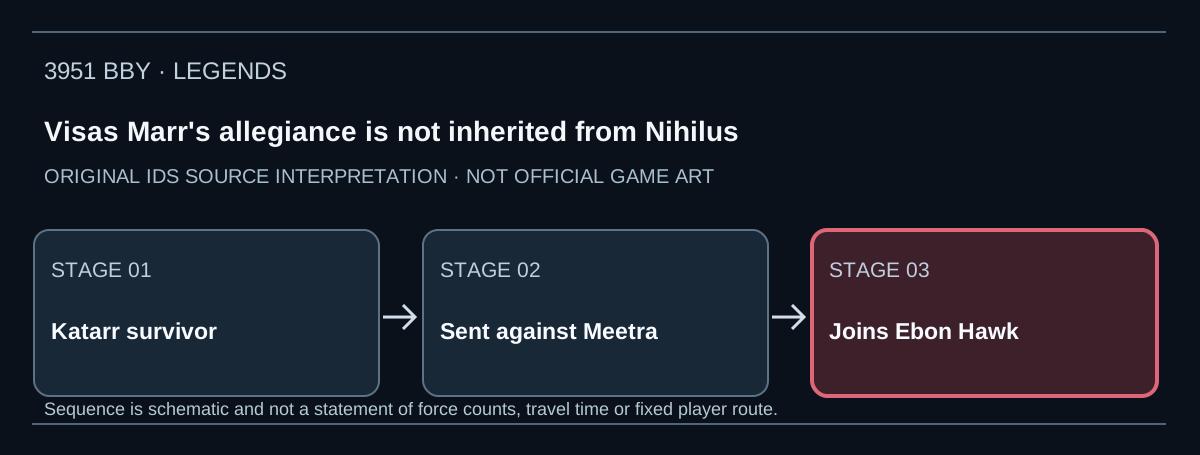
Darth Nihilus detected Meetra’s growing presence in the Force and dispatched Visas Marr to attack her aboard the Ebon Hawk. Visas, the Miraluka survivor of Katarr, was defeated. In the light-side path Meetra spared her, and she joined the crew. The encounter can occur at different points during the player-directed Lost Jedi search, so it should not be assigned a fixed position between every planetary quest. Visas later played a key role in the battle against Nihilus.
People, institutions and consequences
The relationship contrasts two responses to catastrophic violence: Nihilus enslaved a survivor of his attack, while Meetra offered that survivor another social role. Visas’s new allegiance did not erase her memories of Katarr or her complex Force bond with Nihilus. The event is about the possibility of meaningful choice after coercion, not about a victim automatically accepting every belief of her rescuer.
Sources: Knights of the Old Republic II, Ebon Hawk Visas encounter; Star Wars Tales #24, ‘Unseen, Unheard’. Explore source transcript or chronology →. The article distinguishes fixed game events, Legends light-side continuity, player-variable choices and editorial analysis.
A survivor confronts another survivor of mass death
Visas survived Katarr; Meetra survived Malachor V.
Both carry relationships to catastrophic wounds in the Force but respond to them differently.
Mercy interrupts expected domination
Visas expects victor and defeated to reproduce the coercive hierarchy she knows under Nihilus.
Meetra's refusal creates the possibility of another allegiance.
Anthropological assessment
Visas's defection shows how relationships can undermine coercive institutions.
A person socialized through fear may reinterpret loyalty when an opponent behaves outside the moral expectations created by domination.
A survivor chooses a different allegiance
Visas Marr survived the catastrophe on Katarr and came under Darth Nihilus's control. Nihilus sent her to confront Meetra Surik aboard the Ebon Hawk. Meetra defeated her but spared her life, undermining the expectation that the stronger combatant must kill or dominate the weaker. Visas's decision to remain became important to the future attack on the Ravager.
Visas and Meetra carried distinct experiences of overwhelming destruction through the Force. Their alliance emerged not from identical backgrounds but from a change in how Visas was treated. Defection is not an instant erasure of coercion or trauma. It is a process in which new relationships make decisions possible that were excluded under a previous authority.
Can this encounter be given one exact fixed travel date?
Not from gameplay alone. Its timing depends partly on the player's progress through the 3951 BBY journey.
Primary evidence: the Legends game or novel cited below. The analysis distinguishes source events and player branches from IDS interpretations of institutions, trauma and political change.
Interactive historical judgment · 3951 BBY
Interpret this historical record
Answer both questions. Get corrections, an explanation and a score to distinguish what the sources show from interpretation.
Legends · 3951 BBY · Primary story and historical judgment
Visas Marr's allegiance is not inherited from Nihilus
The assignment follows mass violence
Visas Marr was a survivor of the destruction of Katarr. Nihilus made her part of his circle and later sent her to confront Meetra Surik as Meetra's presence became noticeable to him. That encounter is not an independent Sith political program invented by Visas. It grows from an enormous imbalance of power between a person whose world was destroyed and a figure who brought about that destruction. Her association with Nihilus cannot be read as proof that Miraluka culture embraced Sith rule.
The expected punishment does not arrive
When Visas confronted Meetra aboard the Ebon Hawk and was defeated, she expected a violent resolution consistent with the domination she had experienced. Meetra's response opened the possibility of a different relationship. In the light-side narrative she survives, joins the ship's companions and develops a more autonomous set of decisions. The RPG's dialogue can vary with the player's treatment of her. Her accession to the crew is a significant plot point, but not every optional line can be preserved as one official historical transcript.
Testimony changes what the crew understands
Visas offers knowledge of Nihilus and a survivor's perspective on Katarr, shifting the conflict from a distant rumor to personal memory. She later participates in the assault on the Ravager, where the power dynamic is reversed. An anthropological reading focuses on how testimony is heard, how coercive relationships may be broken and how a new group grants belonging. Those themes explain the event more clearly than reducing her identity to the role of a disposable messenger.
Test your historical judgment: Did Visas support Nihilus because all Miraluka followed the same Sith ideology?
Analysis: No. Visas was a survivor of his destruction of Katarr and subject to his control. Her later agency must be understood individually, not attributed to an entire species.
Publication basis: Lucasfilm: KOTOR II companions and choice. Official overviews identify the title, branching structure and larger conflict, not a transcript of every optional mission. Related chronology →
Sources and further reading
- Knights of the Old Republic II: The Sith Lords.