
With T3-M4's records, Meetra began searching for the surviving Jedi Masters. Vrook Lamar was on Dantooine, Zez-Kai Ell on Nar Shaddaa, Kavar on Onderon, and Lonna Vash had gone to Korriban. The game permits several travel orders, so IDS treats these missions as one route-variable block instead of assigning a false fixed sequence.
3951 BBY · Legends · Historical research
THE LOST JEDI SEARCH
Events and source limitations
After escaping Peragus and meeting Atris, Meetra Surik obtained evidence about surviving Jedi Masters. Vrook Lamar was connected to Dantooine, Zez-Kai Ell to Nar Shaddaa, Kavar to Onderon, and Lonna Vash to Korriban. Knights of the Old Republic II allows several orders of visits and choices about confronting the Masters, so the dates form one 3951 BBY block, not a mandatory linear planet-by-planet itinerary. Vash’s fate is not equivalent to the fates of the three Masters who can gather at the Enclave.
People, institutions and consequences
The search reveals how an institution can survive through dispersed people even after its central facilities fail. The Masters are embedded in very different communities with separate power struggles and material conditions. Meetra’s search depends on information from T3-M4, companions, transport and local allies. This collection of relationships is a different kind of institutional resource from a Temple or official council chamber.
Sources: Knights of the Old Republic II; surviving Masters and Lost Jedi quest; The Essential Guide to the Force. Explore source transcript or chronology →. The article distinguishes fixed game events, Legends light-side continuity, player-variable choices and editorial analysis.
Dantooine
Meetra encounters settlers living among the consequences of the destroyed Jedi Enclave and finds Vrook Lamar entangled in the local conflict around Khoonda.
Nar Shaddaa
Refugees from the Mandalorian Wars and Jedi Civil War fill the moon's informal economy while Meetra seeks Zez-Kai Ell and becomes involved with the Exchange and G0-T0.
Onderon and Dxun
Meetra enters a constitutional crisis between Queen Talia and General Vaklu while also reconnecting with Canderous Ordo's reorganized Mandalorians.
Korriban
The old Sith academy is largely abandoned; Meetra finds Lonna Vash dead and confronts the psychological residue of Sith history in the tombs.
Anthropological assessment
The Lost Jedi search makes postwar recovery visible through different local societies.
Each world experiences the same galactic wars differently, showing why a single central chronology cannot substitute for local history.
Four worlds, four different postwar societies
Meetra Surik's search for the remaining Jedi Masters unfolds after years of war, political collapse and distrust. The surviving Masters were not waiting in one temple for a single reunion. They had dispersed to places with different histories: Dantooine’s damaged enclave, Nar Shaddaa’s crowded refugee communities, Onderon’s political crisis and Korriban’s abandoned Sith academy. The player can visit much of this material in different orders, making the journey a network of linked histories rather than one universally fixed itinerary.
T3-M4’s preserved records helped begin the search, while the Ebon Hawk provided the mobility that the scattered Order no longer possessed collectively. Each encounter also asked whether finding a Jedi Master was the same thing as restoring trust in Jedi institutions. The answer was increasingly doubtful.
The limits of a Council-centered story
Vrook, Zez-Kai Ell and Kavar survived in different forms of withdrawal or entanglement. They interpreted Meetra’s history differently and did not automatically agree about how to meet the Sith threat. Lonna Vash’s death on Korriban prevented the search from becoming a complete reunion. Missing people and disagreements belong in the history, not in footnotes to a simplified heroic quest.
What local communities show
On Dantooine, settlers dealt with ruins and a deteriorated security order. Nar Shaddaa revealed the political economy of displaced people after galactic war. Onderon brought constitutional power, succession and Mandalorian memory into view. Korriban exposed the remains of Sith education. These environments reveal consequences that a chronological list of Jedi battles alone could never capture.
Interpretation: what changed beyond the battle?
The search is an anthropological tour of institutional aftermath. People can retain a shared professional or religious identity while ceasing to trust the organizations that once defined it. Each Master’s retreat gave that crisis a local form. Locating survivors did not reverse the Jedi Purge, restore an archive, or rebuild a functioning teaching network.
Meetra's companionship also demonstrates how knowledge can travel through relationships outside official training systems. The crew includes people who learned from survival, service, exile and ordinary political life. Their experiences challenge any account of galactic history that treats elite Force-users as the only actors capable of understanding an era.
Can the archive assign one exact order to all four Master searches?
Not from the game's quest structure alone. Many planet visits are player-directed. Fixed outcomes and later Legends continuity can be described, but a single invented route would misrepresent the original narrative.
Evidence boundary: This reconstruction reads the original Legends game or comic alongside its existing cited chronology. It distinguishes directly depicted events, later continuity and anthropological interpretation. Illustrations of later appearances are not presented as images of a character's creation or a battle not pictured.
Interactive historical judgment · 3951 BBY
Interpret this historical record
Answer both questions. Get corrections, an explanation and a score to distinguish what the sources show from interpretation.
3951 BBY · Legends · Narrative vs. later chronology
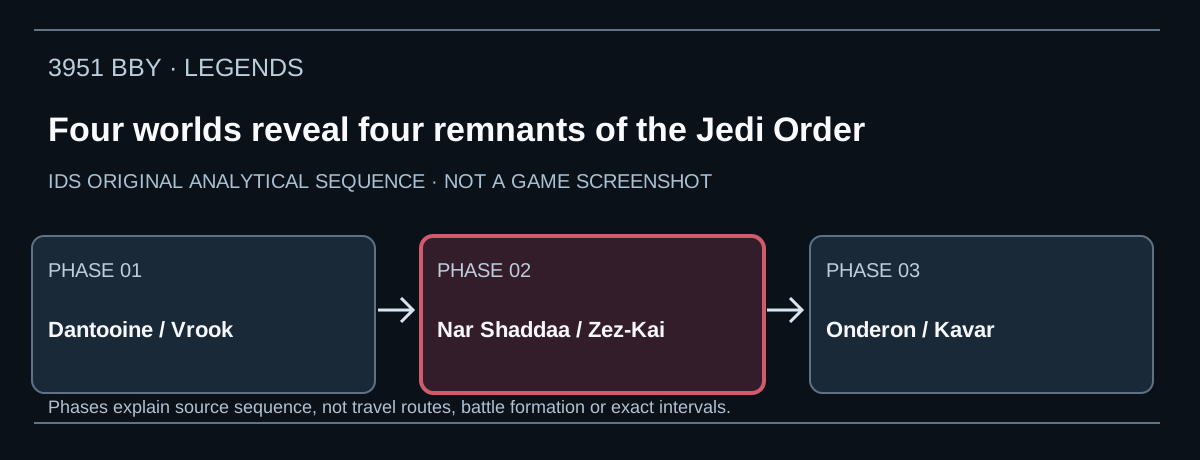
Four worlds reveal four remnants of the Jedi Order
A search for institutional witnesses
Meetra Surik, the Jedi Exile, tries to find surviving Masters while the Order is near extinction. Vrook Lamar is associated with Dantooine's rural enclave, Zez-Kai Ell with the crowded refugee landscape of Nar Shaddaa, and Kavar with Onderon's conflict over monarchy and Republic loyalty. Lonna Vash had traveled to Korriban, but her condition there is a crucial part of the story. The investigation cannot be represented accurately as four safe, equivalent meetings between the Exile and surviving council members.
Planetary settings are political environments
On Dantooine, former Jedi property and displaced settlers complicate the meaning of restoration. On Nar Shaddaa, refugees and criminal groups show the consequences of war outside Senate chambers. Onderon's succession and Dxun's military geography form another struggle over sovereignty. On Korriban, the ruins and the dead Master reveal the continuing danger of Sith sites. These environments are more than backgrounds for retrieving quest items. They shape how the Exile can gain information and whom the player chooses to help.
A flexible itinerary, a narrower continuity claim
The game permits different orders for visiting worlds and allows light- and dark-side choices affecting the Masters' fates. Therefore the article should not assign a fixed sequence of arrivals or state that every encounter concludes with the same speech. Later Legends continuity provides a broader accepted account, but one route through a game should not be presented as every possible version. Lucasfilm's official description confirms decisions alter the Exile's allies and their relation to the galaxy; individual scene chronology still comes from the RPG.
Check your historical interpretation: Does the sequence Dantooine, Nar Shaddaa, Onderon represent a mandatory game route?
Explanation: No. The RPG allows several travel orders; those worlds represent distinct investigation locations, not a fixed chronological travel itinerary.
Primary work: Lucasfilm: KOTOR II narrative and player choice. Official publisher information confirms the work's scope; detailed scenes and dates belong to the full game or novel, with later Legends chronology identified separately. Continue this timeline sequence →
Sources and further reading
- Knights of the Old Republic II: The Sith Lords.