
After Meetra located the surviving Masters, Vrook Lamar, Kavar, and Zez-Kai Ell gathered at the reconstructed chamber of the Dantooine Enclave. They explained their understanding of Meetra's survival at Malachor V: she had cut herself off from the Force rather than die from the wound created there, and her unusual bonds with others now made them fear she could spread that wound.
3951 BBY · Legends · Historical research
THE ENCLAVE COUNCIL
Events and source limitations
In the light-side path of Knights of the Old Republic II, Meetra reunites Masters Vrook Lamar, Kavar and Zez-Kai Ell at Dantooine’s rebuilt Enclave. They explain their interpretation of her severance from the Force after Malachor V and fear the unusual bonds that allow her to influence others. Their intention to separate her from the Force creates a final institutional confrontation. Other gameplay choices can result in fewer Masters present or a different scene; this three-Master gathering represents the established light-side narrative.
People, institutions and consequences
The Masters interpreted Meetra primarily as a danger to be contained. Their assessment relied on knowledge of the Force, but their distance from the experience of ordinary combatants during the Mandalorian Wars shaped what they failed to recognize. The scene tests the difference between protecting an institution and listening to a survivor whose existence challenges its categories. The room’s reconstruction was not the restoration of institutional trust.
Sources: Knights of the Old Republic II, Rebuilt Jedi Enclave dialogue and alternate branches. Explore source transcript or chronology →. The article distinguishes fixed game events, Legends light-side continuity, player-variable choices and editorial analysis.
The Council finally explains the exile
Meetra receives an institutional interpretation of an experience she lived but did not fully understand.
Expert explanation arrives years after punishment.
The Masters choose containment
They decide to sever Meetra from the Force permanently because they interpret her as an existential risk.
Institutional fear again overrides her consent.
Anthropological assessment
The meeting shows expert knowledge being used to justify coercive intervention.
Institutions often treat uncertainty as a reason for precaution, but precaution becomes ethically dangerous when those bearing the cost have little power in the decision.
The Council's fear of an unusual survivor
At the rebuilt Dantooine Enclave, Vrook Lamar, Kavar and Zez-Kai Ell reunited after Meetra Surik's search. The Masters interpreted her survival of Malachor V through the idea of a wound in the Force. Her bonds with other people and ability to live while cut off from the Force appeared to threaten the institutional understanding of what a Jedi could safely become.
The encounter illustrates a fundamental problem of expert authority: the people authorized to define a condition can disagree with the person who experienced it. The Masters had originally punished Meetra without fully explaining her own survival. Now they proposed containment rather than partnership. Their intention to cut off her connection to the Force again shows how protection of an institution can be invoked to justify overriding an individual's autonomy.
Is this meeting fixed for every dark-side game route?
No. The page follows the continuing light-side Legends path in which the three surviving Masters reconvene on Dantooine.
Evidence distinction: The Legends narrative sources below establish participants, outcomes and historical constraints. Commentary on power, memory and institutions is IDS interpretation.
Interactive historical judgment · 3951 BBY
Interpret this historical record
Answer both questions. Get corrections, an explanation and a score to distinguish what the sources show from interpretation.
Legends · 3951 BBY · Event source and interpretation
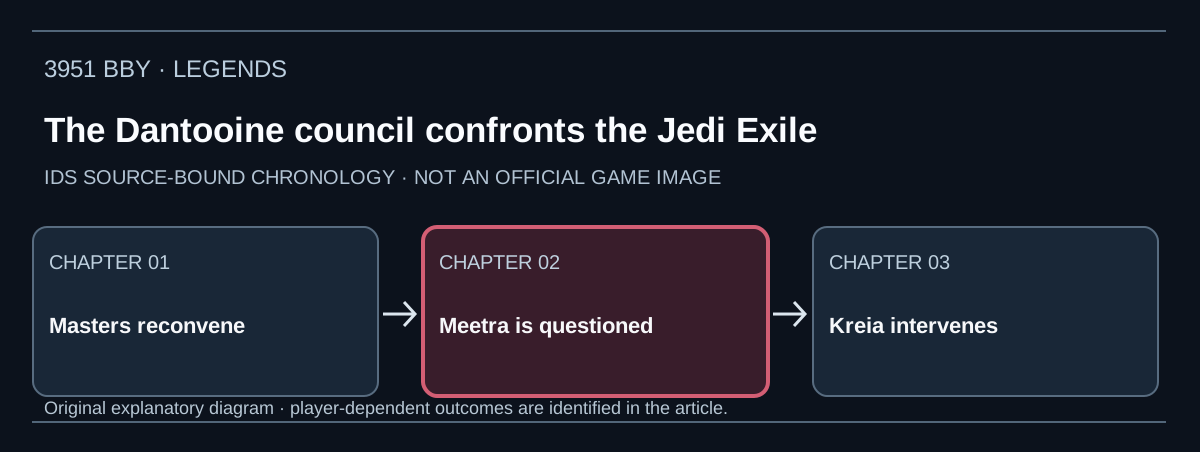
The Dantooine council confronts the Jedi Exile
The reconstructed room is not a restored Jedi Order
Vrook Lamar, Zez-Kai Ell and Kavar converge at the Enclave on Dantooine after the Exile has searched for them. This is an assembly of surviving Masters, not proof that the wider Jedi Order has regained its temples, students, funding or public support. Their discussion revisits the judgment imposed upon Meetra after the Mandalorian Wars, but their immediate concern is the unusual Force bonds through which she now experiences the world. The room's restored physical appearance contrasts with an institution still unable to agree on the meaning of the war.
A different understanding of the Force wound
The Masters describe Meetra's survival after Malachor V as an exceptional response to the pain and loss of a catastrophic battle. The Exile was already cut off from the Force before formal banishment and later relearned connection through companions. The Masters fear that her existence could pose dangers extending beyond herself. The scene should not be simplified into an agreement that the Exile had willingly embraced the Sith, nor should different dialogue options be treated as a single exact transcript.
Kreia changes who has the right to judge
Kreia's intervention exposes both her power and her disagreement with the Masters' interpretation. The encounter has deadly consequences for the Masters in the major light-side course, but not every alternate player choice arrives with all three assembled in precisely the same way. An anthropological account can examine professional authority and the use of claimed expertise to justify coercion. Yet the game does not grant historians a documentary record of an ordinary Republic legal proceeding: it depicts a contested Jedi judgment with supernatural stakes.
Test your historical judgment: Did Meetra lose her connection to the Force because the surviving Masters severed it at this meeting?
Analysis: No. Her unusual state originated at Malachor V years earlier. The Masters' intention to act against her is interrupted, and the scene exposes rather than originates her condition.
Publication basis: Lucasfilm: KOTOR II story overview. Original game content establishes the story; promotional pages do not verify all branch-specific scene details or exact chronological dates. Continue this historical sequence →
Sources and further reading
- Knights of the Old Republic II: The Sith Lords.