
After the Dantooine deaths, events returned Meetra to Atris's polar academy. Atris had surrounded herself with Sith holocrons and increasingly accepted the very doctrines she claimed to preserve the Jedi against. Meetra defeated Atris in combat. In the light-side outcome, Atris survived and was forced to confront that her identity as guardian of Jedi purity had become incompatible with her actions.
3951 BBY · Legends · Historical research
ATRIS CONFRONTED
Events and source limitations
After the Dantooine confrontation, Meetra returned to Atris’s polar academy on Telos. Atris had increasingly immersed herself in Sith holocrons and came to embody the danger she claimed to resist. Meetra defeated her in a personal confrontation. In the light-side path Atris can survive, while other player choices permit different treatment of her. This is the second meeting and should not be collapsed into the earlier discussion immediately after Peragus.
People, institutions and consequences
The case concerns custodianship and institutional self-image. Atris intended to preserve the Jedi and its teachings but became isolated among objects representing rival beliefs. Her conviction that she alone understood proper Jedi identity shielded her from criticism, enabling a gradual contradiction between public claims and private conduct. Defeat exposed that contradiction, but it did not produce one identical personal outcome in every playthrough.
Sources: Knights of the Old Republic II, Atris at the secret Telos Academy; light-side and dark-side outcomes. Explore source transcript or chronology →. The article distinguishes fixed game events, Legends light-side continuity, player-variable choices and editorial analysis.
An archive transforms its curator
Atris believed she could contain Sith knowledge without being influenced by it.
Isolation and repeated exposure reinforced resentment she already carried.
Institutional identity hides personal change
Atris continued to understand herself as a Jedi guardian while adopting Sith practices.
Titles can lag behind behavior.
Anthropological assessment
Atris demonstrates that archives do not influence everyone neutrally.
Curators interpret what they preserve through their own fears and desires, and isolation can remove the social checks that expose gradual ideological change.
An archive of the enemy becomes a dangerous refuge
Atris withdrew to a concealed academy on Telos and surrounded herself with Sith holocrons while maintaining that she was defending the Jedi tradition. She had access to knowledge that most surviving Jedi no longer possessed. Her isolation, however, meant that she increasingly interpreted both the Sith threat and Meetra's past through her own resentment. Possessing texts and artifacts did not guarantee reliable judgment about how they should be used.
Meetra returns with evidence of a larger crisis
By the time of the confrontation, Meetra had encountered the surviving Jedi Masters, the Sith assassins and the damage left by the earlier wars. Atris had attempted to force the hidden enemy into the open, and her plans had endangered others. Their conflict is not reducible to a competition over combat strength: both represent rival interpretations of Jedi responsibility after institutional collapse.
What the ending establishes
Meetra defeats Atris. In the light-side outcome adopted by later Legends treatments, Atris survives to face the implications of her actions. The story also reveals that Kreia has continued toward Malachor V while Darth Nihilus prepares to attack Telos. These revelations connect the academy episode to the final battles, but do not make Atris herself the commander of Nihilus's fleet.
The sources should not be flattened into one possible ending
The game allows differences in the player's dialogue and moral alignment. An archival article should identify when it follows the continued Legends storyline and when an alternative is confined to gameplay. Attributions of motive should be tied to Atris's stated beliefs and observable actions rather than invented private confessions.
Anthropological assessment: custodianship and legitimacy
Atris understood herself as a guardian of Jedi knowledge, yet her practice of collecting forbidden teachings became part of her own fall. Custodians can claim authority from protecting an institution's heritage while undermining the practices that gave that heritage meaning. The episode examines how isolation and control of information can make self-correction difficult.
Evidence comparison
Which details are directly supported?
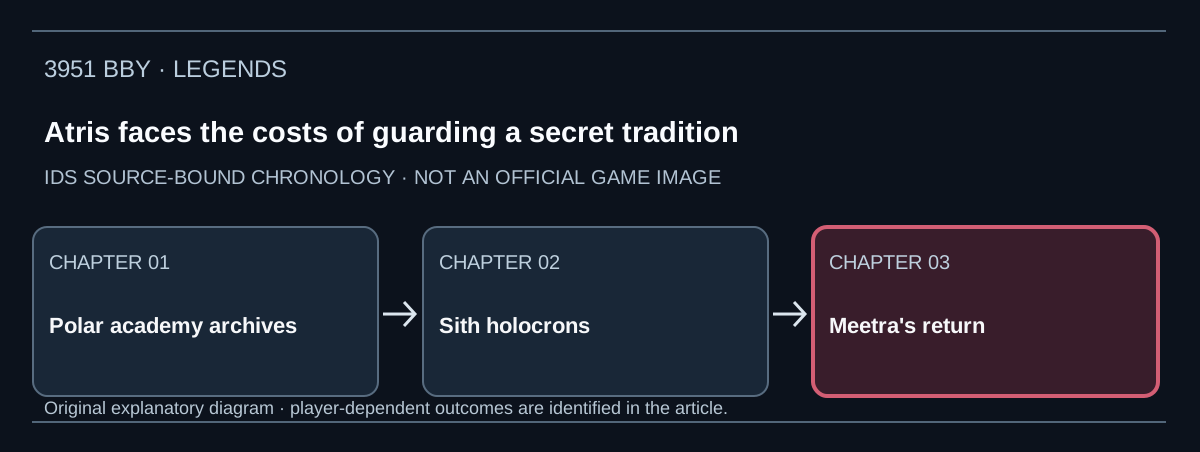
The original game and referenced published chronology support the major participants, outcome, and broad story sequence. The diagram does not claim exact geographical distances or tactical deployments.
Are alternate gameplay choices historical events?
Only the outcome adopted by the continuing Legends storyline is treated as fixed. Other choices remain genuine game possibilities, not simultaneously established events.
Interactive historical judgment · 3951 BBY
Interpret this historical record
Answer both questions. Get corrections, an explanation and a score to distinguish what the sources show from interpretation.
Original-source investigation: Atris's archive: knowledge, secrecy and the limits of a game synopsis
Atris's story belongs to Knights of the Old Republic II, where a Jedi historian with a collection of Sith holocrons comes into conflict with Meetra Surik. The academy archives are consequential because they preserve teachings and dangerous artifacts. The fall of an archivist should not be confused with a change in the official Jedi Order's entire policy, nor with the final struggle against Darth Traya.
The Lucasfilm support record verifies the original game's identity but does not contain a dialogue transcript or specify every confrontation. The relevant game scenes must therefore be used to confirm Atris's actions and the precise narrative order. The editorial question is not whether preserving forbidden material is inherently wrong, but who controlled access, how secrecy affected her judgment and how she handled contrary evidence.
Follow the sources: Lucasfilm's KOTOR II game record · Original Knights of the Old Republic reference. Publisher overviews and in-universe narrators do not replace original game scenes, chapters or comic panels.
Legends · 3951 BBY · Event source and interpretation
Atris faces the costs of guarding a secret tradition
The archive is also a political refuge
Atris had retreated from a disintegrating Jedi Order into a hidden Telos academy. Surrounded by attendants, archives and Sith holocrons, she continued to regard herself as a guardian of a tradition few public Jedi institutions could still sustain. The act of collecting records does not itself grant a curator authority to interpret them without accountability. Her secrecy made it difficult for others to challenge the change in her beliefs, while the objects she preserved were not inert cultural specimens.
The return to Telos is a separate confrontation
Meetra's first conversation with Atris, earlier in the journey, concerned the exile judgment and surviving Jedi information. The later encounter takes place after the crisis around Dantooine and the discovery of wider Sith activity. Atris's growing entanglement with the holocrons is now central to the conflict, and Meetra defeats her. The light-side course leaves Atris alive to confront what she has become. The game permits darker outcomes, so the archive should not claim her fate is the same in every playthrough.
Knowledge possession is not institutional continuity
Atris could maintain a collection and teach within her academy without fully representing the Order's original ethical purposes. Her conflict with Meetra explores the distinction between preserving records and preserving good judgment. That interpretation does not establish a literal causal mechanism by which every Sith object corrupted every viewer, and it should not be generalized into a statement about all forms of archaeological study. The story makes this particular curator's secrecy, choices and fears consequential.
Test your historical judgment: Does Atris's possession of Sith holocrons prove she remained unaffected by them?
Analysis: No. The narrative reveals the danger of the secrecy and knowledge she maintained. She may have understood the collection as preservation, but her judgment and identity had changed.
Publication basis: Lucasfilm: official KOTOR II support. Original game content establishes the story; promotional pages do not verify all branch-specific scene details or exact chronological dates. Continue this historical sequence →
Sources and further reading
- Knights of the Old Republic II: The Sith Lords.