

- Continent
- Alanciar
- Species
- Keshiri
- Born
- 3019 BBY
- Later post
- Point Defiance
- Later role
- Signal officer / Herald
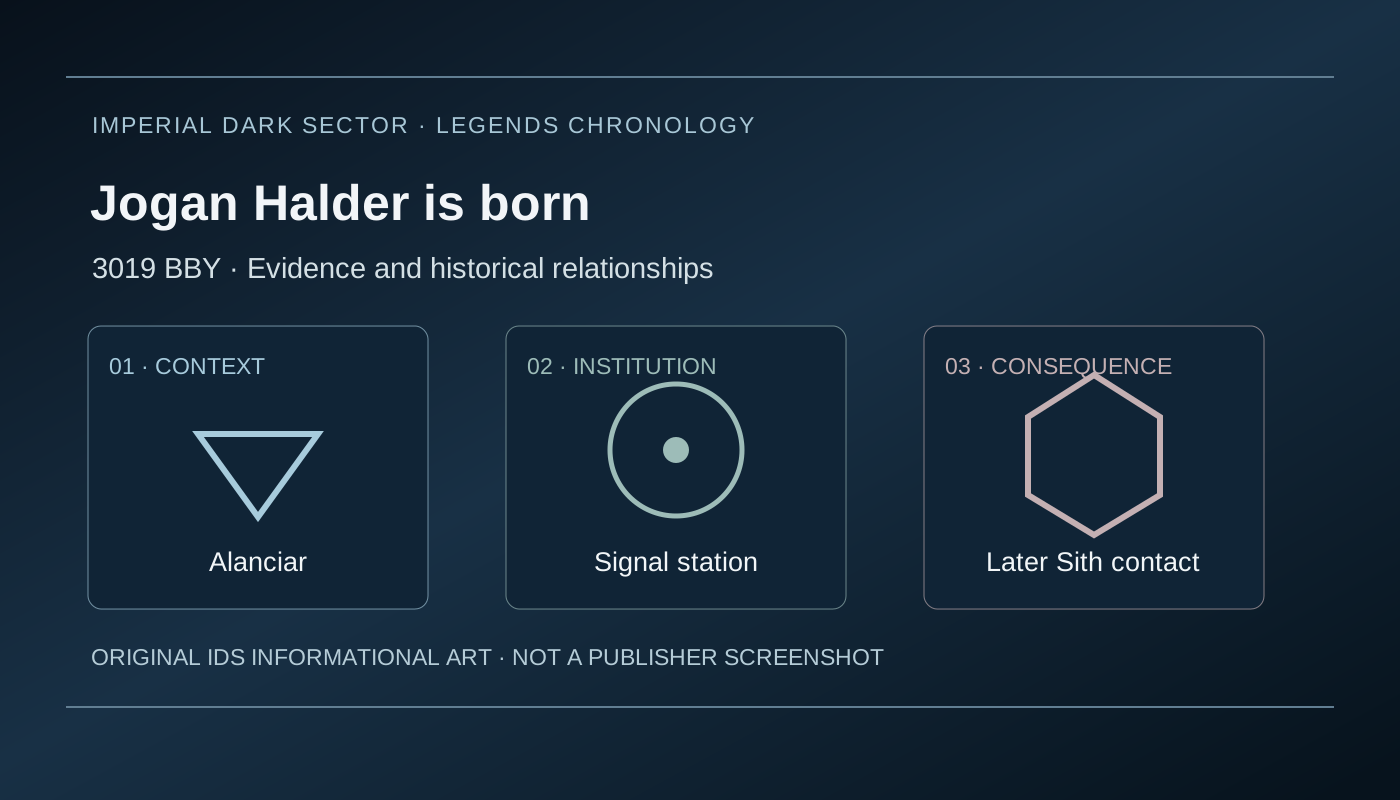
Also in 3019 BBY, Jogan Halder was born on Alanciar. He later became a signal officer posted at Point Defiance in Garrow's Neck. That technical position made him part of the communications network connecting Alanciar's defenses. In 2975 BBY, Sith survivors captured him, transported him to Keshtah Minor, and manipulated him into becoming the public voice used to convince Alanciari that the Lost Tribe had arrived as benevolent Protectors.
Signal officers occupy a strategic middle position
Jogan was not head of Alanciar's government, yet he was more than an ordinary bystander. His work connected places through information.
That middle position made him valuable to occupiers who needed local credibility rather than only military force.
His later importance depends on trust
When Jogan spoke to Alanciar after visiting Keshtah Minor, people heard one of their own military personnel rather than a Sith conqueror.
The Tribe's propaganda strategy worked because social trust could be transferred from Jogan to a message he did not fully understand as manipulated.
His relationship with Quarra adds another network
The secret relationship that begins in 2978 BBY uses the same signaling infrastructure that supports defense.
Military, technological, and intimate networks overlap rather than occupying separate worlds.
Event sequence
Jogan Halder is born.
He joins the Alanciari Signal Corps.
Secret correspondence with Quarra begins.
Sith capture him and later use him as Herald.
Explore this entry
Was Jogan a willing collaborator?
His public message was shaped by deception and controlled presentation on Keshtah Minor, so that label would oversimplify his situation.
Why was a signal officer so valuable?
He had local institutional credibility and understood how messages moved across Alanciar.
Did Jogan know the Lost Tribe before 2975?
Only through Alanciar's inherited historical narratives, not personal contact.
Anthropological assessment
Jogan's later role demonstrates the power of intermediaries. Conquest is easier when outside rulers can translate authority through people already trusted inside the target society.
Communication workers can therefore hold political power disproportionate to formal rank because they mediate what information is seen as believable.
Sources and further reading
- John Jackson Miller, Lost Tribe of the Sith: Pandemonium.
- 3019 BBY — Wookieepedia.
3019 BBY · Legends · Evidence and political anthropology
Jogan Halder is born: what the historical record supports
Source-constrained historical account
Jogan Halder's childhood predates the Lost Tribe's first major contact with Alanciar. His importance emerges decades later when he serves as a signal officer and becomes involved in the attempted Sith invasion and subsequent political settlement. A birth dossier can establish place and chronology without inventing details of childhood experiences that the novel does not record.
Institutions, beliefs and material life
Alanciar's fortified communication system shaped Halder's later options. Signaling posts connected defensive preparations with decision-making across the continent. This later institutional context explains his historical importance better than treating birth year as a cause of eventual cooperation with the Lost Tribe.
Chronology and evidence limitations
Dates in this early Legends era are from fictional reference chronologies, sometimes approximate. A later person's accomplishments cannot be read into a record of their birth. IDS distinguishes events recorded in original books or reference titles from analysis of their social implications. A source illustration or cover may portray an era rather than the precise dated event.
The original published narrative and reference bibliography are recorded below; secondary online reference links are research aids and not interchangeable with primary novel pages or guide citations.
Test your historical judgment
Answer both questions. Your result explains the source-based distinction, including any corrections.