

- Conflict
- 17th Alsakan Conflict
- Date
- 3017 BBY
- Major powers
- Coruscant / Alsakan / Corellia
- Outcome
- Corellian victory
- Settlement
- Peace treaty
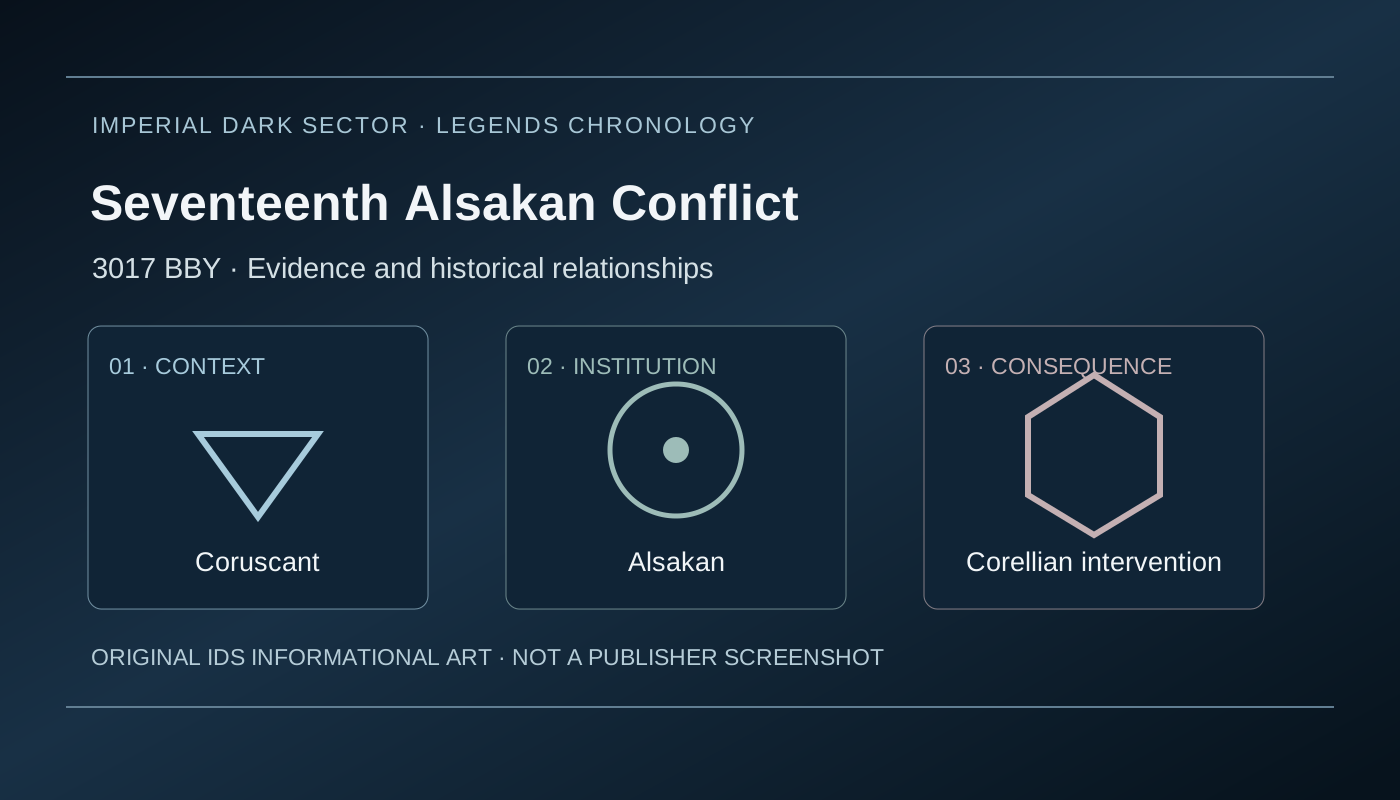
In 3017 BBY, the rivalry between Coruscant and Alsakan erupted one final time. Both powers had spent centuries treating fleet construction and colonial influence as measures of galactic leadership. Yet the final war was decided by a third actor: Corellia. Prince-Admiral Jonash e Solo's long-range frigates combined speed, shielding, and heavy turbolasers so effectively that the massive battleships of the older rivals suddenly looked obsolete.
The old rivalry had become an institution
Coruscant and Alsakan repeatedly fought over capital status, colonization, corporate influence, and control of the Republic's political geography.
By the seventeenth conflict, generations had inherited rivalry as normal state behavior.
Corellian frigates change the military balance
Corellia initially armed to protect its own interests while Coruscant and Alsakan escalated. New engines, shields, and heavy weapons made its frigates unexpectedly superior.
Privateers then struck both rival centers, turning a two-sided contest into a three-sided collapse of assumptions.
Peace is dictated at swordpoint
Coruscant and Alsakan declared war on Corellia together, but the coalition was rapidly defeated.
Jonash e Solo imposed the final treaty on the Senate floor, ending the entire sequence of Alsakan wars.
The end redirects colonization
Centuries of conflict had made parts of the Perlemian corridor less attractive to settlers and investors. Corellian routes benefited as populations and capital shifted westward.
Military geography therefore changed long-term settlement patterns.
Event sequence
Coruscant and Alsakan mobilize competing fleets.
Privateers defeat major forces belonging to both sides.
Former rivals declare war on Corellia.
Jonash e Solo forces a peace settlement.
The Alsakan Conflicts end permanently.
Explore this entry
Why did Corellia win?
Its new long-range frigates combined technologies that made the older massive battleships less effective.
Did Coruscant and Alsakan become friends?
They cooperated against Corellia, but the treaty ended the wars rather than erasing every historical difference.
Why does this deserve its own page after earlier Alsakan entries?
Because it closes one of the longest recurring political conflicts in Legends history.
Anthropological assessment
The final Alsakan Conflict shows how long rivalries can become self-reproducing institutions. People may inherit strategic assumptions whose original causes are thousands of years old.
It also demonstrates technological disruption: political prestige attached to enormous battleships collapsed when a different design made them strategically inferior.
Sources and further reading
- Jason Fry with Paul R. Urquhart, The Essential Guide to Warfare.
- Daniel Wallace and Jason Fry, The Essential Atlas.
- Seventeenth Alsakan Conflict — Wookieepedia.
3017 BBY · Legends · Evidence and political anthropology
Seventeenth Alsakan Conflict: what the historical record supports
Source-constrained historical account
The last Alsakan Conflict ended after Corellian naval intervention outmatched the rival fleets of Coruscant and Alsakan. Reference works credit Prince-Admiral Jonash e Solo with imposing a treaty. The episode belongs to a long series of wars over economic and political leadership, but its final phase must be dated specifically to 3017 BBY.
Institutions, beliefs and material life
The conflict highlights the institutional consequences of changing military technology. Corellia's more capable frigates undermined the assumed superiority of established battle fleets, enabling a third political actor to shape the peace. The treaty did not mean the planets lost their separate social identities; it changed the political conditions of rivalry.
Chronology and evidence limitations
Dates in this early Legends era are from fictional reference chronologies, sometimes approximate. A later person's accomplishments cannot be read into a record of their birth. IDS distinguishes events recorded in original books or reference titles from analysis of their social implications. A source illustration or cover may portray an era rather than the precise dated event.
The original published narrative and reference bibliography are recorded below; secondary online reference links are research aids and not interchangeable with primary novel pages or guide citations.
Test your historical judgment
Answer both questions. Your result explains the source-based distinction, including any corrections.