
01 · Orientation
World overview
Corellia is an ancient Core World famous for shipbuilding and travel, but Imperial-era Corellia is also a place of industrial inequality where wealth, labor, criminal networks, and the desire to leave shape everyday life. IDS treats Corellia as a lived world rather than background scenery. Its location in Core Worlds, its classification as Industrial shipbuilding world, and its association with Corellians, workers, migrants and criminal networks create a social setting shaped by geography, institutions, mobility, and historical change. The purpose of the file is to connect those conditions instead of reducing the planet to a single battle, character, or visual landmark.
02 · Environment
Landscape, climate, and adaptation
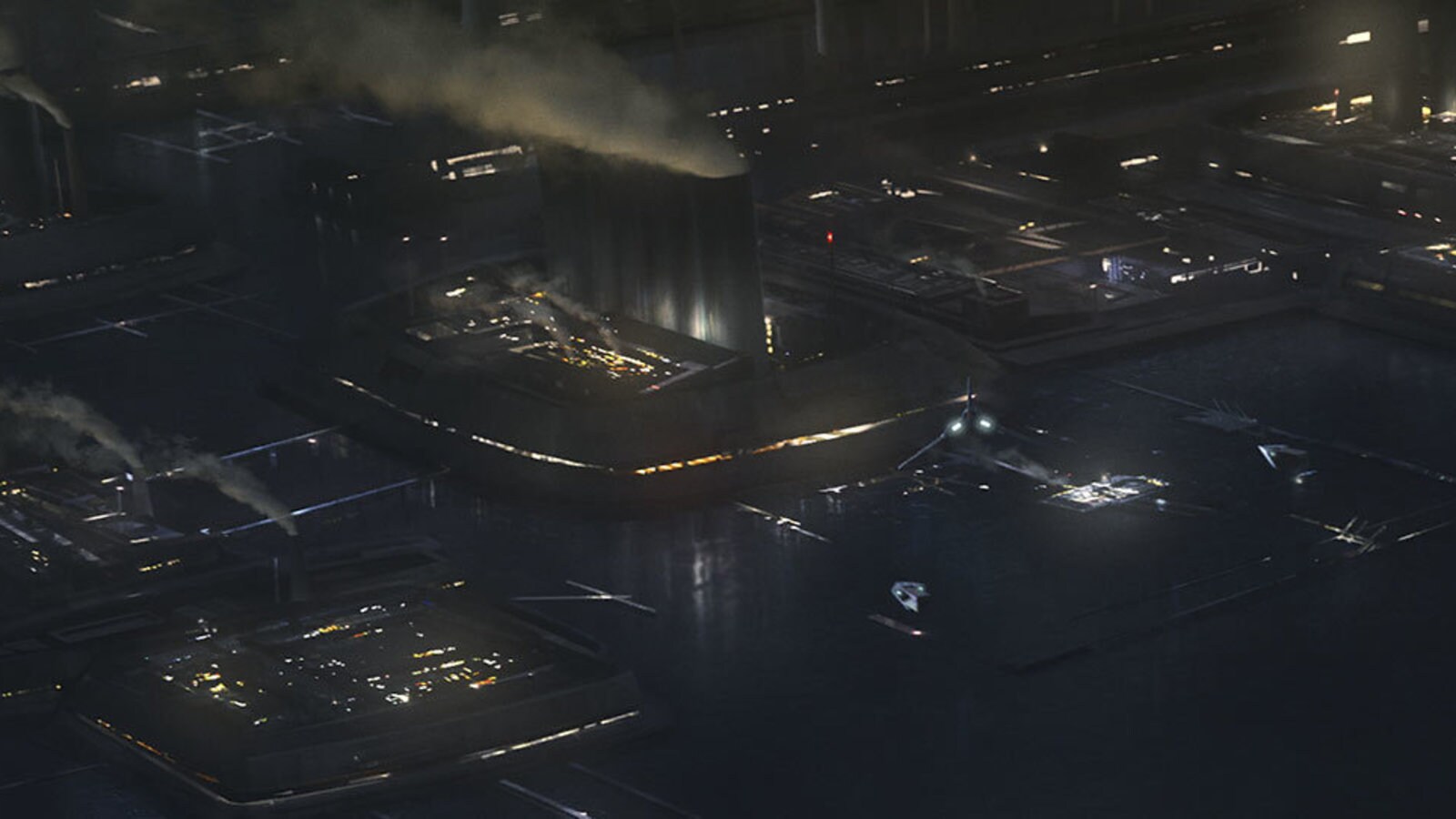
Enormous shipyards and dense industrial cities dominate major population centers. The planet's infrastructure is oriented toward transportation and manufacturing, linking Corellia to trade routes and military production across the galaxy. Quick Facts identifies the climate as Temperate and industrialized and the terrain as Cities, shipyards and industrial zones. Those environmental conditions affect where settlements can develop, how people travel, what resources become politically important, and which forms of infrastructure are practical. Environment does not mechanically determine culture, but it places real constraints on labor, architecture, transportation, defense, and everyday life.
03 · Built environment
Settlement, architecture, and infrastructure
Corellia’s urban identity is industrial. Shipyards, factories, freight corridors, ports, dense neighborhoods, and lower-income districts organize daily life around production and transport. Coronet City and related industrial zones connect technical expertise to social stratification: people living near the systems that build starships do not necessarily share the wealth those ships generate. Under Imperial control, infrastructure that once supported commerce can also support military production and tighter regulation of workers.
04 · Society
People, community, and everyday life
Corellian identity carries a strong association with pilots, engineers, shipbuilders, smugglers, and travelers. Yet the romance of mobility is unevenly distributed. Wealthy families and major corporations have access to opportunity while poor workers and street populations often struggle to escape local systems of exploitation. The communities most closely associated with this file are Corellians, workers, migrants and criminal networks. The IDS focus is industry, labor, mobility, which means the planet is read through differences in institution, class, occupation, migration, and political experience rather than as a single unified culture. A world can contain neighboring populations with distinct languages, religions, histories, and relationships to state power.
05 · Economy & labor
Resources, work, and political economy
Shipbuilding is Corellia’s defining economic sector, but it supports a much larger network of engineers, welders, mechanics, freight handlers, designers, clerks, transport workers, security personnel, and suppliers. Commercial shipping, smuggling, salvage, and criminal markets grow around the same mobility infrastructure. Imperial control gives the state access to industrial capacity while narrowing workers’ freedom. Han Solo’s early life shows the opposite end of that economy: poverty and criminal patronage inside a world famous for technical productivity.
06 · Religion & worldview
Sacred landscape, belief, and moral order
Current canon does not define a single Corellian religion. Corellian identity is more often expressed through local pride, industry, ships, family networks, labor, and political independence. Religious life should therefore be treated as plural and under-documented rather than inferred from regional identity. Religion and worldview are treated as parts of social life rather than decorative lore. Sacred places, collective memory, ritual, moral authority, and relationships to land can influence how communities understand belonging and legitimate power. Where canon documents no shared planetary religion, IDS keeps that absence visible instead of inventing a uniform belief system for everyone living on the world.
07 · Institutions
Government, authority, and power
Under the Empire, Corellian shipyards became strategically important to military production. Industrial authority, policing, corporations, criminal organizations, and Imperial control overlapped, creating a political environment where economic power could be as important as formal government. The major eras associated with Corellia are Republic, Empire, New Republic. Political authority can therefore change as governments, militaries, occupations, local elites, resistance movements, or outside institutions gain and lose control. The archive uses industry, labor, mobility to ask who can make decisions, who bears the costs of those decisions, and how planetary institutions connect local communities to larger galactic systems.
08 · Mobility
Movement, travel, and connection
Corellia’s economy depends on movement, so starports, shipyards, freight systems, speeders, trains, and hyperspace connections are central to the planet’s social organization. Skilled pilots and mechanics can turn technical knowledge into opportunities beyond the world, while people without documents, money, or patronage face greater barriers to leaving. Han’s desire to escape illustrates how mobility can become a class issue: the planet builds ships for the galaxy while some of its residents struggle to gain access to one.
09 · Conflict & security
War, policing, occupation, and defense
Imperial rule militarizes Corellia’s industrial landscape. Security forces, labor control, checkpoints, recruitment, and the diversion of shipbuilding capacity toward state needs make political authority visible through work. Criminal organizations exploit the same conditions, offering protection or opportunity while creating new dependencies. Conflict is therefore not limited to battles. It exists in who controls factories, who can move through ports, who receives legal employment, and who must rely on illicit networks to survive.
10 · Points of interest
Places that make Corellia legible
Places inside Corellia make large planetary histories concrete. Cities, temples, factories, homes, bases, ruins, and landscapes show where institutions actually operate and where people work, worship, govern, travel, fight, remember, and build community. IDS treats these locations as evidence of social life rather than as a sightseeing checklist. Each point is included because it helps explain how geography, political authority, material culture, religion, or historical change becomes visible on the ground.
Coronet City
Corellia’s major city linked shipbuilding, transport, commerce, criminal economies, and Imperial control. Dense urban industry made class and labor central to the planet’s political life.
Corellian Engineering Corporation shipyards
The shipyards made Corellia strategically important by producing vessels that supported civilian travel, military power, commerce, and smuggling. Shipbuilding tied skilled labor directly to galactic infrastructure.
Sewers and industrial undercity
Lower industrial spaces associated with Han Solo’s youth show how poverty, coercion, criminal patronage, and informal survival strategies existed beneath Corellia’s reputation for technical excellence.
11 · Change over time
Historical significance
Corellia contributed to galactic expansion long before the films. During the Imperial period, it produced ships and matériel while many residents experienced worsening inequality. Han Solo's early life on the planet captures the difference between Corellia's reputation for movement and the difficulty of actually leaving. The principal appearances listed for Corellia are Solo, The Bad Batch, Ahsoka. Those stories capture particular moments rather than the complete history of the world. IDS reads wars, occupations, migrations, regime changes, reconstruction, and institutional continuity as processes that reshape social life over time. Historical significance therefore comes from what changes for communities, not only from whether a famous event happened there.
12 · IDS lens
What this world reveals
Corellia is a material-culture world. Ships are not merely vehicles; they connect labor, class, technology, identity, and migration. The planet's famous starships depend on workers and institutions that are often invisible once those ships leave the yard. The archive emphasis for Corellia is industry, labor, mobility. That focus is useful because it connects geography to social organization instead of treating the world as scenery. IDS asks how people experience institutions differently depending on class, community, mobility, political status, access to resources, and historical circumstance, and how those differences become visible in the built and natural environment.
13 · Sources & continuity
Official primary source
The factual baseline for this Corellia file comes from official Star Wars reference material and the canon appearances listed in Quick Facts. IDS uses those sources for names, geography, political events, communities, and chronology, while the surrounding discussion of institutions, religion, settlement, labor, and social change is independently written analysis. Some aspects of everyday life on this world remain undocumented in current Canon.