
01 · Orientation
World overview
Mustafar is a small volcanic world whose mineral wealth, industrial facilities, Sith associations, and later connection to Darth Vader make it a landscape where extraction and political terror overlap. IDS treats Mustafar as a lived world rather than background scenery. Its location in Outer Rim, its classification as Volcanic mining world, and its association with Mustafarians, miners and Imperial personnel create a social setting shaped by geography, institutions, mobility, and historical change. The purpose of the file is to connect those conditions instead of reducing the planet to a single battle, character, or visual landmark.
02 · Environment
Landscape, climate, and adaptation
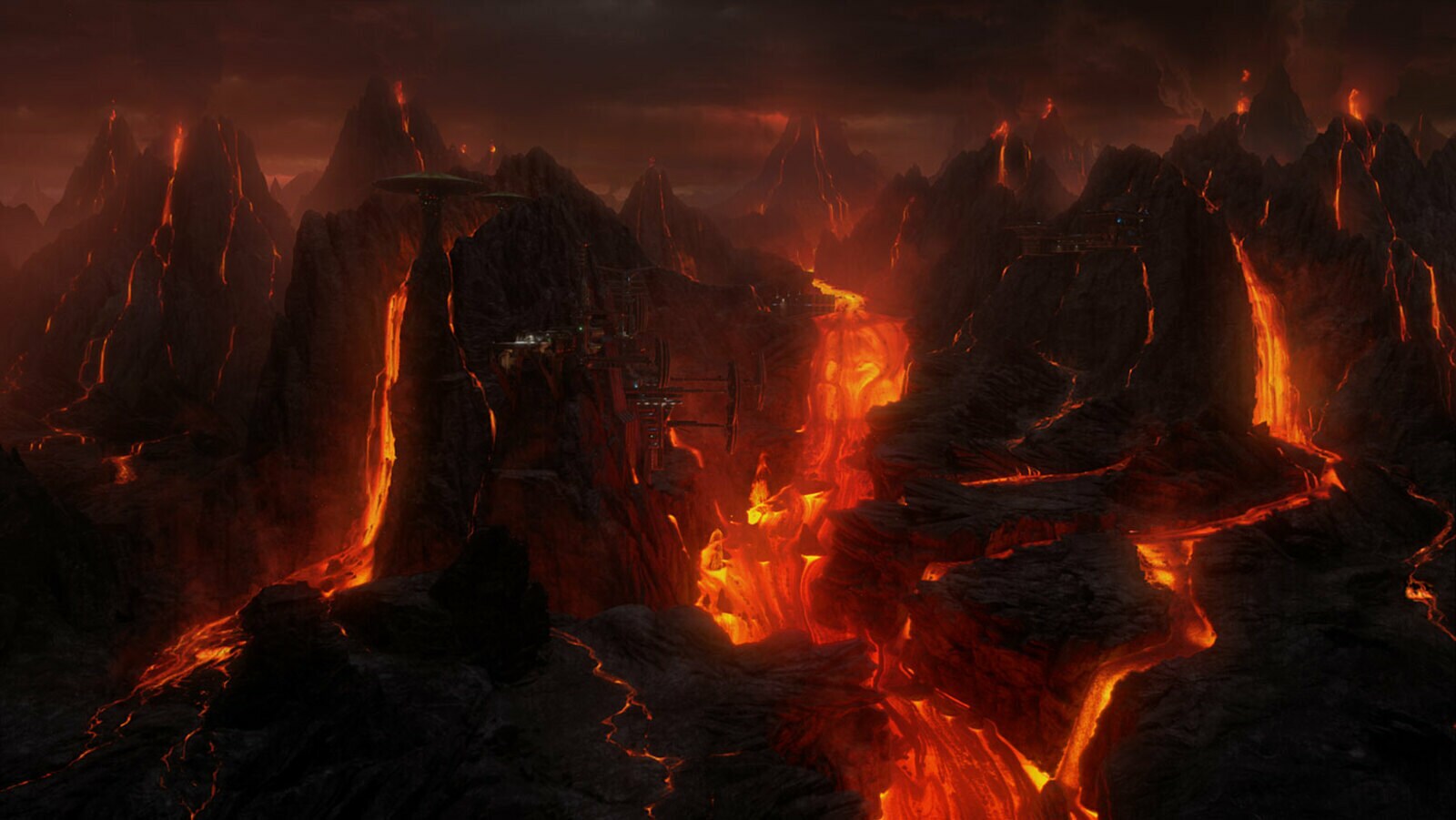
The planet's unstable volcanic surface is dominated by lava flows, fire, dark rock, and industrial installations built to survive extreme heat. Valuable minerals encouraged offworld exploitation despite the danger. Quick Facts identifies the climate as Extremely hot and the terrain as Lava rivers, volcanic plains and industrial sites. Those environmental conditions affect where settlements can develop, how people travel, what resources become politically important, and which forms of infrastructure are practical. Environment does not mechanically determine culture, but it places real constraints on labor, architecture, transportation, defense, and everyday life.
03 · Built environment
Settlement, architecture, and infrastructure
Mustafar’s inhabited spaces are engineered against extreme heat. Mining facilities, fortified industrial platforms, lava-side structures, and later Vader’s castle all depend on insulation, energy management, and controlled access. The architecture is often separated into secure compounds rather than open cities, reflecting the planet’s use for extraction, secrecy, imprisonment, and elite power. Built space therefore reinforces isolation: people come to Mustafar for specific institutional purposes rather than because it supports broad urban life.
04 · Society
People, community, and everyday life
Native Mustafarians adapted physically and technologically to the hostile environment. Offworld organizations viewed the world differently, treating it as a source of resources, a secure industrial location, or a place whose isolation could be used for secrecy and confinement. The communities most closely associated with this file are Mustafarians, miners and Imperial personnel. The IDS focus is extraction, sith memory, coercive power, which means the planet is read through differences in institution, class, occupation, migration, and political experience rather than as a single unified culture. A world can contain neighboring populations with distinct languages, religions, histories, and relationships to state power.
05 · Economy & labor
Resources, work, and political economy
Mustafar’s value comes from minerals and industrial extraction. Mining organizations accept extraordinary environmental risk because the planet’s resources can justify specialized infrastructure and labor. Native Mustafarians, offworld workers, and corporate or political authorities do not necessarily share those benefits equally. Later Imperial use shifts the planet’s significance from primarily economic extraction toward strategic and symbolic functions, yet the earlier industrial systems remain evidence of how corporations make hostile environments profitable.
06 · Religion & worldview
Sacred landscape, belief, and moral order
Mustafar carries powerful Sith associations and later becomes the site of Darth Vader's fortress. Ancient ruins, dark-side history, and the planet's violent landscape give it sacred and occult significance for some Force traditions, even though it is also an industrial extraction world. Religion and worldview are treated as parts of social life rather than decorative lore. Sacred places, collective memory, ritual, moral authority, and relationships to land can influence how communities understand belonging and legitimate power. Where canon documents no shared planetary religion, IDS keeps that absence visible instead of inventing a uniform belief system for everyone living on the world.
07 · Institutions
Government, authority, and power
The Tech Union operated mining interests on Mustafar during the Separatist era. After the Republic fell, Imperial and Sith power reshaped the world's significance. Darth Vader's fortress transformed Mustafar into a personal and political stronghold tied to memory, punishment, and authority. The major eras associated with Mustafar are Clone Wars, Empire. Political authority can therefore change as governments, militaries, occupations, local elites, resistance movements, or outside institutions gain and lose control. The archive uses extraction, sith memory, coercive power to ask who can make decisions, who bears the costs of those decisions, and how planetary institutions connect local communities to larger galactic systems.
08 · Mobility
Movement, travel, and connection
Travel on Mustafar is difficult at both planetary and galactic scales. Local movement requires protected vehicles, platforms, and routes that avoid lava flows and unstable terrain. Offworld arrival is easier for organizations with starships and secure installations, which gives corporations and the Empire disproportionate control over access. Vader’s fortress intensifies that pattern by turning remoteness into security. Isolation becomes an institutional asset because unwanted visitors can be detected and escape can be constrained.
09 · Conflict & security
War, policing, occupation, and defense
Mustafar is repeatedly chosen for violence because it is remote, industrial, and politically marginal. The Separatist Council is eliminated there, Obi-Wan and Anakin’s duel transforms the world into a site of personal catastrophe, and Imperial-era facilities connect it to detention and Sith authority. Security is concentrated within fortified compounds rather than a planetary civic system. Conflict therefore arrives through powerful outsiders who use the environment as a setting for secrecy, punishment, and political finality.
10 · Points of interest
Places that make Mustafar legible
Places inside Mustafar make large planetary histories concrete. Cities, temples, factories, homes, bases, ruins, and landscapes show where institutions actually operate and where people work, worship, govern, travel, fight, remember, and build community. IDS treats these locations as evidence of social life rather than as a sightseeing checklist. Each point is included because it helps explain how geography, political authority, material culture, religion, or historical change becomes visible on the ground.
Darth Vader’s Castle
Vader’s fortress was built at the site of his defeat and above a dark-side locus, turning personal trauma, Sith practice, architecture, and Imperial authority into one deliberately intimidating landscape.
Open connected IDS file →Klegger Corp mining facilities
Industrial sites on Mustafar reveal why outsiders repeatedly occupied such a dangerous world: valuable resources made extreme environmental risk acceptable when institutions could shift that risk onto workers and local populations.
Separatist Council complex
The facility where Vader killed the Separatist leadership marks the violent transition from Clone Wars politics to Imperial rule and shows how remote industrial worlds can become sites of political elimination.
11 · Change over time
Historical significance
Mustafar became the site of the final confrontation between Obi-Wan Kenobi and Anakin Skywalker after the fall of the Jedi Order. During Imperial rule, the planet remained connected to Vader and to the regime's treatment of captured Force users. The principal appearances listed for Mustafar are Revenge of the Sith, Rogue One, Rebels, The Rise of Skywalker. Those stories capture particular moments rather than the complete history of the world. IDS reads wars, occupations, migrations, regime changes, reconstruction, and institutional continuity as processes that reshape social life over time. Historical significance therefore comes from what changes for communities, not only from whether a famous event happened there.
12 · IDS lens
What this world reveals
Mustafar demonstrates how a landscape can acquire political meaning through memory. A mining world becomes a monument to trauma and authority because powerful actors repeatedly use the same place to stage violence and control. The archive emphasis for Mustafar is extraction, sith memory, coercive power. That focus is useful because it connects geography to social organization instead of treating the world as scenery. IDS asks how people experience institutions differently depending on class, community, mobility, political status, access to resources, and historical circumstance, and how those differences become visible in the built and natural environment.
13 · Sources & continuity
Official primary source
The factual baseline for this Mustafar file comes from official Star Wars reference material and the canon appearances listed in Quick Facts. IDS uses those sources for names, geography, political events, communities, and chronology, while the surrounding discussion of institutions, religion, settlement, labor, and social change is independently written analysis. Some aspects of everyday life on this world remain undocumented in current Canon.