
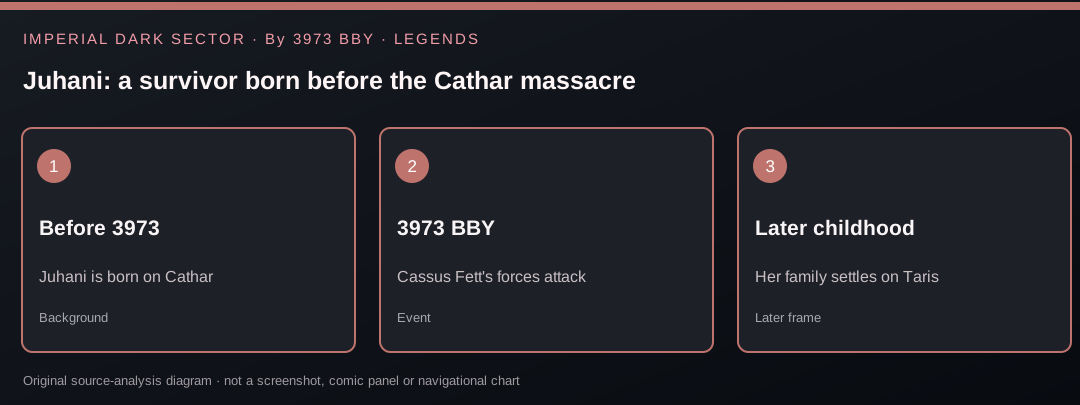
By 3973 BBY, Juhani had been born on Cathar. She was still an infant during the Mandalorian attack that devastated her people. Her parents escaped with her and eventually settled on Taris, where the family entered an urban environment marked by poverty, anti-alien discrimination, and slavery.
3973 BBY · Legends · Source analysis
A Cathar refugee's childhood
What the historical record establishes
Juhani was a child during the devastating Mandalorian attack on Cathar and survived with her family. They eventually settled on Taris, where poverty and anti-alien prejudice shaped her later childhood; her parents died, and she experienced enslavement before entering Jedi training. Because different references reconstruct her childhood retrospectively, the precise interval between flight from Cathar and arrival on Taris should not be asserted without an original dated passage.
People, institutions and consequences
Juhani's biography documents social consequences that continue after the campaign ends. Survival did not secure equal citizenship, housing or freedom from exploitation. Her experience connects mass violence to later displacement, vulnerability to discrimination and access to institutions. The date of her birth should be kept separate from the better-established 3973 BBY massacre marker if her exact year is uncertain.
Source trail: Star Wars: Knights of the Old Republic (2003), Juhani companion dialogue; Knights of the Old Republic Campaign Guide; Cathar historical accounts. Original publication or game reference → Supplementary chronology →. IDS interpretations are marked as analysis; illustrated hero is original symbolic artwork, not an official scene.
A refugee childhood begins with genocide
Juhani's earliest life was shaped by flight from the destruction of her home society.
Taris became home through displacement rather than voluntary migration.
Safety does not end vulnerability
Her family escaped direct Mandalorian destruction but encountered discrimination and economic hardship on Taris.
Anthropological assessment
Juhani's childhood shows that survival after atrocity does not end its social consequences.
Refugees carry trauma into new settings where class, species prejudice, and labor conditions create new forms of vulnerability.
A childhood shaped by genocide and displacement
Juhani's biography begins before the destruction of Cathar and continues through flight from that catastrophe. Her parents escaped with their daughter and eventually reached Taris. That migration did not bring immediate security. The stratified city was marked by discrimination against non-Humans and severe economic inequality, and Juhani's family encountered exploitation. A simple description of her as a future Jedi recruit omits the social conditions that shaped her sense of safety, fear and belonging.
Chronology should not invent a birthday
The references establish that Juhani was alive before the Mandalorian attack on Cathar. They do not provide an exact birthday corresponding to every timeline compilation's year. The accurate formulation is 'by 3973 BBY,' rather than claiming certainty that a child was born at a particular moment for which there is no contemporary source.
Escape and protection are not the same
The family survived direct military violence yet became vulnerable within an urban labor system in which species classification affected opportunity and status. Their experience provides a link between a large military crime and the smaller-scale institutions of exploitation encountered by refugees. The two are connected without being identical. This history explains why Juhani's later reactions cannot be reduced to a single temperamental trait.
Does Juhani's refugee childhood belong only to the Battle of Cathar?
No. The destruction of Cathar begins the displacement, while the family’s experiences on Taris show how the consequences continued long after they escaped the immediate attack.
Evidence note: Dates, participants and outcomes follow the Legends source material identified below. Interpretive comparisons are IDS analysis, not invented historical dialogue or tactical reporting.
Historical judgment · 3973 BBY
Test your historical interpretation
Choose two answers. Your assessment includes an explanation and a correction for each question, not just a score.
By 3973 BBY · Legends · original-source review
Juhani: a survivor born before the Cathar massacre
What the sources establish
Juhani was an infant during the Mandalorian violence on Cathar. Her parents escaped with her and eventually reached Taris. The Campaign Guide gives 3973 BBY for the Battle of Cathar, so the accurate birth statement is by 3973 BBY, not an exact birthday in that year.
Power, identity, and society
Juhani's personal history connects mass violence to migration. The family sought safety, yet life as non-Humans in Taris's Lower City exposed them to discrimination and exploitation. The destruction of a community does not end when a refugee family escapes the original attack.
Evidence limits
KOTOR depicts Juhani remembering childhood hardship; its lines should not be turned into an invented birth scene or a precise age in the massacre. A later comic depicts the Mandalorian battle from a different perspective.
Historical check: Does the 3973 BBY battle date prove Juhani was born in 3973 BBY?
Explanation: No. It provides a latest-possible birth year, since she was already alive during the battle.
Sources and further reading
- Star Wars: Knights of the Old Republic.
- Knights of the Old Republic Campaign Guide.