
ALDERAAN AFTER THE DESTRUCTION
- Homeworld lost: the planetary center of community is destroyed
- People remain: Alderaanians living or traveling offworld survive
- Connections rebuilt: Leia and Evaan locate and contact survivors
- Future negotiated: security, political trust, and cultural continuity remain open questions
- Year
- 0 ABY
- Continuity
- Canon
- Location
- Galactic settlements including Sullust
The destruction does not eliminate every Alderaanian
In A New Hope, Grand Moff Tarkin orders Alderaan destroyed by the Death Star as Leia watches. The attack destroys the planet and kills its inhabitants, including the ruling family, but it cannot kill Alderaanians who happen to be away from their homeworld. The 2015 Canon Princess Leia miniseries develops that aftermath: Leia turns from the recent victory at Yavin toward people scattered throughout the galaxy.
Alderaan's loss is not only the destruction of buildings or administrative offices. Communities may lose meeting places, relatives, records, ritual sites, and opportunities to pass knowledge between generations. The comics show a political and personal effort to reach survivors; these broader categories are anthropological interpretation, not an inventory of every cultural item destroyed.
A mission beside Evaan Verlaine
Leia works alongside Evaan Verlaine, an Alderaanian pilot whose devotion to her people does not translate into uncritical admiration for Leia herself. Their uneasy partnership matters: survivors are not a single political bloc, and their distinct experiences shape how they assess the former monarchy, the Rebellion, and the risks of traveling with an Imperial target.
The series follows the effort to find displaced Alderaanians, including a dangerous stop connected to Sullust. Lucasfilm's biography of Nien Nunb confirms that Evaan sought his help to smuggle surviving Alderaanian refugees off Sullust. Leia's royal standing gives her a visible claim to leadership, but it cannot guarantee consent. Locating people, earning trust, and deciding what obligations remain after the loss of the planet are separate tasks. Avoid treating the miniseries as a complete census of survivors or as evidence for a precise date of every encounter.
Questions of trust and responsibility
Some surviving Alderaanians worry that contact with Leia will bring Imperial attention to their communities. Other characters challenge the monarchy's political choices. Their grievances do not transfer responsibility for the Death Star's attack from Tarkin and the Empire to its victims. They do reveal that survivors can disagree about leadership even while recognizing a shared catastrophic loss.
The distinction matters for historical interpretation. A political leader may seek to represent an entire people without being authorized to speak for every displaced individual. Leia's mission presents an ethical tension between urgent collective organization and the ability of survivors to choose whether to participate. The series dramatizes that tension through characters rather than supplying a universal Alderaanian response.
Anthropological assessment: diaspora, kinship, and legitimacy
Diaspora describes populations dispersed away from a homeland while maintaining some relationship to the place, people, or history they associate with it. Not all offworld Alderaanians necessarily shared the same memories or experiences of exile. After the destruction, even residents who had left voluntarily faced the loss of the homeworld to which they might have returned.
Kinship and social ties matter because belonging is sustained in relationships, not simply by planetary borders. Families, friendships, public rituals, and community obligations can carry identity into new settlements. The comic provides examples of efforts to connect survivors; it does not document the entire range of Alderaanian family or ritual practice.
Political legitimacy also becomes contested. Leia inherits an association with the Alderaanian royal household, but displaced communities may question whether royal authority should determine their future. The productive historical question is not whether every survivor agrees with Leia; it is how a community negotiates a common identity while permitting disagreement about leadership, safety, and political goals.
Interactive evidence lab
Did the destruction of Alderaan mean there were no Alderaanians anywhere in the galaxy?
No. Many were offworld and Leia sought to reunite them.
Compare the narrative, institutional response and social consequences.
Test your historical judgment
Choose an answer for each question to see a score, corrections, and a research takeaway.
Canon · 0 ABY · Connected source analysis
A diaspora is not reducible to the loss of a location
The destruction of Alderaan killed an immense population and eliminated the political and cultural center that sustained many Alderaanian institutions. But people who were already offworld survived. In Marvel's Princess Leia, Leia Organa and Evaan Verlaine seek scattered Alderaanians, confronting distrust as well as the difficulties of transport and coordination. This is a history of people trying to preserve collective identity when a homeworld can no longer serve as its organizing place.
Alderaanian culture cannot simply be rescued by gathering artifacts. Living practices depend on survivors who may disagree about responsibility, political loyalty and the future. Leia's role as a royal heir gives her symbolic authority, but the story also asks whether that position entitles her to decide the fate of everyone else. The new graphic separates the destruction, the continued existence of a dispersed population and the work of rebuilding community.
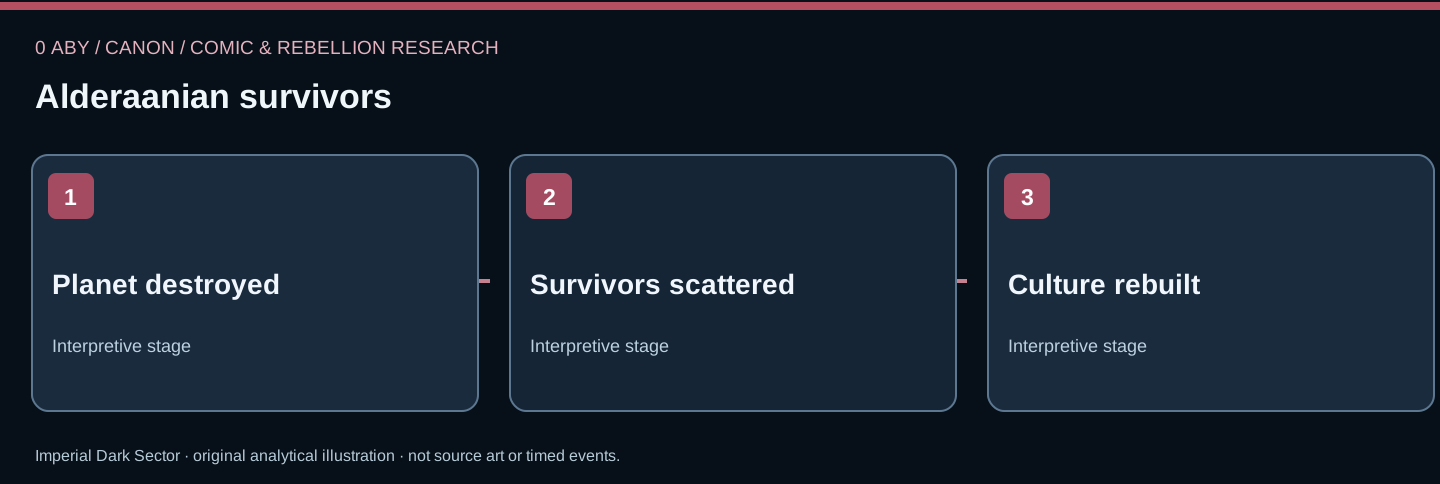
Test the evidence: Did Alderaan's destruction mean every Alderaanian was killed?
Explanation: No. Offworld survivors remained, and Leia sought to reconnect them.
Compare the connected event → · Rebellion comics research guide →
This interpretation uses the printed Marvel / Lucasfilm Canon story and the original publisher, creator or Databank references already identified in the file. Particular issue-panel dialogue and casualty figures still require original-edition checking; editorial observations are not direct quotations.
Sources and boundaries
Primary narrative: Mark Waid (writer), Terry Dodson and Rachel Dodson (art), Star Wars: Princess Leia #1–5 (Marvel, 2015). Publisher context: StarWars.com, “Rescue Missions Go Awry in Princess Leia #5”. Alderaan's destruction is depicted in Star Wars: A New Hope (1977). Additional Lucasfilm corroboration: Nien Nunb Databank (the refugee extraction on Sullust). The comic is a fictional Canon source; the diaspora, political-legitimacy, and kinship discussions are explicitly interpretations. Exact counts, itineraries, and cultural practices are not inferred where the story does not document them.