
Canon · 0–2 ABY · Guided historical research
The Rebellion in Marvel's Canon comics
Follow ten researched articles on how Rebel command, civilian communities, Imperial covert action, Mon Cala shipbuilding, and the consequences of betrayal shaped the years after Yavin.
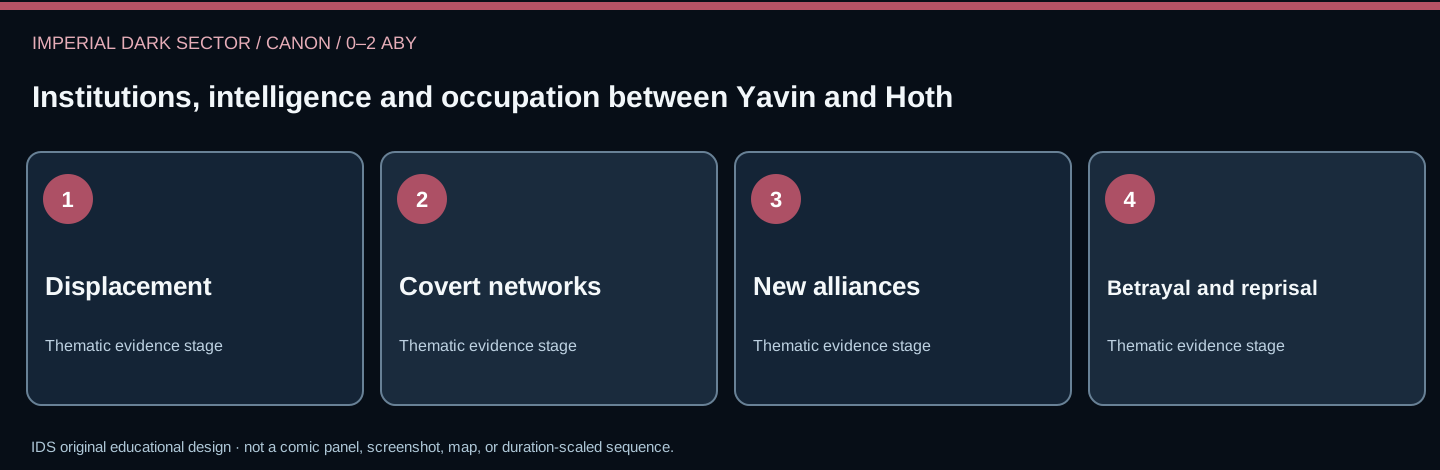
After the Death Star, the Alliance is still exposed
The Battle of Yavin marks a turning point, not the end of the war. As the Rebel base became known, command structures and experienced personnel had to move. Marvel's early Canon comics connect this vulnerable period to an attack on the Imperial factory at Cymoon 1. The contrast is important: the Rebellion could cause a major Imperial loss and still be too weak to hold a famous location permanently. Neither victory nor withdrawal alone describes its institutional capacity.
Leia's search for Alderaanian survivors raises a different kind of continuity problem. A population can remain connected through family, memory and chosen institutions even after its homeworld is destroyed. Leia's inherited public role opens doors but also demands that she listen to the surviving people rather than simply declare their shared future. In this history, evacuation, diaspora and military raids belong near each other without being interchangeable events.
Vader's private search changes the information war
Boba Fett's discovery of Luke Skywalker's name and Vader's recruitment of Doctor Aphra both show why private knowledge could matter alongside fleet operations. Fett's report gave the surviving Sith a personal interpretation of the Rebel pilot's identity. Aphra provided technical expertise, underworld contacts and dangerous droid assistance outside normal Imperial military chains. The two cases should not be flattened into an assumption that every Imperial knew Vader's hidden motives.
Vader Down then brings several networks into direct conflict around Vrogas Vas. Luke, Vader, Aphra and Rebel personnel pursued different objectives while sharing the same battle space. The comics' crossover structure explains why the sequence spans more than one book. Readers must identify issue-level evidence before attributing a specific action to one character or treating the encounter as a single private duel.
Mon Cala changes the Alliance's ability to fight
The Mutiny at Mon Cala arc depicts the importance of existing commercial and technical expertise when Imperial subjects organize resistance. The Alliance gained ships, but equally important were experienced people capable of operating and maintaining them. Those capacities were developed in Mon Calamari society prior to any promise of Rebel military support. The history of Lee-Char's earlier defeat adds political context to the later mutiny.
At Mako-Ta, the resulting Rebel fleet became vulnerable when its concentration and defenses were exploited by the Empire. A newly powerful coalition also had to trust information flowing between its members. This illustrates a persistent dilemma of insurgent institutions: resources must be pooled to coordinate, but assembling them creates targets. The comic does not authorize invented ship casualty totals, so the linked article separates the plot from speculative operational detail.
A campaign and a reprisal remain separate episodes
The collapse of the Mid Rim Offensive involved an extended campaign across multiple systems, not one universally documented battle. War spread opportunities and obligations across supply routes and local communities, and the Alliance could win some engagements while losing strategic access elsewhere. Precise campaign outcomes require specific issue, novel or reference evidence.
Leia's retaliation on Shu-Torun belonged to a later arc after Queen Trios's betrayal. Industrial sabotage can weaken support for an occupier while increasing risk for workers and communities who depend on those systems. An analysis of its ethics must distinguish the comic's actual events from broad claims about the motives of every resident. The linked dossiers keep Mako-Ta's military defeat and the Shu-Torun operation on separate pages.
Follow the linked event files
The Yavin evacuation
Read this dossier →Surviving Alderaanians
Read this dossier →Fett reports Skywalker
Read this dossier →Cymoon One industrial raid
Read this dossier →Vader recruits Aphra
Read this dossier →Vader Down
Read this dossier →Mon Cala mutiny
Read this dossier →Hope Dies at Mako-Ta
Read this dossier →Mid Rim withdrawal
Read this dossier →Shu-Torun retaliation
Read this dossier →Test your historical judgment
Does recruiting experienced Mon Calamari crews mean the Alliance invented their maritime traditions?
Explanation: No. Their existing industrial and naval knowledge was an important contribution to the coalition.
Is the Mid Rim Offensive's collapse the same story as Leia's later Shu-Torun raid?
Explanation: No. They were different campaigns, with different settings and consequences.
Sources and limits
The linked Canon comics and games provide events, while the anthropological analysis examines institutions, inequality, memory, labor and authority. Publication previews and Databank summaries are not substitutes for every panel or optional mission. The research illustrations are original IDS evidence diagrams, not official artwork, documentary scenes or licensed publisher material.
Doctor Aphra — Lucasfilm overview →
Vader Down — Lucasfilm interview →
Mon Cala — interview with Kieron Gillen →
Princess Leia #5 — official comic preview →
Hope Dies — official #50 coverage →
Back to the Age of Rebellion guide → · All timeline articles →