
THE SKYWALKER INTELLIGENCE CHAIN
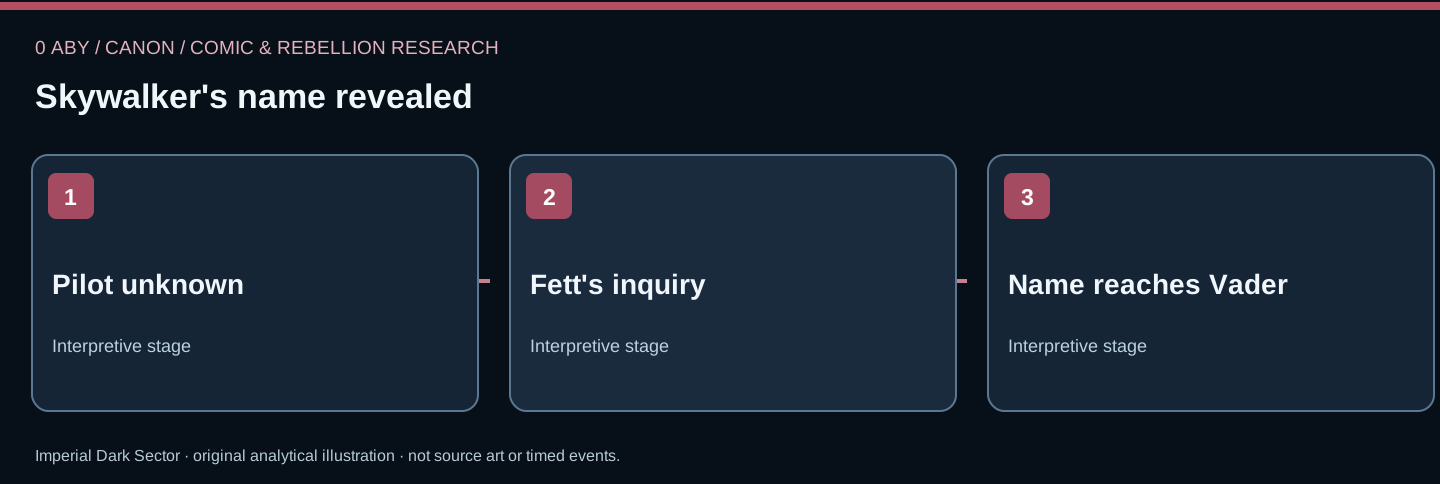
- Unknown pilot: Vader seeks the identity of the Death Star's destroyer
- Field investigation: Boba Fett pursues the Rebel trail
- Information: Fett reports the surname “Skywalker”
- Interpretation: Vader recognizes its personal significance
- Year
- 0 ABY
- Continuity
- Canon
- Location
- Imperial Star Destroyer, after a search on Tatooine
The unknown X-wing pilot attracts attention
Following the Battle of Yavin, Vader seeks the identity of the Rebel pilot who destroyed the first Death Star. Lucasfilm confirms that Vader hired Boba Fett to identify the pilot who destroyed the Death Star. In Marvel's 2015 Star Wars series, Fett investigates a lead connected to Luke Skywalker on Tatooine. Fett's information becomes part of a larger narrative involving Vader's pursuit of the young Rebel, whose connection to the Jedi is already significant.
The distinction between what the comic depicts and what the audience knows is essential. Film viewers know Luke's parentage from the original trilogy, but the story dramatizes the moment when Vader acquires a specific piece of identifying information. This account belongs to the early post-Yavin comic chronology, not the later conversation with Emperor Palpatine in The Empire Strikes Back.
A name changes the Sith Lord's understanding
Boba Fett tells Vader the pilot's name: Skywalker. In the final pages of Star Wars (2015) #6, Vader's reaction turns a brief report into a major revelation. The surname connects the successful Rebel pilot with his own former identity as Anakin Skywalker. It also challenges his assumptions about the fate of the family he believed lost.
Fett does not need to explain Anakin's biography to make the report consequential. Vader supplies the family context himself. The issue's storytelling relies on the difference between a hunter who has discovered a name and a Sith Lord for whom that name carries the weight of personal history.
A private revelation remains hidden
This is not depicted as a public Imperial announcement that Luke is Vader's son. It is an individual report from a hired specialist to a powerful patron. That structure makes the episode an example of intelligence flowing through an informal network rather than through a regular military command briefing.
The wider Marvel Darth Vader (2015) series explores Vader's independent planning and his distrust of the Emperor's manipulation. These developments help explain why Vader treats information about Luke as a personal strategic asset. The comics do not establish a detailed public record of every subsequent Imperial officer who knew Luke's family identity.
Anthropological assessment: kinship and control of information
Kinship concerns socially recognized relationships of family, descent and belonging. A surname is not universal proof of ancestry, but names can carry claims about family history. In this scene, “Skywalker” becomes decisive because Vader interprets it through knowledge of his own past. The report matters through its social meaning, not because a surname alone demonstrates a biological relationship.
Information brokerage describes how people positioned between groups obtain and transfer valuable knowledge. Fett operates outside the ordinary Imperial officer corps, and Vader purchases specialized investigative work. The result illustrates how authoritarian institutions can rely on informal experts even when they possess extensive formal security apparatus.
Secrecy and political authority are related but distinct. Vader has considerable coercive power, yet his knowledge about family and succession is incomplete. The episode therefore reveals a limit of centralized authority: controlling military resources does not mean having complete control over personal histories or intelligence. These are interpretive categories applied to fictional events rather than claims made explicitly by every character.
Interactive evidence lab
Did Vader first hear Luke's surname directly from Palpatine?
No. In the Canon comics Boba Fett reports the name to Vader after investigating.
Compare the narrative, institutional response and social consequences.
Test your historical judgment
Answer both questions for a score, corrections and a brief research takeaway.
Canon · 0 ABY · Connected source analysis
A surname becomes military intelligence and a private threat
Vader knew that a young Rebel pilot had destroyed the Death Star, but identifying him required information gathered outside the initial battle. In the Marvel comics, Boba Fett followed the trail and reported the name Skywalker. Jason Aaron's interview about Star Wars #6 identifies this as a significant Vader moment because the surname connected the military defeat to a private family history Palpatine had not described in those terms.
The exchange demonstrates how intelligence changes meaning depending on who receives it. To a bounty hunter, a name can complete an assignment. To Vader, it calls his prior understanding of Padmé and their child into question. The original comic is a stronger source than a later retelling for the exact conversation, while the historian must not infer that all Imperial officers immediately received the same family information.
Test the evidence: Did Vader already know the Death Star pilot's family name during the Battle of Yavin?
Explanation: No. Fett's later report supplied the surname that carried personal significance.
Compare the connected event → · Rebellion comics research guide →
This interpretation uses the printed Marvel / Lucasfilm Canon story and the original publisher, creator or Databank references already identified in the file. Particular issue-panel dialogue and casualty figures still require original-edition checking; editorial observations are not direct quotations.
Sources and boundaries
Primary story: Jason Aaron and John Cassaday, Star Wars (Marvel, 2015) #5–6, especially the revelation in #6. Related continuity: Kieron Gillen and Salvador Larroca, Darth Vader (2015) #6. Lucasfilm interview: Jason Aaron on the big Darth Vader moment in Star Wars #6. Additional Lucasfilm references: Who Is Boba Fett? and its summary of the corresponding Darth Vader #6 scene. The related Marvel series depict the same name revelation. It is distinct from the later film conversation with Palpatine and from this site's anthropological interpretation.