
COVERT RECRUITMENT · WHO PROVIDES WHAT?
- Vader
- Political power, resources and threats, outside ordinary accountability
- Doctor Aphra
- Recovery skills, technical knowledge, access to dangerous artifacts and droids
- Triple-Zero and BT-1
- Weaponized droid assistance and extreme risks to others
- Year
- 0 ABY
- Continuity
- Canon
- Location
- Imperial-controlled research sites
A Sith Lord acts without his master's full trust
In the 2015 Canon Darth Vader comic series, Vader's position is damaged by the destruction of the first Death Star. Emperor Palpatine tests him and pursues other possible instruments of Imperial power. Vader consequently looks for resources and specialists who can help him act beyond the most visible administrative channels.
This context explains why recruitment matters. The Empire has official armies, procurement systems and officers, yet a powerful individual can still build private networks to serve his own position. Covert operations do not make Vader independent of Palpatine. They show how competition and mistrust can operate within an authoritarian hierarchy.
An archaeologist becomes a dangerous specialist
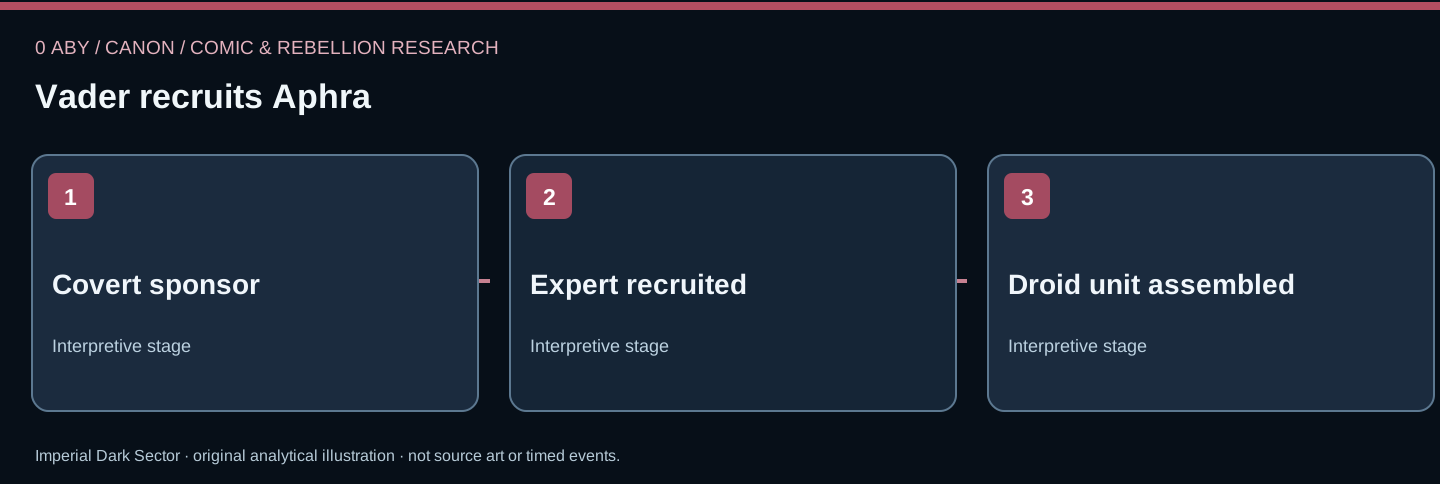
Chelli Lona Aphra studied at the University of Bar'leth and obtained her doctorate under duress, according to the Lucasfilm Databank. Her technical expertise in recovering unusual objects makes her useful to Vader, although she willingly acquires objects through dubious methods. Vader recruits her in Darth Vader (2015) #3. The partnership brings the murderous protocol droid Triple-Zero and the heavily armed astromech BT-1 into Vader's orbit. These characters invert the familiar friendly roles of protocol and astromech droids.
Aphra is not introduced as a formally appointed Imperial admiral or a representative of academic archaeology generally. She is a distinctive fictional individual whose choices mix professional curiosity, self-interest, and survival. Calling her expertise archaeological does not make her conduct ethical or representative of responsible archaeological practice.
An unstable alliance
Aphra gains access to resources and opportunities, but Vader's patronage is dangerous. His authority rests on coercive power, not on an equal employment relationship. If she ceases to be useful or becomes a liability, her position may become untenable. That asymmetry shapes the behavior of a collaborator whose improvisation is useful precisely because it lies outside ordinary procedure.
Later Vader stories expand their activities and eventual conflict. This dossier focuses on the beginning of the partnership in the early post-Yavin period, not the whole chronology of Aphra's subsequent series. The recruitment scene and the later development of the network should not be treated as simultaneous events.
Anthropological assessment: knowledge, patronage and material culture
Material culture concerns the objects people make, exchange, use and assign meaning to. Aphra's knowledge makes artifacts useful to powerful patrons, but an object does not have a single inevitable political purpose. The same expertise that could describe an object's history can also be employed to extract, sell or weaponize it.
Patronage is a relationship in which a powerful figure provides access or protection in exchange for services and loyalty. Vader's arrangement with Aphra offers access while concentrating the power to punish her. It provides a way to analyze the relationship without claiming that every informal Imperial operative worked under identical conditions.
Ethics and provenance are central to real-world archaeology. Recovering an object raises questions about ownership, the communities connected to it, documentation and the effects of removal. Aphra's fictional adventures create a useful contrast between technical skill and ethical responsibility. Her actions should not be mistaken for an account of actual archaeological professional standards.
Interactive evidence lab
Did Aphra meet Vader as a formally appointed Imperial admiral?
No. He recruited a resourceful civilian archaeologist for covert work.
Compare the narrative, institutional response and social consequences.
Test your historical judgment
Choose the strongest supported answers. You will receive a score, individual corrections and an educational takeaway.
Canon · 0 ABY · Connected source analysis
Archaeological expertise becomes a dangerous political resource
Vader's recruitment of Chelli Aphra after the Battle of Yavin is documented in Marvel's Darth Vader comics and Lucasfilm's Doctor Aphra profile. Her value was not formal command of Imperial soldiers but technical knowledge, contacts and a willingness to recover unusual technology. The private droid operation allowed Vader to act outside normal oversight while maintaining a distance between his official role and the work performed by contractors.
This patronage was never an equal bargain. Aphra gained access to money and opportunities, but the threat posed by Vader and her lethal droids constrained her choices. Reading the episode anthropologically means distinguishing expertise from institutional authority: possessing specialized knowledge can make a person valuable without making that person safe. Triple-Zero and BT-1 further show why the acquisition of tools has consequences for people who are not part of the original contract.
Test the evidence: Did Aphra enter Vader's service as a regular officer of the Imperial Navy?
Explanation: No. She was recruited as a covert specialist whose skills supported Vader's private plans.
Compare the connected event → · Rebellion comics research guide →
This interpretation uses the printed Marvel / Lucasfilm Canon story and the original publisher, creator or Databank references already identified in the file. Particular issue-panel dialogue and casualty figures still require original-edition checking; editorial observations are not direct quotations.
Sources and boundaries
Primary narrative: Kieron Gillen and Salvador Larroca, Darth Vader (Marvel, 2015), especially issue #3 for Aphra's introduction and recruitment, and the ensuing opening arc. Lucasfilm character background: Who Is Doctor Aphra? (StarWars.com) and the Doctor Aphra Databank. The story establishes characters and actions; material-culture, patronage and professional-ethics discussions are IDS interpretations. See also the Doctor Aphra character dossier.