
Hero image: Official image of the Home One Mon Calamari capital vessel, illustrating the class of naval capability that later strengthened the Rebellion; not a direct scene of the 1 ABY mutiny. Image and story source →
FROM PLANETARY RESISTANCE TO FLEET POWER
- Imperial domination creates tensions on Mon Cala
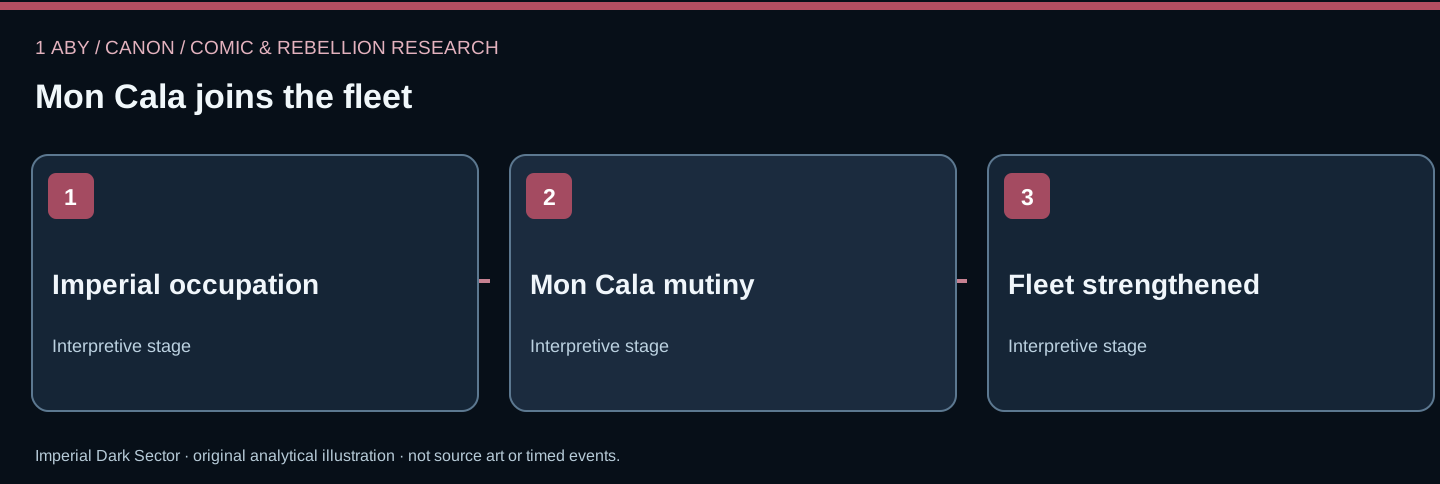
- Leia's mission secures King Lee-Char's appeal, inspiring the mercantile fleet's mutiny
- Existing mercantile ships and their crews strengthen Alliance capital-ship capability
- External support and fleet upgrades raise questions of trust and security
- Year
- 1 ABY
- Continuity
- Canon
- Location
- Mon Cala and Alliance fleet rendezvous
The Alliance needs more than a symbolic victory
The destruction of the first Death Star demonstrated that the Rebel Alliance could inflict a major defeat on the Empire. It did not give the Alliance an equivalent navy. Sustained resistance required large ships, trained crews, maintenance and logistics, and alliances beyond isolated military cells. Mon Calamari-built vessels became an important part of that capacity.
In Marvel's Canon Star Wars (2015) #44–49, the Mutiny at Mon Cala story revisits the Mon Calamari struggle under Imperial domination. It should not be confused with the earlier Imperial occupation of Mon Cala or with the later Battle of Endor. The site's 1 ABY label is an approximate editorial placement within the post-Yavin comic period rather than a day-level date established in the issues.
King Lee-Char, C-3PO and the Mercantile Fleet mutiny
Leia's immediate objective was to gain the Mon Cala Mercantile Fleet: existing ships and their crews, not a fleet of warships newly constructed during the operation. Regent Dors Urtya initially refused to assist the Rebels because he feared Imperial reprisals. Leia pursued a plan to reach imprisoned King Lee-Char and secure a message capable of changing the fleet's loyalties.
In the comics, C-3PO uses language and social expertise during a complicated undercover operation involving an opera-house impersonation. The Rebels reach Lee-Char and record his appeal to his people shortly before Imperial personnel kill him. When that appeal is transmitted to the fleet, its crews mutiny against Imperial control. Political legitimacy and communications prove crucial to an outcome that cannot be explained by ship specifications alone.
The fleet's escape strengthens the Alliance. It does not mean Imperial rule disappears from every part of Mon Cala during this same episode. The mutiny and subsequent full liberation of the planet are distinct historical developments.
Queen Trios and a later security crisis
Queen Trios of Shu-Torun appears to provide helpful technical support to the Alliance. Her connection to Vader, however, makes that assistance a source of vulnerability. The Hope Dies storyline, beginning with Star Wars (2015) #50, dramatizes the devastating consequences of compromised fleet preparations at Mako-Ta.
Chronology matters here. Gaining Mon Calamari vessels and the subsequent Imperial ambush are connected developments, but not one instantaneous event. The betrayal is introduced here as a forward connection; it receives its own timeline dossier. The page should not credit the Mon Calamari themselves with Trios's covert actions.
Anthropological assessment: sovereignty and technical dependence
Sovereignty and political consent. Naval alliances require agreements among groups with distinct histories and goals. Mon Cala's experience under occupation makes control of local ships and institutions a political question, not only a matter of ship tonnage. Treating all members of a species as automatic allies would erase internal differences.
Labor and material infrastructure. A capital ship requires design knowledge, shipyard production, maintenance, crews and supply networks. Military capability therefore depends on social institutions and expertise as much as heroic combat. The comics do not document every worker's status, so claims about specific universal labor conditions would exceed the available evidence.
Trust and security. Fleet upgrades can create dependence on contractors, suppliers and political intermediaries. The Trios storyline provides an example of how hidden loyalties may undermine otherwise valuable assistance. This is an interpretation of fictional relationships, not an assertion that all outside assistance is inherently disloyal.
Interactive evidence lab
Were Mon Calamari cruisers produced spontaneously when the Death Star exploded?
No. Their incorporation required later political and military work.
Compare the narrative, institutional response and social consequences.
Test your historical judgment
Select the strongest supported answers to receive a score and explanations.
Canon · 1 ABY · Connected source analysis
Naval liberation depends on a society's existing skills
The Rebel Alliance's gain at Mon Cala was more than a successful recruitment speech by Leia. Kieron Gillen's Mutiny at Mon Cala storyline builds on the earlier Imperial subjugation of King Lee-Char and on the political choices of Mon Calamari crews. Their mercantile vessels and technical traditions gave the Alliance capabilities it lacked, but these resources entered the war through specific acts of resistance under considerable Imperial pressure.
A capital ship's later fame can obscure the expertise of the society that designed and operated it. Technicians, navigators and crews brought skills and institutional memory into the Alliance alongside physical hulls. The political situation should not be simplified as the entire planet or every Mon Calamari immediately joining one faction. The original story distinguishes imprisoned leadership, mutiny and the later strengthening of the Rebel fleet.
Test the evidence: Did the Rebel Alliance invent Mon Calamari shipbuilding when it needed capital ships?
Explanation: No. It drew upon ships and skills already developed by Mon Calamari society.
Compare the connected event → · Rebellion comics research guide →
This interpretation uses the printed Marvel / Lucasfilm Canon story and the original publisher, creator or Databank references already identified in the file. Particular issue-panel dialogue and casualty figures still require original-edition checking; editorial observations are not direct quotations.
Sources and boundaries
Primary Canon account: Kieron Gillen and Salvador Larroca, Star Wars (Marvel, 2015) #44–49, “The Mutiny at Mon Cala.” Marvel's official collection synopsis confirms the operation and C-3PO's opera-house role. Lucasfilm's interview with Gillen confirms the story's connection to the formation of the Rebel fleet. Later continuity: Star Wars #50 onward, “Hope Dies.” Lucasfilm discussion: Marvel's Star Wars #50: Hope Dies (StarWars.com). Political interpretation and infrastructure analysis are IDS commentary, not verbatim claims from the comics. Exact dating and participation totals should not be inferred without primary evidence.