
Hero image: Marvel's The Scourging of Shu-Torun collected-edition cover, used to identify the story rather than claiming an event still. Image and story source →
The cost of retaliatory sabotage
Which publisher arc contains the raid on Shu-Torun?
Distinguish source evidence from interpretation and exact dating.
- Year
- c. 2 ABY
- Continuity
- Canon
- Setting
- Shu-Torun
A strategic response to Mako-Ta
After Queen Trios's deception caused devastating Rebel fleet losses, Leia sought to weaken the Imperial industrial economy that supported the enemy navy. She assembled a small team including Luke, Han, the performer Tunga, the slicer Meorti and survivors of Saw Gerrera's partisans.
The planet's energy architecture
Shu-Torun depended on the Spike, an enormous complex channeling planetary energy. Leia's plan targeted key components to prevent the Empire from exploiting that infrastructure. She wanted a blow against Imperial production without mass civilian casualties.
An ally wants to destroy the entire world
Benthic's partisan fighters had a more extreme idea. Their own losses and hatred of Imperial rule led them to attempt a wider catastrophe that could kill countless residents of Shu-Torun. The episode forced the rebel team to confront the difference between military sabotage and vengeance against a civilian population.
Anthropological assessment
Shu-Torun illustrates disagreement within the rebellion over legitimate targets. Strategic infrastructure can be attacked without treating everyone who lives near it as collectively guilty for the decisions of an Imperial collaborator.
Interactive history lab
Did Leia originally plan to exterminate Shu-Torun's whole civilian population?
No. Her mission aimed to disable Imperial infrastructure; Benthic's plan created the greater danger.
Choose a lens and see how the interpretation changes.
The cost of retaliatory sabotage
The Marvel storyline The Scourging of Shu-Torun collects Star Wars (2015) #62–67. Leia acts against Queen Trios after the betrayal at Mako-Ta. Marvel's issue summaries identify Leia's team, Benthic's Partisans, the royal palace and the industrial structure called the Spike. The plot therefore includes different rebel actors whose immediate aims and acceptable risks are not identical.
The story permits a focused discussion of limits on retaliation. A royal regime's support for Imperial military production does not establish that every resident supports its ruler. Damaging infrastructure may harm those with little power over the war. Marvel's own descriptions ask whether an operation could threaten the planet itself; this is a moral and political conflict within the plot, not evidence of a documented real-world casualty total.
Publication and date note: The article's year is a chronology placement, not a verified calendar day. Film, comics, book and game release dates are not in-universe event dates. Consult Marvel's The Scourging of Shu-Torun collection for the originating evidence.
Test your historical judgment
Select an answer for each question. The final score explains both corrections and the key historical distinction.
Canon · 2 ABY · Connected source analysis
Retaliation against infrastructure is a political choice
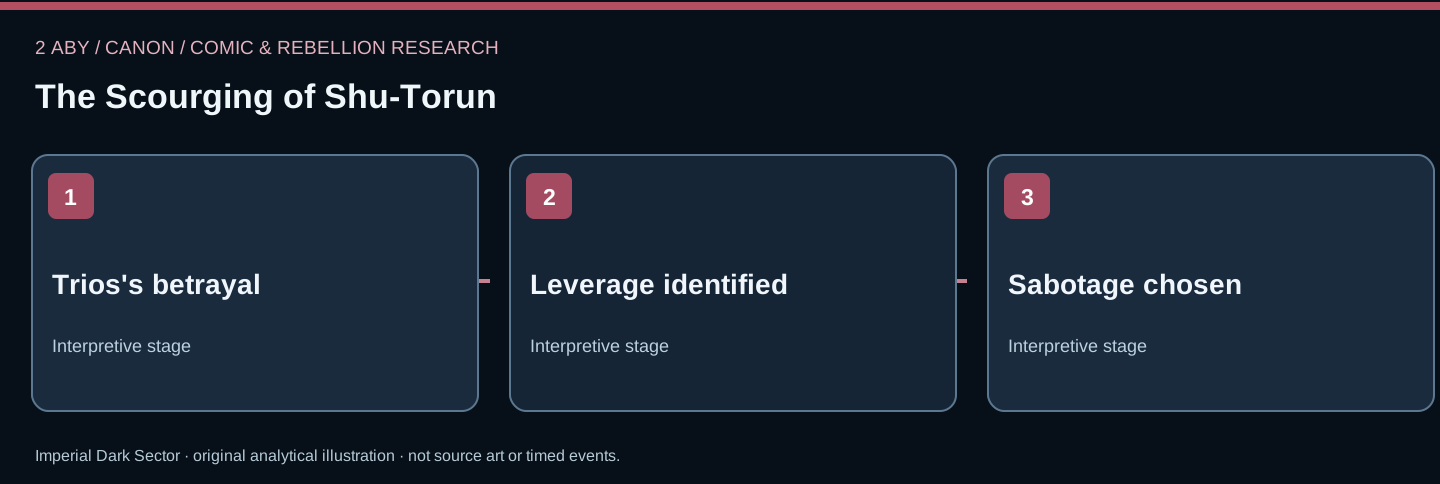
After Queen Trios helped expose Rebel forces, Leia led a campaign of sabotage against Shu-Torun's production and logistical system. Marvel's collected Scourging of Shu-Torun storyline connects this decision to the earlier disaster at Mako-Ta, but it is a separate arc with its own ethical problems. The objective was to damage the support supplied to Imperial power, not to retell the prior space battle.
Shu-Torun's mining economy created leverage because infrastructure necessary to the Empire also supported workers and residents. Historical analysis must ask who is exposed when a government and its economic systems are targeted in reprisal. The comic supplies the participants and narrative sequence. It does not by itself justify imagining every civilian's response or inventing a numeric assessment of the raid's social cost. The graphic distinguishes betrayal, strategy and effects rather than representing the mining system as an exact map.
Test the evidence: Was the Scourging simply another name for the earlier fleet battle at Mako-Ta?
Explanation: No. It was a later retaliatory operation on Shu-Torun following that betrayal.
Compare the connected event → · Rebellion comics research guide →
This interpretation uses the printed Marvel / Lucasfilm Canon story and the original publisher, creator or Databank references already identified in the file. Particular issue-panel dialogue and casualty figures still require original-edition checking; editorial observations are not direct quotations.
Sources and continuity
Kieron Gillen, Star Wars (2015) #62–67, The Scourging of Shu-Torun. View relevant source material →. The exact internal order of events in a single year is not always established; the article presents a coherent reading path rather than inventing precise dates.