

- Year
- 5 BBY
- Continuity
- Canon
- World
- Rix Road, Ferrix
Dating and evidence: Dates are drawn from Canon stories and official references. Older and younger episodes within the same numbered year need not occur in the precise sequence suggested by listing order; source continuity governs. Images of later character appearances are identified.
A community prepares to honor one of its own
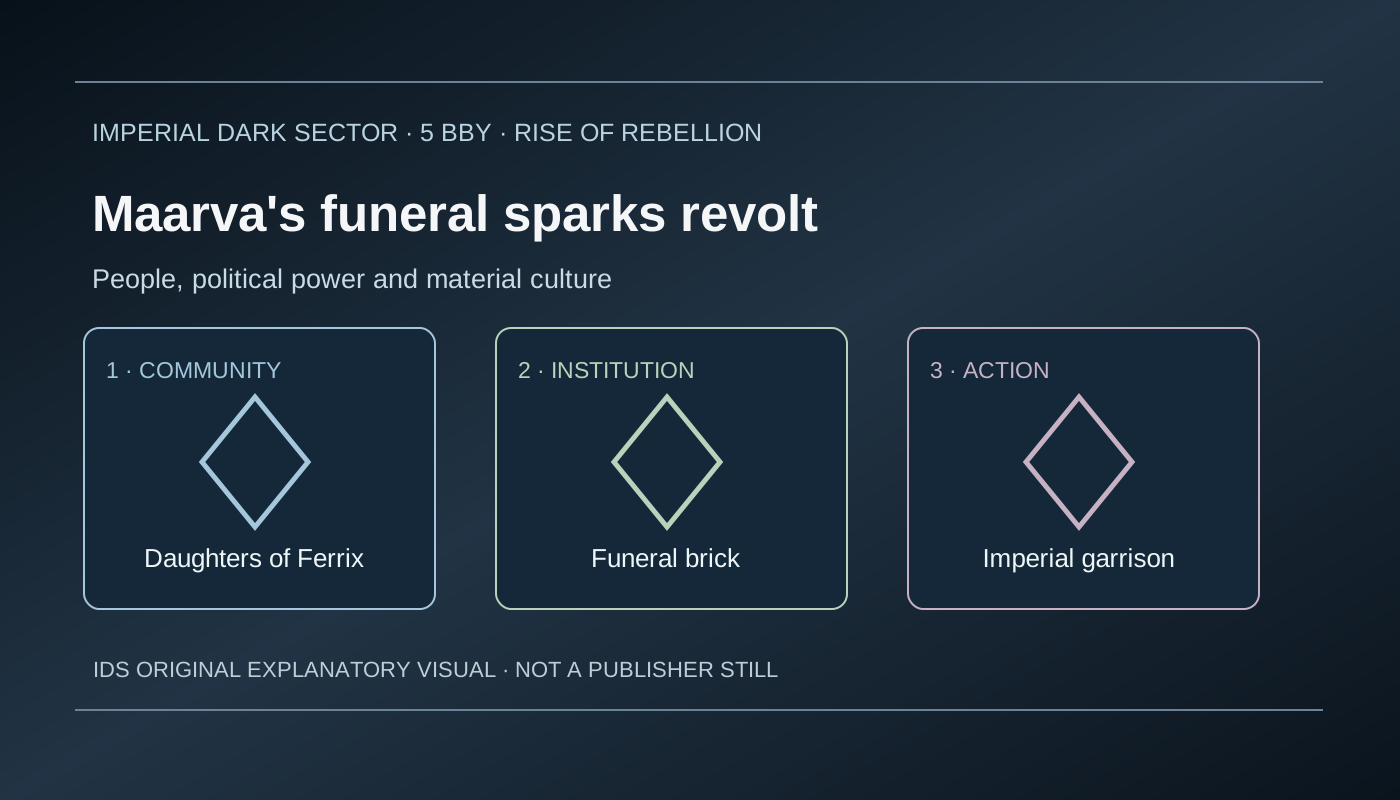
Maarva Andor died after months of illness and growing opposition to Imperial occupation. The Daughters of Ferrix organized the funeral procession in accordance with local traditions, including the custom of making a brick from a deceased person's remains.
A speech carried into the streets
B2EMO played Maarva's final recording during the procession. She urged the gathered people to oppose the Empire rather than remain passive. Imperial officers attempted to interrupt the message, provoking anger among mourners.
Riot, rescue and departure
Brasso used Maarva's funerary brick against Imperial troops, and Wilmon Paak threw an explosive device. In the resulting confrontation Cassian rescued the imprisoned Bix Caleen and helped friends leave the planet.
Anthropological assessment
Ferrix offers a rare study of funeral ritual becoming public action. The procession was not originally a military march, but collective mourning created an organized gathering whose shared emotions could become a challenge to political authority.
Interactive history lab
Did the funerary brick represent an anonymous weapon rather than a local memorial custom?
It was made from Maarva's remains as part of Ferrix tradition, and was later used during the riot.
Select a research lens to compare the story's historical, institutional, and cultural significance.
Sources and continuity
Andor, Rix Road; StarWars.com episode guide. Source and chronological background →.
Canon · 5 BBY · Emerging resistance
Maarva's funeral sparks revolt: narrative and historical method
What the source tells us
The Daughters of Ferrix organized Maarva Andor's funeral procession in a town with traditions surrounding the dead, including making a commemorative brick from a person's remains. Imperial authorities restricted the ceremony while suspecting it could attract opponents. Maarva's recorded address urged her neighbors to resist; Brasso later used her funeral brick against an Imperial officer as the crowd rose up.
Anthropological interpretation
Funeral practice gave the community a recognized reason to assemble in public despite surveillance. Material culture—the memorial brick, instruments and recorded voice—made memory available as collective action. The state's attempts to control a rite of mourning demonstrated why ordinary customs could become politically charged under occupation.
Source and chronology distinction
This event occurs in the 5 BBY Canon chronology. The original television shows premiered much later in the real world. Andor season-one episodes and the early Rebels story follow separate resistance groups with different leadership; treat local traditions as distinct from the later unified alliance.
Test your historical judgment
Both questions include scoring, corrections and a source explanation.