
01 · Orientation
World overview
Ferrix is a working industrial community built around salvage, repair, trade, craft knowledge, neighborhood obligation, and strong local customs, making it one of Star Wars' clearest portraits of everyday life under expanding Imperial control. IDS treats Ferrix as a lived world rather than background scenery. Its location in Outer Rim, its classification as Industrial salvage world, and its association with Workers, mechanics, traders and families create a social setting shaped by geography, institutions, mobility, and historical change. The purpose of the file is to connect those conditions instead of reducing the planet to a single battle, character, or visual landmark.
02 · Environment
Landscape, climate, and adaptation
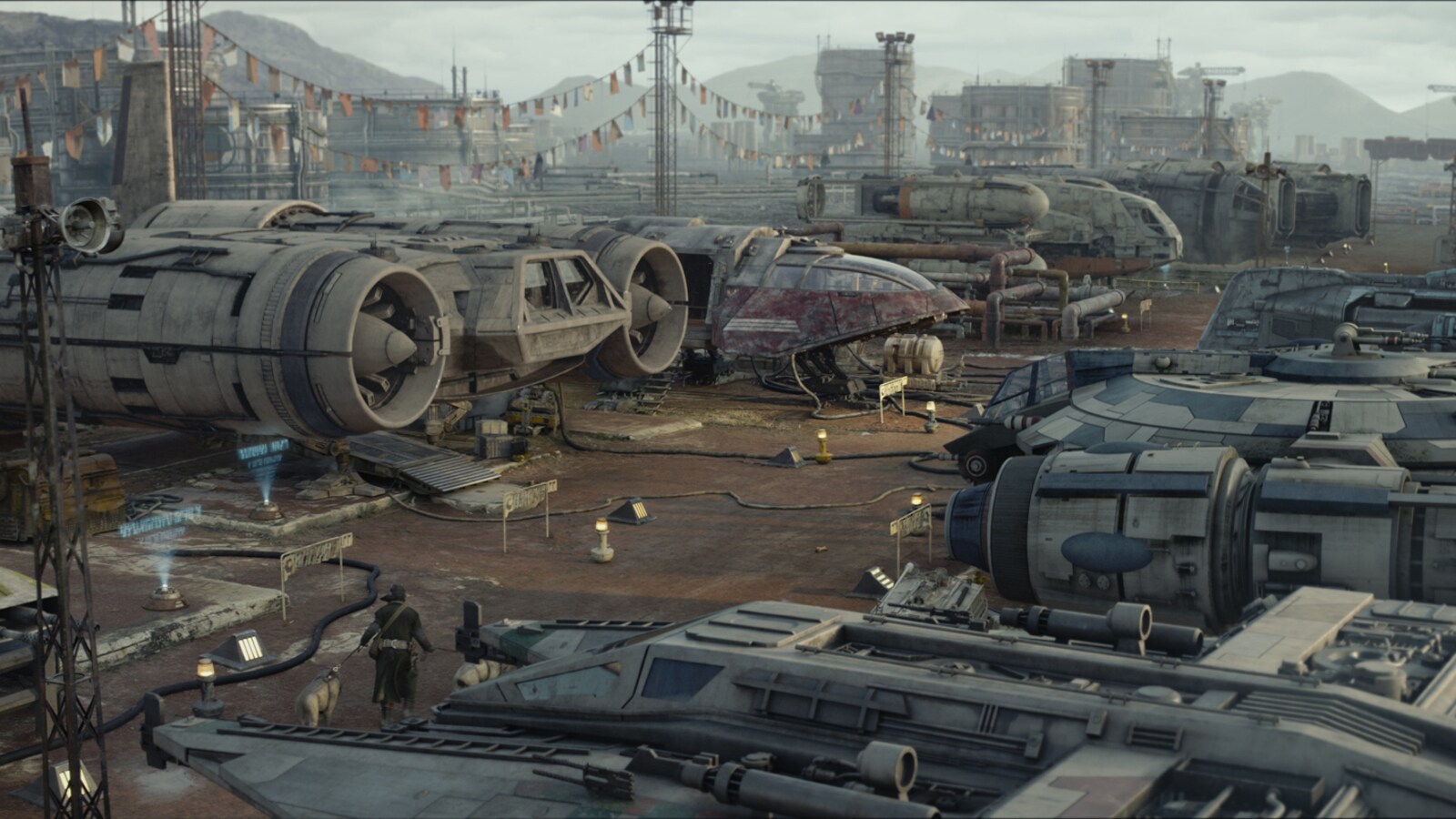
Ferrix sits along important hyperspace routes and supports salvage yards, workshops, warehouses, streets, and industrial spaces. The built environment reflects repair and reuse rather than elite monumental architecture. Quick Facts identifies the climate as Temperate and dry and the terrain as Plains, dense settlements and salvage yards. Those environmental conditions affect where settlements can develop, how people travel, what resources become politically important, and which forms of infrastructure are practical. Environment does not mechanically determine culture, but it places real constraints on labor, architecture, transportation, defense, and everyday life.
03 · Built environment
Settlement, architecture, and infrastructure
Ferrix is a dense working town shaped by salvage, fabrication, workshops, brick structures, narrow streets, communal gathering points, and reused industrial spaces. Homes and workplaces sit close together, making neighbors highly visible to one another. That physical density supports solidarity as well as surveillance. When Imperial personnel occupy buildings and streets, the community feels the intrusion immediately because political authority enters spaces previously organized around work, family, funeral practice, and local routine.
04 · Society
People, community, and everyday life
Community life is organized through work, family, friendship, trade, neighborhood reputation, and distinctive funeral traditions. The use of funerary bricks physically incorporates the dead into the settlement, turning memory into part of the town's material landscape. The communities most closely associated with this file are Workers, mechanics, traders and families. The IDS focus is labor, community solidarity, resistance, which means the planet is read through differences in institution, class, occupation, migration, and political experience rather than as a single unified culture. A world can contain neighboring populations with distinct languages, religions, histories, and relationships to state power.
05 · Economy & labor
Resources, work, and political economy
Ferrix depends on salvage, repair, industrial craft, transport, parts trading, contracting, and other forms of skilled manual labor. Workers know how to disassemble, reuse, and value complex machinery, giving technical knowledge social importance. Employment is embedded in relationships rather than anonymous markets alone. Imperial and corporate security interventions threaten those networks because arrests, searches, and occupation disrupt the trust and movement on which work depends. Economic life therefore becomes part of the town’s political resistance.
06 · Religion & worldview
Sacred landscape, belief, and moral order
Ferrix has one of the galaxy's clearest local funerary traditions. The dead are cremated and incorporated into funerary bricks that remain physically part of the settlement. Canon does not fully explain the theology behind the practice, but memory, ancestry, and material belonging are central. Religion and worldview are treated as parts of social life rather than decorative lore. Sacred places, collective memory, ritual, moral authority, and relationships to land can influence how communities understand belonging and legitimate power. Where canon documents no shared planetary religion, IDS keeps that absence visible instead of inventing a uniform belief system for everyone living on the world.
07 · Institutions
Government, authority, and power
Before direct Imperial control, corporate security forces exercised authority in the area. Their failure brought the Empire more deeply into Ferrix, replacing distant administration with occupation, surveillance, interrogation, and military force. The major eras associated with Ferrix are Empire. Political authority can therefore change as governments, militaries, occupations, local elites, resistance movements, or outside institutions gain and lose control. The archive uses labor, community solidarity, resistance to ask who can make decisions, who bears the costs of those decisions, and how planetary institutions connect local communities to larger galactic systems.
08 · Mobility
Movement, travel, and connection
Ferrix is connected to offworld transport through yards, freight activity, and visiting ships, but everyday life is intensely local. Streets, work sites, homes, and community institutions are close enough that information travels quickly by observation, bells, signals, and word of mouth. Cassian Andor uses galactic mobility more than many residents, allowing him to move between local obligations and distant conflicts. Imperial checkpoints and searches attempt to turn that open social circulation into something more controlled.
09 · Conflict & security
War, policing, occupation, and defense
Conflict on Ferrix escalates through policing before it becomes rebellion. Corporate security arrives to enforce authority, the Empire replaces it with a more powerful occupation, and residents experience searches, surveillance, executions, detention, and the conversion of local buildings into command infrastructure. Maarva’s funeral transforms mourning into collective defiance because the Empire tries to regulate a community ritual it does not understand. Security failure follows from treating local solidarity as a problem that can be solved only through more coercion.
10 · Points of interest
Places that make Ferrix legible
Places inside Ferrix make large planetary histories concrete. Cities, temples, factories, homes, bases, ruins, and landscapes show where institutions actually operate and where people work, worship, govern, travel, fight, remember, and build community. IDS treats these locations as evidence of social life rather than as a sightseeing checklist. Each point is included because it helps explain how geography, political authority, material culture, religion, or historical change becomes visible on the ground.
Rix Road
Rix Road became a stage for labor, funeral ritual, protest, surveillance, and uprising. Its significance comes from repeated community use rather than from formal government status.
Hotel and Imperial headquarters
The Empire’s conversion of a local hotel into a command center shows how occupation can appropriate ordinary civic infrastructure and make coercive authority physically present in community life.
Ferrix salvage yards
Salvage, repair, and industrial reuse anchor Ferrix’s working-class economy. These workplaces explain why mutual aid, craft knowledge, and labor solidarity are central to local identity.
11 · Change over time
Historical significance
Cassian Andor's life is deeply tied to Ferrix and its people. A corporate attempt to arrest him escalated into Imperial intervention. Later, Maarva Andor's funeral became a moment when local grief, memory, and anger turned into open resistance. The principal appearances listed for Ferrix are Andor. Those stories capture particular moments rather than the complete history of the world. IDS reads wars, occupations, migrations, regime changes, reconstruction, and institutional continuity as processes that reshape social life over time. Historical significance therefore comes from what changes for communities, not only from whether a famous event happened there.
12 · IDS lens
What this world reveals
Ferrix is ideal for studying community care and labor politics. Resistance emerges from ordinary social relationships and shared obligations, not simply from formal membership in a rebel organization. The archive emphasis for Ferrix is labor, community solidarity, resistance. That focus is useful because it connects geography to social organization instead of treating the world as scenery. IDS asks how people experience institutions differently depending on class, community, mobility, political status, access to resources, and historical circumstance, and how those differences become visible in the built and natural environment.
13 · Sources & continuity
Official primary source
The factual baseline for this Ferrix file comes from official Star Wars reference material and the canon appearances listed in Quick Facts. IDS uses those sources for names, geography, political events, communities, and chronology, while the surrounding discussion of institutions, religion, settlement, labor, and social change is independently written analysis. Some aspects of everyday life on this world remain undocumented in current Canon.