
01 · Orientation
World overview
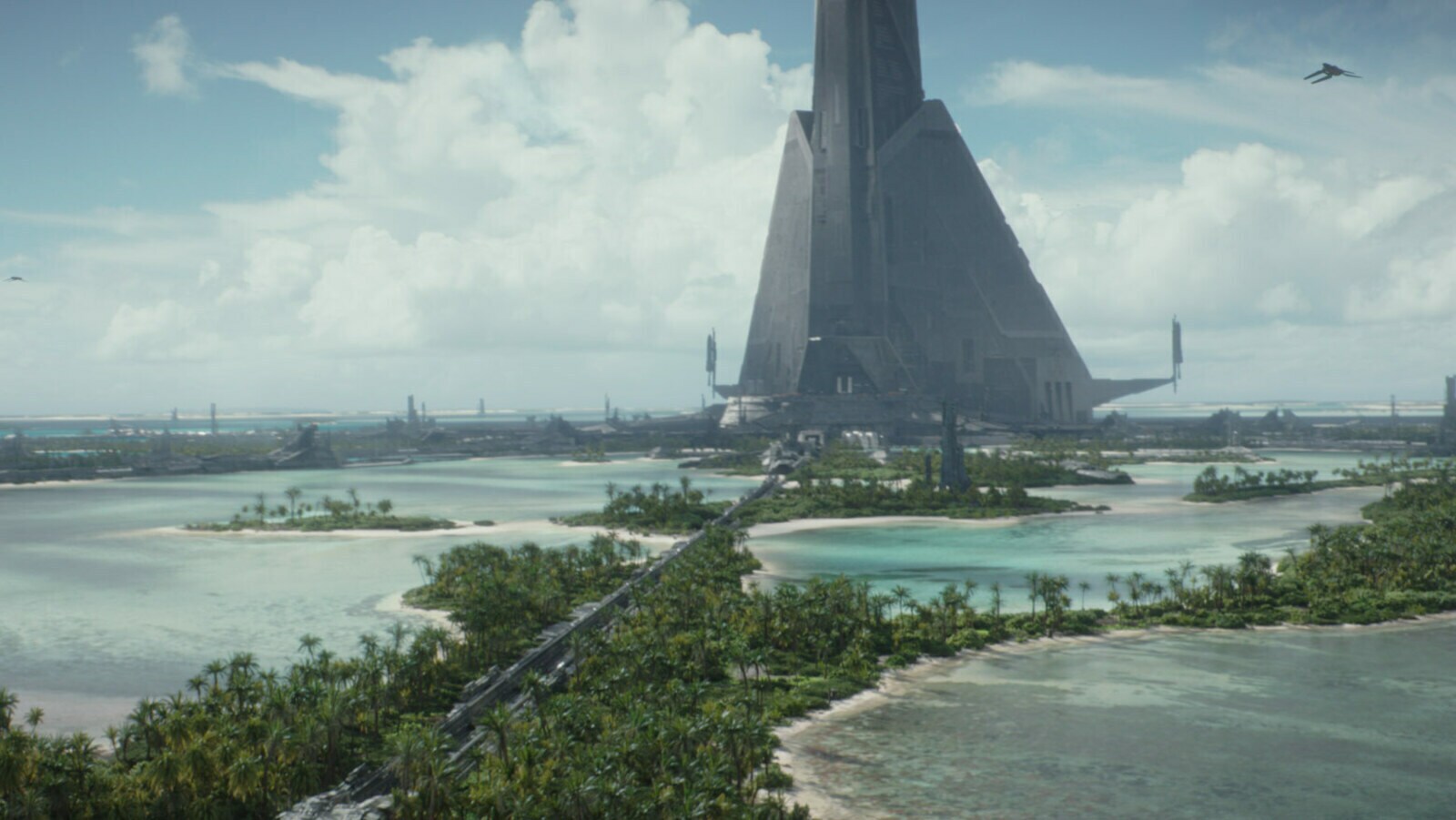
Scarif combines a tropical island environment with one of the Empire's most secure military and archival complexes, showing how information control can be protected as aggressively as weapons or territory. IDS treats Scarif as a lived world rather than background scenery. Its location in Outer Rim, its classification as Tropical Imperial security world, and its association with Imperial personnel and temporary workers create a social setting shaped by geography, institutions, mobility, and historical change. The purpose of the file is to connect those conditions instead of reducing the planet to a single battle, character, or visual landmark.
02 · Environment
Landscape, climate, and adaptation
Warm seas, beaches, palms, islands, and shallow coastal zones would make Scarif appear idyllic without the military infrastructure. Imperial towers, landing areas, garrisons, data facilities, and a planetary shield transform the environment into a controlled security zone. Quick Facts identifies the climate as Tropical and the terrain as Oceans, islands, beaches and military installations. Those environmental conditions affect where settlements can develop, how people travel, what resources become politically important, and which forms of infrastructure are practical. Environment does not mechanically determine culture, but it places real constraints on labor, architecture, transportation, defense, and everyday life.
03 · Built environment
Settlement, architecture, and infrastructure
Scarif combines tropical geography with highly controlled Imperial infrastructure. Citadel Tower, data vaults, landing pads, garrisons, communications systems, and the orbital shield gate transform an otherwise striking environment into a restricted administrative and military complex. Beaches and lagoons are visually open, but access is tightly managed. The contrast reinforces Imperial secrecy: the planet appears spacious while movement, information, and entry are concentrated through a small number of hardened institutional chokepoints.
04 · Society
People, community, and everyday life
Scarif is less a conventional civilian society than an institutional world populated by soldiers, officers, technicians, archivists, and support staff. Access is structured by clearance, assignment, and military purpose. The communities most closely associated with this file are Imperial personnel and temporary workers. The IDS focus is archives, secrecy, militarization, which means the planet is read through differences in institution, class, occupation, migration, and political experience rather than as a single unified culture. A world can contain neighboring populations with distinct languages, religions, histories, and relationships to state power.
05 · Economy & labor
Resources, work, and political economy
Scarif’s primary function is not a diversified civilian economy but the storage, administration, development, and protection of Imperial military research. Clerks, technicians, officers, data specialists, security personnel, pilots, and support workers sustain an information infrastructure whose value comes from secrecy. Resources flow toward classified state projects rather than local public needs. The world demonstrates that archives and research facilities are productive institutions: information management can be as strategically valuable as manufacturing physical weapons.
06 · Religion & worldview
Sacred landscape, belief, and moral order
Scarif is presented primarily as an Imperial institutional and military world, not a sacred center. Religious life is largely absent from the surviving depiction, which itself reflects how completely the site is organized around security, archives, research, and restricted access. Religion and worldview are treated as parts of social life rather than decorative lore. Sacred places, collective memory, ritual, moral authority, and relationships to land can influence how communities understand belonging and legitimate power. Where canon documents no shared planetary religion, IDS keeps that absence visible instead of inventing a uniform belief system for everyone living on the world.
07 · Institutions
Government, authority, and power
The Empire used layered security to protect sensitive research and records. The planetary shield, gate, troops, fleet support, and archive all demonstrate a state treating information as strategic infrastructure. The major eras associated with Scarif are Empire, Age of Rebellion. Political authority can therefore change as governments, militaries, occupations, local elites, resistance movements, or outside institutions gain and lose control. The archive uses archives, secrecy, militarization to ask who can make decisions, who bears the costs of those decisions, and how planetary institutions connect local communities to larger galactic systems.
08 · Mobility
Movement, travel, and connection
The planetary shield and gate make movement to Scarif unusually centralized. Ships cannot simply arrive wherever they choose; access is authenticated and routed through Imperial control. On the surface, landing zones, transports, and restricted facilities further channel movement. The Rebel assault succeeds only by penetrating these systems and opening communication long enough to transmit the Death Star plans. Mobility and information become inseparable because escaping with knowledge is more important than holding the planet.
09 · Conflict & security
War, policing, occupation, and defense
The Battle of Scarif is a raid on an archive rather than a campaign for territorial conquest. Rebel forces accept catastrophic losses to obtain and transmit information that can make future resistance possible. Imperial security relies on layered access control, garrison forces, orbital infrastructure, and secrecy, but the system has vulnerabilities once attackers reach the interior. The destruction of the facility by the Death Star also shows how authoritarian states may erase their own personnel and infrastructure to contain a security breach.
10 · Points of interest
Places that make Scarif legible
Places inside Scarif make large planetary histories concrete. Cities, temples, factories, homes, bases, ruins, and landscapes show where institutions actually operate and where people work, worship, govern, travel, fight, remember, and build community. IDS treats these locations as evidence of social life rather than as a sightseeing checklist. Each point is included because it helps explain how geography, political authority, material culture, religion, or historical change becomes visible on the ground.
Citadel Tower
The tower stored Imperial records and Death Star plans, showing how information management, bureaucracy, and physical security can be as strategically important as weapons themselves.
Planetary shield gate
Scarif’s shield gate controlled access to the entire world, turning orbital infrastructure into a tool for secrecy, movement control, and defense of Imperial research and archives.
Imperial data vault
The data vault concentrated classified technical information in a highly controlled environment. The Rebel raid demonstrates how archives become contested political resources when states monopolize knowledge.
11 · Change over time
Historical significance
The Death Star plans were stored on Scarif. Rogue One infiltrated the facility and transmitted the plans to the Rebel fleet, making the world central to the events immediately preceding the destruction of the first Death Star. The principal appearances listed for Scarif are Rogue One. Those stories capture particular moments rather than the complete history of the world. IDS reads wars, occupations, migrations, regime changes, reconstruction, and institutional continuity as processes that reshape social life over time. Historical significance therefore comes from what changes for communities, not only from whether a famous event happened there.
12 · IDS lens
What this world reveals
Scarif highlights archives as political institutions. Records can be weapons because controlling information determines who can understand, challenge, or reproduce a system of power. The archive emphasis for Scarif is archives, secrecy, militarization. That focus is useful because it connects geography to social organization instead of treating the world as scenery. IDS asks how people experience institutions differently depending on class, community, mobility, political status, access to resources, and historical circumstance, and how those differences become visible in the built and natural environment.
13 · Sources & continuity
Official primary source
The factual baseline for this Scarif file comes from official Star Wars reference material and the canon appearances listed in Quick Facts. IDS uses those sources for names, geography, political events, communities, and chronology, while the surrounding discussion of institutions, religion, settlement, labor, and social change is independently written analysis. Some aspects of everyday life on this world remain undocumented in current Canon.