
GALACTIC WAR · 3640 BBY · LEGENDS
Darth Malgus declares a New Empire
The rogue Sith's revolt creates an unexpected common enemy for Republic and Empire alike.
← Full chronology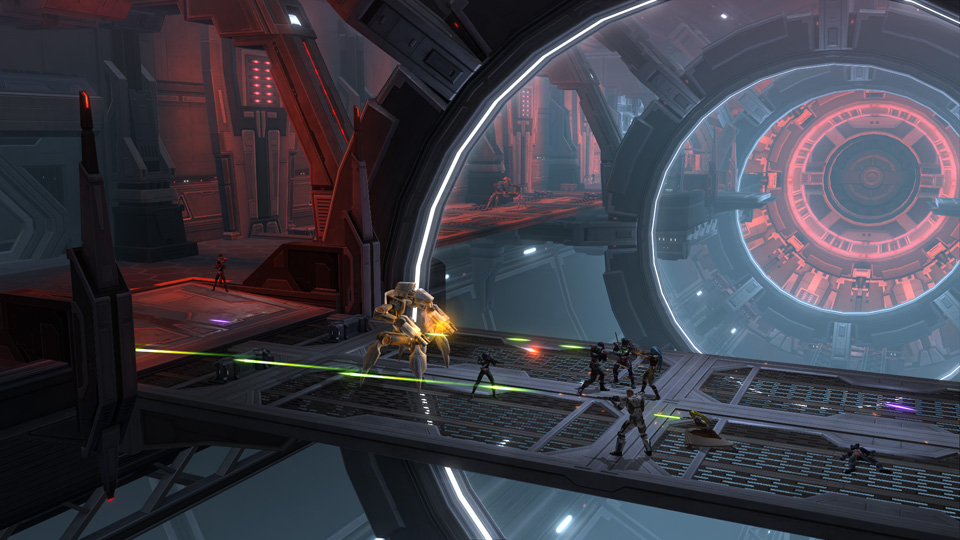
Continuity and method: Star Wars Legends, c. 3640 BBY. The title refers to Malgus's political claim, not a new constitutional charter shown on screen. The anthropological assessments are editorial interpretations of published game material.
Malgus rejects the Sith Empire he helped expand
Darth Malgus had served as a powerful military commander during the Great Galactic War and the conflict that followed. His reputation rested on bold assaults, battlefield discipline and an unwillingness to defer to what he regarded as ineffective political leaders. As the Sith Empire suffered military reversals, Malgus grew more openly hostile to the Dark Council and its competing ambitions. His claim that the Empire needed strength was not simply a call for another offensive. He proposed a different authority structure led by himself and prepared to fight former colleagues to make it real.
The new Empire and a contested vision of inclusion
Malgus's breakaway faction sought to recruit groups and species that the older Sith hierarchy had often marginalized. This aspect of his political program distinguished him from some Imperial traditionalists, but it did not turn him into a democratic ruler. He still intended to govern through military force and personal domination. A more inclusive army can coexist with an authoritarian government. The central question for the historian is whether expanded participation changes the underlying distribution of power, not whether a leader uses language of merit and strength.
Technological ambition and secret preparations
Malgus commandeered an Imperial battlestation and assembled a powerful force capable of threatening both the Sith Empire and the Republic. Experimental warships and advanced military production were central to his plans. He exploited knowledge of Imperial equipment and decision-making that he had obtained during legitimate service. This illustrates the danger created when an elite commander defects with access to the state's own networks. The conflict was not fought between two wholly separate technological cultures; it was an internal rebellion whose leader knew the institutions he intended to defeat.
Ilum becomes the focus of the offensive
Ilum had longstanding significance as a source of lightsaber crystals and as a theater of Republic–Imperial fighting. Malgus's new forces intervened while the two established sides were contesting the planet. His fleet struck at weakened combatants rather than limiting the attack to the Sith officers who had rejected his claim. The official SWTOR Battle of Ilum description identifies the new Empire as a threat to both the Republic and the Empire. This is important because it explains why soldiers from opposed governments could be sent against the same rogue Sith leader.
The two rival states respond
Republic and Imperial commanders each recognized that a victorious Malgus might destroy their ability to act independently. They sent skilled forces to attack the breakaway military, seize opportunities within its fleet and trace its battlestation. This was an alliance of immediate interests, not evidence that the wider Galactic War was over. On Ilum, the tactical problem involved fighting an enemy equipped with familiar Imperial technology while protecting forces already damaged by prolonged conflict. The operations were a struggle over military continuity as much as an ideological contest over Sith leadership.
The Battle of Ilum and its aftermath
During the Battle of Ilum, strike teams fought through Malgus's troops and gained the means to reach his orbital stronghold. The official flashpoint narrative describes the use of a captured or commandeered vessel to approach the battlestation. Malgus's initial setback did not end the uprising because his station remained capable of supporting further operations. The campaign therefore moved from a contested planet to a concentrated attack against the command center of the new Empire. This chronology distinguishes the land and fleet fighting at Ilum from the subsequent assault called The False Emperor.
The assault on the stolen battlestation
In The False Emperor flashpoint, elite combatants boarded Malgus's stolen station to confront its defenders. They faced droids, soldiers and other loyal units before reaching the rogue commander. The battlestation's corridors, automated weapons and defensive design showed the physical scale of the infrastructure he had taken over. The mission sought to stop the new Empire's expanding offensive, not to replace the entire Galactic Republic with a Sith administration. Once Malgus was defeated, his immediate attempted takeover collapsed, although later SWTOR material established that the character's history had not ended permanently.

Why Malgus's defeat did not end the war
The destruction of the rebellion removed a competing Imperial command, but it left the Republic and the Sith Empire locked in their wider conflict. The Dark Council remained influential, and the eventual power struggles involving Revan and the Emperor would generate new emergencies. Treating the Ilum campaign as an endpoint for the entire Galactic War would exaggerate one military victory and erase the years of political conflict that followed. It was decisive for Malgus's particular New Empire project, not for the independent existence of the two major governments.
Anthropological assessment: reform and coercion
Malgus's movement provides a useful contrast between reformist language and governing practice. He appealed to competence and species inclusion while seeking the right to command through conquest. Institutional reform can be offered for reasons that include genuine dissatisfaction with inequality, personal ambition and military calculation. The story gives readers material for questioning how authoritarian leaders borrow the vocabulary of merit to legitimize a new hierarchy. It does not prove that every recruit shared Malgus's intentions or that improvements in recruitment automatically produced freedom for civilians.
Material culture and military legitimacy
The stolen battlestation and experimental fleet were more than weapons; they were visible assertions of sovereign authority. Large capital ships imply access to skilled labor, engineers, supply chains, secrecy and officers willing to obey orders. By seizing such infrastructure, Malgus claimed the capacity to act like a government before receiving broad political recognition. That is why the conflict mattered beyond a duel between Sith. A military faction with resources can challenge an existing state, but its ability to manufacture warships cannot by itself establish a legitimate mandate to rule the people those ships threaten.
Source limitations and date
The Old Republic's Legends chronology places Malgus's New Empire uprising around 3640 BBY. The official HoloNet descriptions of The Battle of Ilum and The False Emperor establish the sequence of a defection, experimental fleet, Ilum battle and attack on the stolen battlestation. The 2011 game's original release is not its in-universe date. The official screenshots presented here illustrate the battlestation's interior, while a separate game screenshot shows Malgus in the False Emperor encounter. Neither should be used to imply an undocumented coronation scene or an exact death count for the campaign.
Interactive evidence lab
Answer these questions to separate documented events from political claims.