
A captive made into political currency
Who stages the auction of Han's carbonite block?
Source facts versus historical interpretation
- Year
- 3 ABY
- Continuity
- Canon
- Place
- Jekara
Han becomes a prize in an underworld conflict
Boba Fett had taken Han Solo from Cloud City while he was encased in carbonite and expected to collect a bounty from Jabba the Hutt. An interruption to that journey enabled Qi'ra's revived Crimson Dawn organization to steal the frozen prisoner. Han could neither object nor understand how his body was being used by competing factions.
The criminal elite converges on Jekara
Qi'ra organized an auction intended to attract the Hutts, the Empire, independent bounty hunters and the Rebel Alliance. Her plan was political as well as commercial: by concentrating these interests, she could interfere with the established balance of power and advance her own campaign against Sith dominance.
Boba Fett and Vader intervene
Fett attempted to recover the bounty that had been taken from him. Darth Vader also became involved, while Leia and Han's other friends sought a chance to rescue him. Qi'ra confronted Vader with techniques and alliances that revealed the reach of her preparations, but the encounter did not immediately deliver Han back to his friends.
Anthropological analysis
Jekara presents the commodification of a person across competing institutions. Criminal markets, dynastic patrons and a government official all treated the same human prisoner as leverage, showing how different political orders can participate in a shared economy of coercion.
Interactive evidence lab
Was the auction an event where Han could choose his own fate?
No. Han was immobilized in carbonite while the factions contested his custody.
Switch lenses to see how the event connects to power and culture.
A captive made into political currency
In Charles Soule's War of the Bounty Hunters comics, Qi'ra's Crimson Dawn intercepts the carbonite-encased Han after his departure from Cloud City and uses him to draw rival criminal and Imperial figures to an auction. The event connects underworld syndicates with the Empire and the Rebels, but it does not take place inside the original film's Bespin carbon-freeze sequence.
Han's lack of agency is essential to the auction: other people assign monetary and political value to his captivity. This is an example of commodification in a fictional criminal marketplace. Qi'ra's broader campaign has goals beyond gaining Jabba's reward, so treating the scene as an ordinary single-buyer sale would miss its political purpose.
Evidence standard: This entry uses a broad in-universe year. Exact dates and optional gameplay outcomes cannot be inferred from publication dates or other events. Lucasfilm's Qi'ra comic-trilogy overview.
Test your historical judgment
Canon · c. 3 ABY · Source and society
A person becomes a prize in a contest of organizations
The War of the Bounty Hunters comic crossover places Han Solo's carbon-frozen body at the center of a transaction orchestrated by Qi'ra and Crimson Dawn. Lucasfilm's preview for the third issue documents the auction on Jekara and the presence of figures including Boba Fett and Darth Vader. The social logic is not simply that a valuable object has changed hands: Han remains a captive person whose lack of choice permits other groups to perform their own claims to power.
Qi'ra's auction makes underworld prestige visible through competitive bidding, access to a restricted gathering and the threat posed by Imperial authority. Former relationships are repurposed as political leverage, but the existence of a public sale does not prove that all factions share Qi'ra's longer strategic ambitions. The episode also belongs after Bespin's carbon-freezing, not before Vader's test of the process.
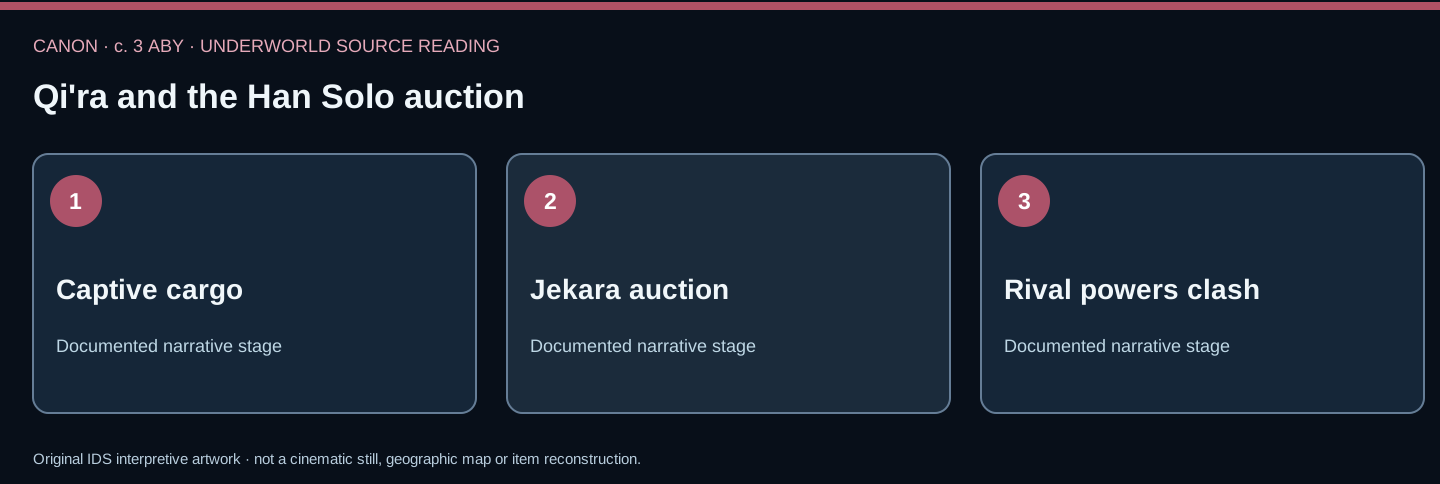
Check the evidence: Did Qi'ra's auction occur before Han was frozen on Bespin?
Explanation: No. The auction was possible because Han had already been frozen and taken by Boba Fett.
Compare a connected event → · Underworld stories research route →
Source context: Official Lucasfilm primary game or comic description. Dates are approximate within the between-films setting; optional game missions must not be presented as one mandatory path.
Sources and interpretation
Charles Soule, War of the Bounty Hunters #1–5; StarWars.com Hidden Empire history. Check original source background →. Interpretive commentary is separated from the narrative facts.