
Canon · c. 3 ABY · Guided historical research
Underworld power from Qi'ra to Kay Vess
Five Canon stories illustrate auctions, class divisions, syndicate reputation, concealed state influence, and the struggle over objects from the past.
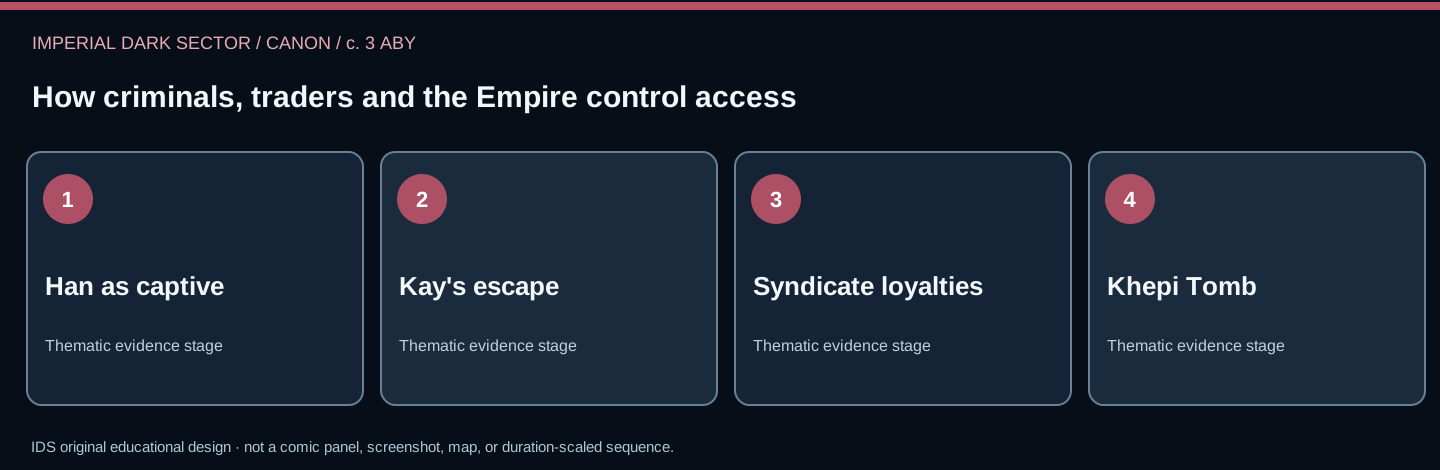
The underworld is not outside political power
Criminal organizations in this era interact with Imperial state institutions and with wealth concentrated in privileged cities. Qi'ra's auction of the carbon-frozen Han Solo on Jekara exposed a different form of political competition from an ordinary military campaign. Rival powers could gather to contest possession of a captive person, while Han had almost no agency in the transaction. Lucasfilm's official preview identifies the sale as part of the War of the Bounty Hunters comic crossover after Han's imprisonment at Bespin.
That earlier auction is connected thematically to Kay Vess but does not occur as a mission inside the Outlaws base game. The files should be read as distinct source stories. Comic-book issues establish the auction's people and sequence; gameplay material establishes the choices available to Kay. This distinction avoids implying that an optional reputation task or later expansion takes place during the Jekara auction.
A worker's district beneath a casino economy
Kay begins on Cantonica in the Worker's District of Canto Bight, a sharp contrast to the wealthy residents and tourists attracted to the city's casinos. Her escape from the orbit of Sliro's Zerek Besh network is therefore partly a story about unequal access to transport, finance and protection. Lucasfilm identifies Nix as her close companion and the Trailblazer as a vessel whose ownership history connects earlier smugglers with Zerek Besh.
When Kay reaches Toshara, she enters a moon where Imperial administration coexists with criminal syndicates. The official Databank describes this as a corrupt political environment, not a world with no government. Choices about loyalty, stealth and employment can affect reputation with different groups, but their outcomes vary with the player's actions. A historical timeline should document the fixed narrative and explain the range of optional pathways rather than claiming every player betrays the same people.
Private gangs and covert Imperial authority
The secret interests of Zerek Besh demonstrate that the boundary between organized crime and state intelligence can be deliberately obscured. That conclusion concerns particular characters and revelations; it is not evidence that all syndicates are operated by the Imperial Security Bureau. Their leaders compete, their resources differ and their members do not all share the same political obligations. The same city can contain formal law enforcement, corporate wealth, organized crime and people attempting to navigate between them.
Kay's decisions must also be distinguished from the position of ND-5, a droid whose earlier military function and subsequent employment are detailed in the Lucasfilm Databank. Their partnership creates trust, but the characters do not start from equal circumstances. Reading the main-story revelations alongside the faction mechanics is a useful way to understand how an individual's choices can be both constrained and consequential.
Piracy and the cultural meaning of a tomb
The A Pirate's Fortune story pack follows the main game. Kay and Nix work with Hondo Ohnaka against Stinger Tash and the Rokana Raiders, including an expedition into the Khepi Tomb. Lucasfilm's release description directly establishes this sequence. A quest for treasure can also be read as a struggle over ownership: the people who are most able to enter a site and remove its objects are not automatically those with the strongest cultural claim.
The archive should therefore distinguish confirmed game objectives from archaeological conclusions the game does not provide. A named tomb and a set of raiders do not establish the full history of the culture that made the site. The educational graphic and linked file make this limitation visible instead of claiming to reproduce an ancient excavation plan.
Follow the linked event files
Qi'ra's Han Solo auction
Read this dossier →Kay escapes Canto Bight
Read this dossier →Competing syndicates
Read this dossier →Zerek Besh revealed
Read this dossier →Kay and Hondo at Khepi
Read this dossier →Test your historical judgment
Does a flexible reputation system prove every player experienced one identical series of betrayal missions?
Explanation: No. The game includes variable choices, and a chronology must distinguish fixed story from optional play.
Is the Khepi Tomb quest set before Kay's initial heist?
Explanation: No. Lucasfilm specifies that A Pirate's Fortune follows the base game's main storyline.
Sources and limits
The linked Canon comics and games provide events, while the anthropological analysis examines institutions, inequality, memory, labor and authority. Publication previews and Databank summaries are not substitutes for every panel or optional mission. The research illustrations are original IDS evidence diagrams, not official artwork, documentary scenes or licensed publisher material.
Qi'ra's auction — Lucasfilm comic preview →
Kay Vess — official Databank →
A Pirate's Fortune — Lucasfilm →
Back to the Age of Rebellion guide → · All timeline articles →