Garsa Fwip owns and operates the Sanctuary in Mos Espa during the New Republic era. Her club is part music hall, part gambling den, part social refuge, and part political meeting place. That makes Garsa more than a stylish hostess. She manages an institution whose value comes from making powerful people comfortable enough to gather in one room.
A Twi'lek who owns the room
Garsa is immediately significant within the visual history of Twi'leks because she occupies the position of proprietor rather than captive. Jennifer Beals has described the character as someone who is “no one's slave” and “no one's master,” a deliberate distinction from older representations of Twi'lek women.
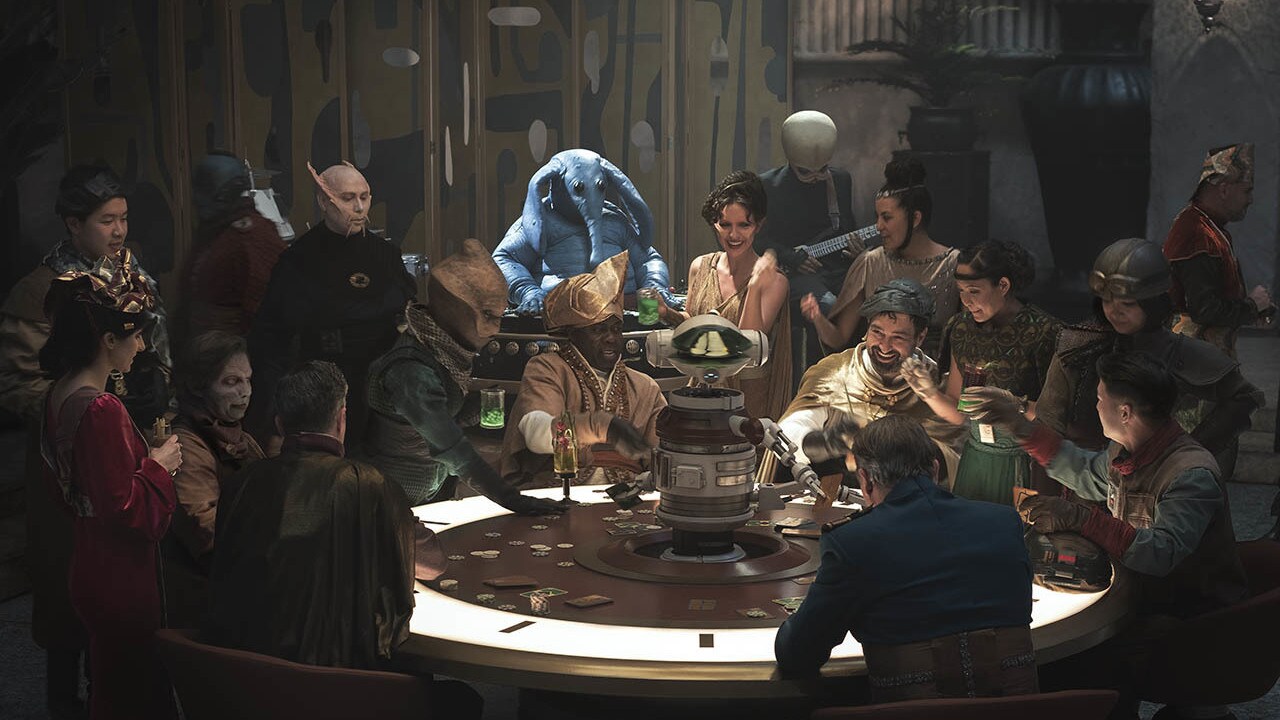
Her wealth is visible in the Sanctuary itself. On a desert world where water is scarce, the establishment uses plants, decoration, service staff, live music, and controlled atmosphere to create luxury.
Receiving Boba Fett
When Boba Fett claims Jabba's former territory, Garsa receives him through the language of hospitality rather than open submission. The encounter shows how a local business owner manages regime change. She recognizes the new daimyo while preserving the dignity and autonomy of her establishment.

Soft power in Mos Espa
Garsa's influence comes from social position. She knows who enters her club, understands the mood of the city, and can communicate with competing power holders without becoming one of their soldiers. That kind of soft power is easy to miss in a setting dominated by bounty hunters and crime lords.
Her interaction with Krrsantan is a good example. When his violence threatens the Sanctuary's rules, she attempts to de-escalate the situation and restore the establishment's social order.

The Sanctuary bombing
The Pyke Syndicate eventually attacks the Sanctuary with an explosive device. Garsa is killed along with staff and patrons. The bombing turns a civilian social institution into a target because of the larger conflict over Tatooine.
Her death demonstrates the vulnerability of soft power. The Sanctuary can shape relationships and reputation, but it cannot protect itself from actors willing to destroy the social space entirely.
Costume, wealth, and Twi'lek representation
Garsa's clothing, jewelry, lekku styling, and carefully controlled environment are part of how the character communicates status. Her visual design signals wealth without placing her inside the familiar costume language of enslaved Twi'lek dancers.
Why Garsa matters
Garsa adds entrepreneurship, property, service management, and elite urban life to the Twi'lek archive. Read beside Oola and the unnamed Sanctuary server, she also allows IDS to examine three different positions inside service economies: enslaved performer, wage or staff laborer, and proprietor.
Sources and continuity
This file is Canon and draws on The Book of Boba Fett, official material on the Sanctuary, and production commentary.
Garsa's Sanctuary Databank ↗
StarWars.com on Garsa's Sanctuary ↗
Hospitality as local power
Garsa’s Sanctuary is valuable because people with money, status, and criminal connections choose to gather there. Managing the venue gives her information, relationships, and influence beyond ordinary commercial ownership.
Hospitality becomes a political skill. Knowing how to welcome dangerous people without appearing subordinate lets the Sanctuary operate as a neutral-looking social institution.
The vulnerability of civilian institutions
The Sanctuary also shows how quickly a public space can become collateral in a struggle between armed factions. Music, service, and leisure do not place the venue outside political conflict.
Its destruction demonstrates that criminal warfare reorganizes civilian life by making ordinary workplaces targets when they become symbolically or strategically useful.
Connected archive