
- World
- Suurja
- Jedi faction
- Revanchists
- Mandalorian commander
- Rohlan Dyre
- Outcome
- Jedi captured
After the conventional Suurja battles, a Revanchist scouting group remained active on the world. Revan left to continue investigating Mandalorian activity elsewhere, leaving Jedi including Alek and Ferroh behind. Rohlan Dyre led Mandalorian shock troopers in an ambush that captured the group. The prisoners were transported to Flashpoint Station, where Demagol was experimenting on Force-sensitive captives.
3964 BBY · Legends · Historical source lab
THE REVANCHIST AMBUSH
Documented sequence and limitations
After the four Suurja battles, Revanchist Jedi including Alek and Ferroh took part in scouting activity on the world. Mandalorians led by Rohlan Dyre ambushed the group, capturing survivors who were transported to Flashpoint Station. The station had already been seized from the Republic. Its occupation as a research site for Demagol’s coercive experiments developed into a separate crisis involving the captives.
People, institutions and context
Jedi volunteers working outside the Council’s preferred policy met an experienced Mandalorian military system. Once captured, their status changed from battlefield opponents to detained subjects vulnerable to technological control. Rohlan’s later questions about Mandalorian command do not erase the violence of this episode. The ambush and the earlier station takeover must be dated separately.
Source trail: Knights of the Old Republic (2006) #7–10, Flashpoint; Suurja history. Chronology/source record →. Exact primary edition page citations remain under review. Banner art is original IDS symbolism, not the source comic.
Idealistic intervention meets an experienced war machine
The Revanchists believed the Jedi had a moral responsibility to investigate and eventually oppose Mandalorian atrocities. Their cause may have been ethically serious, but the scouting party still entered a military environment controlled by forces more experienced in the local war.
The ambush shows the gap between moral commitment and operational readiness.
Rohlan Dyre fights a war he increasingly doubts
Dyre participated in the capture while questioning Mandalore's goals and the logic of testing Republic defenses. He would repeatedly desert, be recaptured, and return to the front.
His biography prevents the Mandalorian side from being treated as ideologically uniform. People can participate in institutions they distrust, especially when exit is difficult.
Capture feeds Demagol's research system
The prisoners were valuable not only as enemies but as biological subjects. Their capture supplied Demagol with the human material for his effort to identify the source of Force sensitivity.
Battlefield detention thus became a pipeline into coercive research.
Explore this entry
Why were the Revanchists on Suurja if the Council opposed intervention?
They were already organizing around Revan's argument that the Jedi should act. Scouting allowed them to investigate the conflict while the institutional dispute continued.
Was Rohlan Dyre secretly helping them?
Not at this point. He commanded the Mandalorian force that captured them, even while his broader doubts about the war were growing.
Anthropological assessment
The ambush shows that dissent does not automatically produce refusal. Rohlan's participation and doubt coexist, illustrating how institutions can retain people who no longer fully believe in their mission.
The Revanchists show the opposite problem: moral certainty can motivate intervention before a group has developed the practical capacity to protect itself.
When an idealistic scouting mission became a prisoner convoy
Revanchist Jedi went to Suurja while the Jedi Council still resisted direct military intervention. Their moral concerns about Mandalorian violence were serious, but the group was not yet a cohesive army with the experience of the Neo-Crusader front. Rohlan Dyre's troops ambushed the scouts after Revan had left to investigate developments elsewhere. Jedi including Alek and Ferroh were taken prisoner and transferred to Flashpoint Station.
Prisoners classified as resources
Demagol's interest in Force-sensitive captives shifted the meaning of detention. The prisoners were not merely bargaining chips or people removed from the battlefield. Their bodies became sources for an experimental program designed to discover and perhaps reproduce Force sensitivity. The event thus connects the conduct of the war to abusive research behind the front line.
Dissent within Mandalorian identity
Rohlan Dyre's position complicates any simple division into heroic Jedi and uniformly enthusiastic Mandalorian aggressors. His eventual criticism of Mandalorian policy arose from within the fighting force. The ability to question an institution does not necessarily grant the freedom to leave it. The story is useful for understanding military organizations whose members differ in loyalty, belief and ability to refuse participation.
Were the Revanchists already Revan's later wartime command?
No. The scouting group belonged to an earlier stage of interventionist Jedi activity. This ambush predates Revan's mature Republic generalship.
Evidence note: These sections interpret the Legends source material cited below. The original game or comic establishes participants and outcomes; the institutional comparison is IDS analysis. Unsupported casualty totals and imagined tactics are intentionally omitted.
Historical judgment · 3964 BBY
Test your historical interpretation
Answer both questions for a scored assessment with educational explanations and corrections.
c. 3964 BBY · Legends · Flashpoint comic arc
A Suurja ambush feeds the Flashpoint detention system
A battlefield outcome has another destination
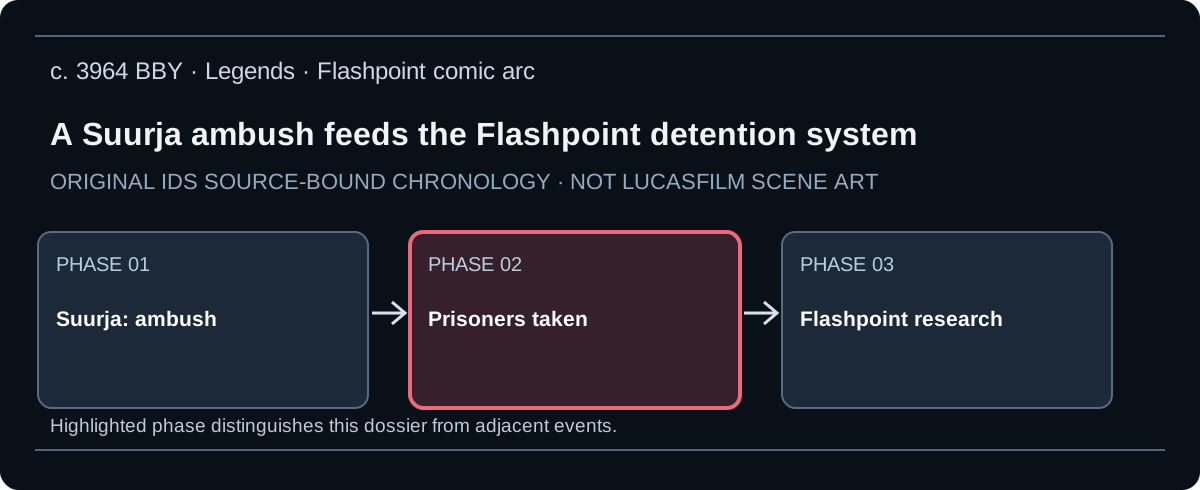
Revanchist Jedi acting against Mandalorian forces on the Suurja front were caught in an ambush and taken prisoner. The storyline becomes important because captured Force-sensitive enemies could be transported to Flashpoint Station, where the Mandalorian researcher Demagol sought ways of understanding and exploiting Jedi abilities. This should not be written as a triumphant raid with invented Republic victory figures; it is a capture that changed the prisoners' institutional status and immediate survival prospects.
Rohlan Dyre is not a stand-in for every Mandalorian
The Flashpoint arc introduces Rohlan Dyre as a warrior who has doubts about the war and Demagol as a scientist working within the Mandalorian military. The writer’s issue #8 notes explain that these characters have distinctly different outlooks. Describing an army through a single cultural trait would obscure the ideological disagreement that the comics deliberately portray. In this event, the prisoner convoy ties front-line violence to specialized research and command authority.
Multiple scales of evidence
The ambush belongs to the events revealed in the original Knights of the Old Republic #7–10 storyline, not to a first-person playthrough of the later video games. Sources for the exact captives, vehicle movements and chronological sequence must be checked against the panels. The transition from arrest or battlefield capture to exploitation at a laboratory is an anthropological point about how military organizations classify and manage prisoners, not an additional reported skirmish.
Test your historical judgment: Is capture on Suurja the same event as Demagol's later work at Flashpoint?
Evidence-based explanation: No. The ambush describes a military encounter and prisoner taking; Flashpoint concerns captivity, experimental research, resistance and rescue. Their connection is logistical, not identical chronology.
Original research trail: Original creator commentary: Flashpoint #7 · Flashpoint #10 and simultaneous comic events. Original issues and text pages remain the source for exact scenes; writer commentary supplies documented production context.
Sources and further reading
- Knights of the Old Republic comics, Flashpoint arc.
- The Essential Guide to Warfare.