
- World
- Flashpoint
- Facility
- Stellar Research Station
- Outcome
- Mandalorian capture
- Dating
- 3965 / 3964 source tension
Near the transition from the False War into the 3964 fighting, Mandalorian forces seized Flashpoint Stellar Research Station. The Republic had built the outpost on an airless planet extremely close to its star, protected by an artificial magnetic shield so scientists could study stellar processes. Its light defenses made it an easy military target. Once occupied, the station was handed to Demagol and became a prison and laboratory for captured Jedi.
3965–3964 BBY · Legends · Source and society
FLASHPOINT STATION
Event sequence and source limits
Flashpoint Stellar Research Station was established for stellar observations on an airless world exposed to dangerous radiation, with protective shielding built around scientific equipment. The Mandalorians seized it before their repeated confrontations on Suurja. Under Demagol, the captured site became a laboratory for experiments on Force-sensitive prisoners. Its initial capture and the later arrival of Revanchist captives are separate events, although both belong to the opening phase of the war near 3965–3964 BBY.
People, technology and institutions
The history of Flashpoint demonstrates the conversion of civilian scientific infrastructure into coercive military capacity. Its location and life-support arrangements gave the occupying force exceptional control over detained people. The case concerns authority and consent, not simply technology. Research facilities, personnel and instruments acquired new roles after the occupation; prisoners did not volunteer to be subjects of Demagol’s tests.
Sources: Knights of the Old Republic #7–10, Flashpoint arc; reference chronology. Supporting chronology →. IDS interpretations are separated from published events; event banner is original editorial art, not a published illustration.
A scientific installation is an easy military target
Flashpoint was built for research rather than war. Its sophisticated environmental protection did not imply equally strong defenses against an invasion.
The Mandalorians exploited that imbalance: specialized scientific infrastructure could be captured cheaply and repurposed immediately.
Demagol converts knowledge infrastructure into coercive research
The station's remoteness, shielding, and laboratories made it attractive to Demagol. Captured Jedi became involuntary experimental subjects in his attempt to identify a physical source for Force sensitivity.
The same material systems that had supported legitimate research now enabled abuse because consent and oversight disappeared.
The planet itself becomes part of the prison
Flashpoint's radiation and lack of atmosphere made survival outside the shielded facility nearly impossible. Jedi who tried to escape into the environment died quickly.
Captivity therefore depended not only on guards but on technological control over breathable, survivable space.
Event sequence
Mandalorians seize the lightly defended Republic station.
Demagol receives Jedi captives, including Revanchists taken on Suurja.
Zayne Carrick, Rohlan Dyre, and allies infiltrate the station.
The prisoners are freed and Demagol's operation collapses.
Explore this entry
Why does IDS use a date range here?
Because published Legends chronology is internally inconsistent. Using a range preserves both source traditions instead of pretending the contradiction does not exist.
Why not create separate 'capture' and 'Battle of Flashpoint Station' pages?
They describe the same seizure of the station. Splitting them would turn a dating disagreement into two fictional events.
Anthropological assessment
Flashpoint demonstrates how scientific infrastructure can be politically reversible. Laboratories do not carry ethics on their own; their social purpose depends on authority, consent, and oversight.
The environment also becomes a technology of power. Whoever controls the station controls the conditions required for human survival outside it.
From research outpost to captive-experiment station
Flashpoint Station originally stood in an unusually hostile environment, chosen for scientific purposes rather than easy civilian settlement. Its remote position offered isolation and specialized facilities. After Mandalorian forces seized it, those qualities made it difficult for outside forces to inspect or rescue the people held there. The takeover converted a research setting into an instrument of wartime imprisonment.
Demagol's research agenda
Demagol used prisoners, including Force-sensitive people, as subjects in an effort to identify what gave Jedi their abilities. The distinction between voluntary research and coercive experimentation is the moral center of the episode. Captured individuals did not become legitimate experimental material because a military authority classified them as enemies. The station's laboratories and isolation enabled abuses that would have been harder to conceal in an ordinary city.
Knowledge and violence in one institution
Flashpoint shows why technology cannot be evaluated apart from its governing authority. A laboratory may be useful for the study of a dangerous environment and later be repurposed for torture or forced experimentation. The material space remained recognizable, but the people controlling it changed the purpose of its instruments. Zayne Carrick's eventual involvement is significant partly because ordinary wartime chains of command were not protecting the captives.
Does scientific infrastructure make a violent program legitimate?
No. Access to laboratory equipment and technical expertise is not consent. The history of Flashpoint illustrates how an occupying military can misuse research facilities against prisoners.
Evidence note: These sections interpret the Legends source material cited below. The original game or comic establishes participants and outcomes; the institutional comparison is IDS analysis. Unsupported casualty totals and imagined tactics are intentionally omitted.
Historical judgment · 3965–3964 BBY
Test your historical judgment
Choose two answers. Receive a scored explanation with corrections and further reading guidance.
Flashpoint Station: research converted into imprisonment
Mandalorian front · c. 3965–3964 BBY. Original published story records, later chronology and anthropological interpretation are distinct evidence types.
An exposed research outpost
Flashpoint began as a Republic facility studying its nearby star, with environmental dangers and shielding systems that shaped the station’s vulnerability. After Mandalorian forces acquired the installation, control of its infrastructure made it possible to convert a scientific site into a holding and experimentation complex. The military seizure and the later work of the physician Demagol should be analyzed separately: occupying a laboratory did not by itself establish the precise methods of every subsequent experiment.
The original comic arc reveals consequences
The Knights of the Old Republic Flashpoint story, especially issues #7, #8 and #10, follows Zayne Carrick and other fugitives through the war zone and confrontation with Demagol. Writer John Jackson Miller’s notes for #10 identify a scheme to disrupt the station’s shield generation and explain why the escape plot required the Mandalorians to abandon some available vehicles. These comments concern the rescue and evacuation sequence, not the exact date of the outpost’s initial capture.
Publication order is not scene order
Miller explains that issues #9 and #10 were reversed in the publication schedule even though their storylines occur simultaneously. This is a verifiable example of why chronological history cannot be assembled by assuming that issue numbers map directly onto fictional elapsed time. The station’s role as a coercive research site also raises questions about the use of professional expertise in military institutions. Those institutional observations are analysis; the comic panels supply the actual behavior of the characters.
Research judgment: Does the publication of KOTOR #10 after #9 prove that its events occurred later?
Explanation: No. The writer explains that the issues were scheduled in a different order while their narratives occurred simultaneously.
Follow the evidence: Writer notes: Flashpoint Part 1, issue #7 → · Writer notes: Flashpoint Part 3, issue #10 →. The linked source descriptions and commentaries are publication evidence; detailed scene claims require the original game or comic.
3965–3964 BBY · Legends · Source and society
A scientific facility becomes an instrument of captivity
Flashpoint Station's original purpose was scientific research close to a star. Its protective equipment made work possible in an unusually hostile environment but did not make the outpost a strong defensive position. The Mandalorian seizure demonstrated how research infrastructure could be captured and assigned a completely different political and military function.
Once Demagol took control, Jedi captives became subjects of coercive experiments. The shift from studying stellar phenomena to imprisoning people represents a transformation in the institution's purpose, not evidence that the Republic scientists had designed the original laboratory for those experiments. Descriptions of the facility should also keep the station distinct from later prisons or academies elsewhere in the conflict.
The comic issues and John Jackson Miller's creator notes offer a stronger sequence than a generic Mandalorian-war summary, but the chronological transition is sometimes placed across 3965–3964 BBY. IDS identifies that uncertainty rather than insisting upon a single unsupported calendar day. The illustration is a thematic three-stage diagram, not an imagined floor plan.
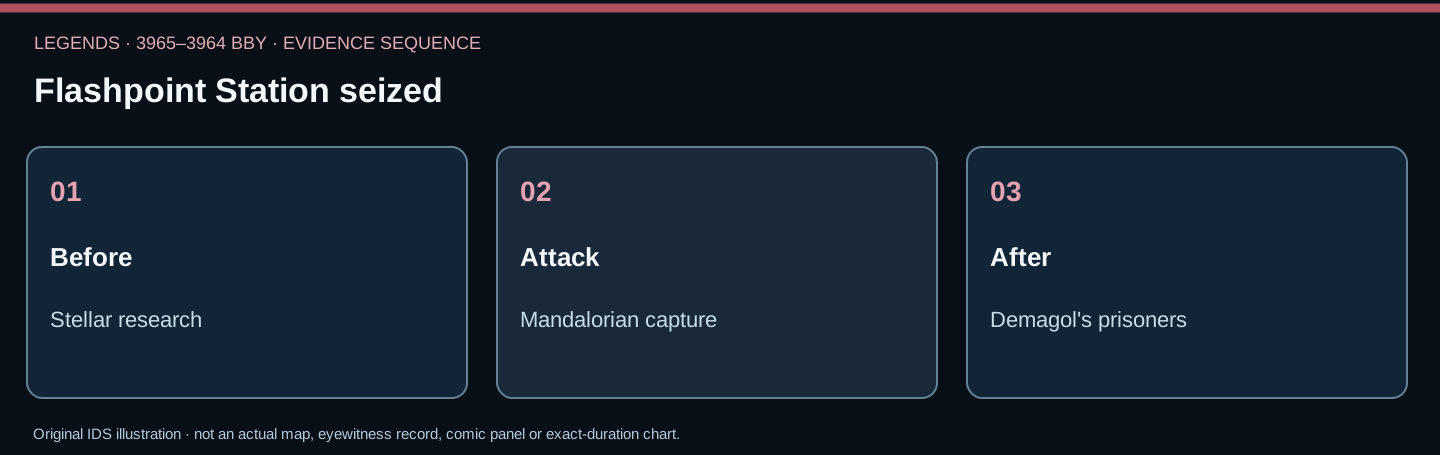
Check the historical interpretation: Was Flashpoint Station originally built to hold Jedi prisoners for Demagol?
Explanation: No. It was a Republic stellar-research site that the Mandalorians captured and repurposed.
Compare a related history → · Explore the complete timeline →
Reference: John Jackson Miller, Knights of the Old Republic issue notes. A summary or creator commentary is distinguished from an independently checked printed issue/page; no invented dialogue, visual details or casualty totals.
Sources and further reading
- “The Taris Holofeed: Prime Edition.”
- Knights of the Old Republic comics, Flashpoint arc.
- The Essential Atlas.
- The Essential Guide to Warfare.