
- World
- Jebble
- Region
- Outer Rim
- New function
- War forge / staging base
- Planned target
- Alderaan
After Taris fell, Neo-Crusader forces captured Jebble, a frozen mining world that had once helped supply the ecumenopolis. The Mandalorians transformed the Ice Citadel and surrounding infrastructure into a forward base. Thousands of recruits assembled there for a planned strike toward Alderaan, while scientists and military personnel used the planet for war production.
3963 BBY · Legends · Source and society
JEBBLE FALLS
Event sequence and source limits
Mandalorian forces seized Jebble after breaking through the Taris defensive region during the 3963 Onslaught. The icebound world had served regional extraction and trade, and its facilities were then used for a Mandalorian staging base. The Ice Citadel concentrated soldiers and support workers as commanders planned further attacks. This was the military occupation of Jebble, not yet the subsequent catastrophe caused by arrival of the Muur Talisman. The distinction matters because the concentration of recruits shaped what happened after the artifact arrived.
People, technology and institutions
Existing mining and supply infrastructure made Jebble strategically valuable to occupiers as well as its former commercial partners. Military control could redirect locally produced goods, labor and transport. Crowding large numbers of personnel into the Citadel created a concentrated vulnerability. The event should not be read as evidence that every local worker agreed with Mandalorian government or that the invaders initially understood the risks of the artifact.
Sources: Knights of the Old Republic #25–28, Vector; The Essential Guide to Warfare. Supporting chronology →. IDS interpretations are separated from published events; event banner is original editorial art, not a published illustration.
Republic supply infrastructure changes sides
Warehouses, transport links, mining systems, and settlements do not lose value when a government changes. The occupier can redirect them.
Jebble's infrastructure moved from supporting Taris to sustaining the army that had conquered Taris.
The staging base concentrates thousands of fighters
Neo-Crusader recruitment drew together Mandalorians and newly incorporated warriors from conquered populations. Jebble gathered them for a future Alderaan operation.
Concentration created military efficiency, but it also created vulnerability when the Muur Talisman later introduced a biological threat.
A marginal resource world becomes strategically central
Jebble was not politically famous before the war. Its value came from location, mining, and logistics.
War can rapidly reorder status: peripheral worlds become central because campaigns need what they can supply.
Explore this entry
Why did the Mandalorians want Jebble?
Its location and infrastructure made it a useful waypoint and staging base after the conquest of Taris. It helped support the next Coreward operations.
Why keep the capture and Disaster on Jebble separate?
Because the first shows successful military conversion of a resource world, while the second shows that system collapsing because of a Sith artifact and rakghoul outbreak.
Anthropological assessment
Jebble shows conquest as institutional recycling. Occupiers often inherit roads, warehouses, labor systems, and extraction networks rather than building a war economy from nothing.
Its later disaster also demonstrates the risk of concentration: systems optimized for moving large numbers of people and supplies can accelerate biological or social catastrophe.
The occupation before the disaster
Jebble's importance lay in what could be done with its existing infrastructure. The icy resource world was already connected to the Taris supply network, and its capture allowed Neo-Crusader officers to redirect warehouses, mines, transit systems and the Ice Citadel toward their own campaign. Soldiers and recruits gathered for a projected operation against Alderaan. The incident therefore belongs to the wider transformation of Mandalorian raiding into organized conquest with staging worlds and reliable military production.
Logistics makes marginal places powerful
Jebble was not the capital of a great interstellar state. Its location and working facilities made it useful to the people trying to control the route to the Core. A world that seemed peripheral to Republic political life could become strategically central because ships, personnel and raw materials passed through it. Capturing such a place provided an army with advantages that winning a famous battle alone might not.
The outcome creates the next danger
The concentration of recruits and supplies made Jebble efficient, but also vulnerable. When Pulsipher brought the Muur Talisman into the occupied installation, the effects spread through people who were already assembled in a confined military system. The later Disaster on Jebble should be told as a separate event. The successful capture and establishment of a military center helps explain why that later catastrophe was so consequential.
Why is occupation a separate story from the outbreak?
Without an organized base and gathered troops there would have been a different scale of exposure. The capture created the population and infrastructure that the artifact later threatened.
Evidence note: These sections interpret the Legends source material cited below. The original game or comic establishes participants and outcomes; the institutional comparison is IDS analysis. Unsupported casualty totals and imagined tactics are intentionally omitted.
Historical judgment · 3963 BBY
Test your historical judgment
Choose two answers. Receive a scored explanation with corrections and further reading guidance.
3963 BBY · Legends · phase-specific source review
Jebble before Vector: the occupation of a supply world
Control of Jebble meant control of infrastructure
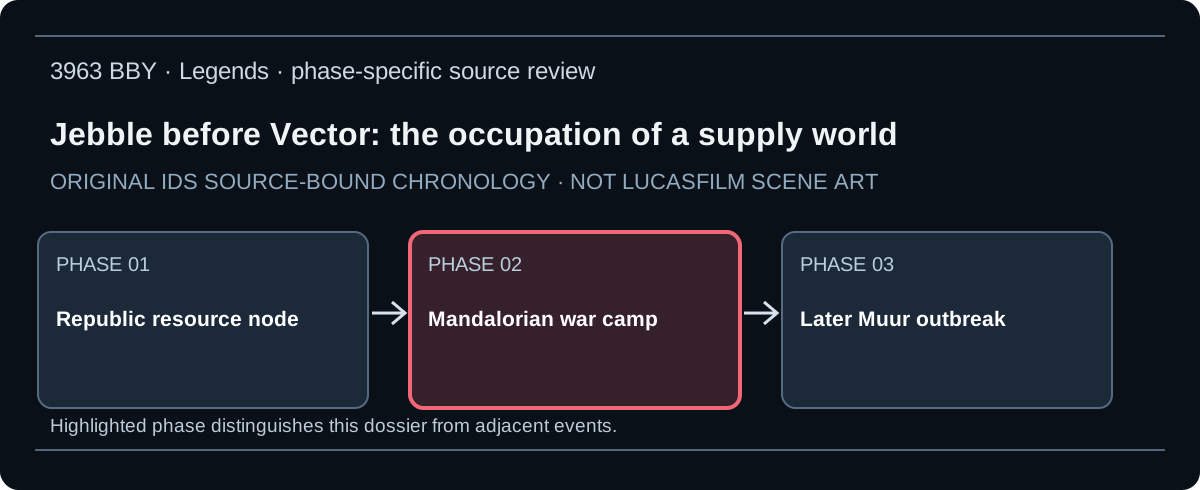
Jebble had been a resource world connected to the Taris economic region. Mandalorian occupation changed its purpose: local supply and mining facilities became part of a military staging system, with troops assembled and preparations for further expansion. The camp could operate as a place to receive equipment and recruits even though the planet's surface was icy and remote. A 'war forge' should be understood here as an occupied production-and-mustering network, not a literal starship factory spanning the whole world.
The writer describes the camp rather than merely its battle
John Jackson Miller’s commentary on Knights of the Old Republic #26 says Jebble was conceived to show a Mandalorian counterpart to Republic Army camps at Serroco. He discusses difficulties in recruitment, transportation and how soldiers viewed specialists such as Pulsipher. This is strong evidence that the camp's military organization matters in the original comic. The note does not independently provide the day of the original invasion or verify every claimed troop total in later reference summaries.
A later outbreak creates a separate timeline entry
When the Muur Talisman enters the Vector plot, Jebble is already a militarized gathering place. That concentration helps make the plague more dangerous and gives the story its later stakes. The massacre and Celeste Morne’s fate belong in the disaster dossier, not the capture paragraph. Editors should not use artwork of the Muur outbreak as though it depicts the earlier landing operation, and must label any drawn strategic plan as a reconstruction rather than an original scene.
Test your historical judgment: Did the Mandalorian capture immediately cause the Muur Talisman disaster?
Evidence-based explanation: No. First Jebble was taken and organized for military use; the artifact crisis occurs during the later Vector narrative. Conflating these stages erases the camp’s logistical and social history.
Original research trail: Author's commentary on the occupied camp in KOTOR #26 · The later Jebble catastrophe. Original issues and text pages remain the source for exact scenes; writer commentary supplies documented production context.
Legends · Late Mandalorian Wars research
Jebble before the disaster: a conquered resource world
Source-supported reconstruction
Mandalorian Neo-Crusaders captured Jebble, a frozen resource world that had been tied to the Taris region's economy. They occupied the Ice Citadel and used mining-related facilities, personnel concentrations and transport networks to stage forces for further operations, including Serroco. This capture preceded Pulsipher's arrival with the Muur Talisman and the later rakghoul crisis, even though all are placed in 3963 BBY.
Institutions and material culture
The takeover of Jebble shows that an occupier can redirect existing infrastructure without first constructing an entirely new military city. Warehouses, landing sites and extraction routes can become parts of an invasion network. Bringing thousands of personnel into an enclosed base may increase efficiency but also makes them vulnerable to sudden internal emergencies. The transformation from valuable base to dangerous site belongs to the later chapters of this sequence.
Continuity and evidence limit
Occupation, outbreak and bombardment are related stages, not separate names for the same instant. The references do not supply a full roster of every recruit.
Historical judgment: Was Jebble destroyed at the moment the Mandalorians captured it?
Correction and explanation: No. They first used it to assemble troops and supplies, before the artifact crisis.
Source trail: Knights of the Old Republic 25–28 (Vector). Source reference and bibliography ↗. Original-page citations remain under review.
Sources and further reading
- The Essential Atlas.
- The Essential Guide to Warfare.
- Knights of the Old Republic 25–28.
What happened next: The later Muur Talisman emergency is a different phase from the capture. Read the Jebble disaster dossier →. Compare both stages in the overview →.