
- Movement
- Revanchists
- Key evidence
- Cathar massacre vision
- Leader
- Revan
- Initial role
- Jedi / Mercy Corps intervention
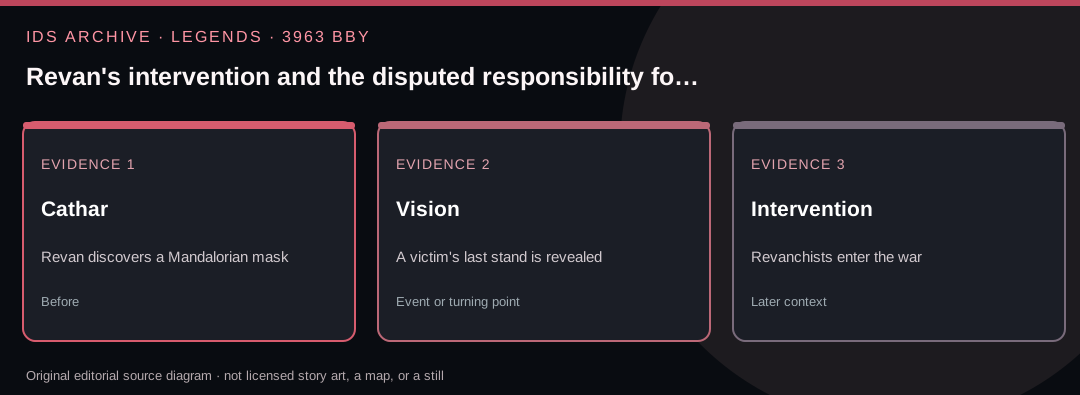
In 3963 BBY, the Revanchist debate over intervention reached a turning point on Cathar. Searching the abandoned world for proof of the Mandalorian atrocity, Revan, Alek, Ferroh, and other Jedi found the mask of the Mandalorian warrior who had died opposing Cassus Fett's massacre. The assembled Force-users experienced a vision revealing the killing. Revan took up the fallen Mandalorian's mask and swore not to remove it until the Mandalorians were defeated.
3963 BBY · Legends · Source and society
REVAN’S INTERVENTION
Event sequence and source limits
The interventionist Revanchists under Revan and Alek entered the Republic’s major Mandalorian war effort against the Jedi Council’s preference for restraint. In Knights of the Old Republic #42, a Force vision on Cathar reveals the slaughter of the Cathar and the Mandalorian dissenter who attempted to protect them. Revan adopted her mask as a vow of action. Dating is not completely consistent: later reference histories place Revanchist participation near 3963 BBY, while Bastila’s dialogue in the 3956 BBY game implies 3961 BBY. A subsequent 3962 appointment to command is distinct.
People, technology and institutions
Revan’s mask transformed an act of individual dissent into an emblem for a wider political cause. The vision supplied collective moral evidence within the Jedi tradition. At the same time, intervention created a dispute about who had the right to authorize military action, the Council or individual Jedi facing an atrocity. The significance of stopping Mandalorian violence should not conceal the later institutional consequences of Revan’s independent command.
Sources: Knights of the Old Republic #42; Knights of the Old Republic (2003); The Essential Guide to Warfare. Supporting chronology →. IDS interpretations are separated from published events; event banner is original editorial art, not a published illustration.
An atrocity becomes politically actionable when it becomes collectively visible
The Cathar massacre had happened a decade earlier. Its victims did not become more dead in 3963. What changed was the evidentiary situation among the Jedi.
A shared Force vision transformed suspicion and survivor testimony into an experience the assembled Jedi treated as undeniable.
A victim's defender becomes the symbol of a movement
The mask belonged to the Mandalorian who refused Fett's extermination order and died with the Cathar. Revan adopted it as a vow.
An object therefore carried a chain of meanings: dissent within Mandalorian culture, memory of genocide, and the public identity of a new Jedi war leader.
The Jedi Order divides over responsibility
The Council feared a deeper unseen threat and the corrupting effect of war. Revan's faction argued that nonintervention was itself a moral choice with catastrophic consequences.
Both sides interpreted Jedi responsibility differently: protect the Order from a hidden danger, or intervene against an immediate, documented one.
The intervention that saves the Republic also changes the Jedi
Revan's leadership would eventually turn the military tide. Yet prolonged war, escalating tactics, and later contact with Vitiate's Empire would contribute to a new catastrophe.
Knowing that future does not make the initial anti-genocide argument meaningless; it shows that morally compelling interventions can still produce unintended institutional transformations.
Explore this entry
Did the Council suddenly approve the whole war?
No. Later material describes limited sanction and continuing reluctance. Many Jedi still joined Revan in defiance of the Council's caution.
Why does the mask matter so much?
It tied Revan's identity to a specific act of Mandalorian dissent against genocide. The symbol gave the movement a moral narrative, not just a military leader.
Anthropological assessment
The Revanchists show how evidence can reconfigure a moral community. Atrocities do not automatically produce intervention; they must be recognized, interpreted, and connected to an accepted obligation to act.
The mask also demonstrates material culture's political power. Objects can condense memory, identity, and collective promises into something followers can literally see.
Historical judgment · 3963 BBY
Test your historical judgment
Choose two answers. Receive a scored explanation with corrections and further reading guidance.
3963 BBY · Legends · evidence file
Revan's intervention and the disputed responsibility for Cathar
Published evidence
A Revan-centered vision on Cathar reveals that a Mandalorian opposed the slaughter of Cathar civilians. The discovery of her mask becomes central to Revan's symbolic identity and the decision by interventionist Jedi to enter the Mandalorian Wars.
Institutions and culture
The mask gives political action a material symbol. By adopting it, Revan connects a war movement to the memory of a specific victim rather than merely asserting an abstract moral argument. The narrative also shows disagreement within the Jedi about legitimate intervention.
What remains unverified
The later retrospective flashback is not contemporaneous public news coverage. Do not confuse discovery of evidence on Cathar in 3963 BBY with the earlier massacre itself.
Check the historical record: Did Revan discover that all Mandalorians supported the Cathar massacre?
Explanation: No. The vision shows a Mandalorian who tried to resist the atrocity.
Sources and further reading
- Knights of the Old Republic 42.
- The Essential Guide to Warfare.
- Knights of the Old Republic Campaign Guide.