
After the Mandalorian devastation of Duro, Supreme Chancellor Tol Cressa appointed Revan Supreme Commander of the Republic Military. The appointment formalized authority Revan had already been building through battlefield success and the loyalty of interventionist Jedi and Republic troops.
3962 BBY · Legends · Source and society
REVAN RECEIVES COMMAND
Event sequence and source limits
Supreme Chancellor Tol Cressa appointed Revan Supreme Commander of the Republic Military in 3962 BBY following Mandalorian successes including the devastation of Duro, and increasing Republic reliance on Revan’s military leadership. The position formally recognized someone whose earlier involvement with the Revanchists had challenged the Council’s policy. Revan’s intervention, formal supreme command and the later end of the war at Malachor V are separate milestones. The 3962 appointment helps reconcile sources that disagree about the exact year Revan first fought.
People, technology and institutions
The appointment marked an institutional change, not just a personal victory. A Jedi with a charismatic following acquired recognized authority from the Republic’s civilian government, shifting relationships among the Chancellor, professional soldiers and Jedi Council. Wartime administrative urgency helps explain the decision, while the consequences should be analyzed through political institutions rather than assuming formal authority automatically guaranteed wisdom.
Sources: The Essential Guide to Warfare; Knights of the Old Republic Campaign Guide; Mandalorian Wars chronology. Supporting chronology →. IDS interpretations are separated from published events; event banner is original editorial art, not a published illustration.
Charismatic authority becomes formal authority
Revan's influence had grown outside ordinary Jedi hierarchy.
The Republic converted that battlefield prestige into official command.
War changes civil-military relationships
A Jedi who had defied the Council now directed the Republic's military strategy.
Emergency conditions elevated a figure whose authority crossed institutional boundaries.
Anthropological assessment
Revan's appointment shows how wartime legitimacy can move faster than normal institutional promotion.
Successful outsiders can be absorbed into formal command when existing structures cannot solve the crisis alone.
The Old Republic / connected history
Revan receives formal command of a desperate Republic
By 3962 BBY, the conflict with the Mandalorian Neo-Crusaders had reached a stage in which the Republic required a more coherent response to invasions across multiple worlds. Revan's growing military reputation and the intervention of Revanchist Jedi led to greater command authority. The appointment of a Supreme Commander mattered because it gave organizational form to leadership that had already been exercised through volunteer Jedi and wartime relationships. Revan's strategy could now coordinate larger military assets rather than relying on isolated initiatives.
The decision also altered the relationship between the Republic government, the Jedi Council and the officers fighting under Revan. Some Jedi had opposed entering the war; others believed continued nonintervention was indefensible. The appointment transformed a disputed religious and ethical question into part of military governance. It did not erase the original disagreement or guarantee that Revan's future actions would remain accountable to ordinary peacetime standards.
Charismatic leadership enters bureaucracy
A commander known for battlefield victories can gain personal loyalty from followers before receiving a formal title. The appointment gives an institution a way to use that authority. It can also create tension when people obey the leader because of past personal commitment rather than only because of an office that can later be reassigned.
Emergency powers change expectations
The Republic's need for victory enabled increasingly extreme military planning. Revan's command should be situated in the conditions of prolonged attack, exhausted defenders and public urgency. Explaining those pressures does not mean treating every later method as morally justified.
Did appointment as Supreme Commander remove all disagreement among Jedi?
No. Participation in the Mandalorian Wars remained contested within the Jedi Order. Revan's formal command did not eliminate those ethical disputes.
Sources and dating: The Essential Guide to Warfare; Knights of the Old Republic II narrative. Legends; variable player choices are not treated as universal chronology. Interpretive statements are distinguished from original published events.
Connected history · 3962 BBY · Legends
From battlefield legitimacy to state authority
Revan's appointment
Supreme command represented a political decision as well as a military one. Revan's prior battlefield influence came from wartime alliances and interventionist Jedi; the appointment gave that influence a recognized place in Republic command. It should not be treated as proof that the Jedi Council had reversed every objection to intervention.
The Mandalorian Triumph
The Mandalorian campaign spread pressure across multiple systems, making the Republic's need for coordination easier to understand. A campaign's name can project inevitability; a command appointment instead records an institutional response to a crisis.
Evidence check: can we reconstruct a precise sequence for every battle?
No. Published campaign overviews and dated milestones do not supply a reliable day-by-day ordering for every engagement. A broad chronological relationship is not the same as a verified operational timetable.
Trace the Mandalorian campaign that preceded the response →
This comparison is historical interpretation based on the article's listed Legends sources; it does not assert an unrecorded meeting, order, or casualty figure.
Historical judgment · 3962 BBY
Test your historical judgment
Choose two answers. Receive a scored explanation with corrections and further reading guidance.
Legends · historical source review
Military appointment follows political failure
Supreme Chancellor Tol Cressa's appointment of Revan to high command gives formal recognition to a leader who has already gained influence through wartime action and defiance of the Jedi Council. The position lets the Republic reorganize its offensive more coherently, but it does not retroactively turn every earlier decision by Revan into one approved by the Council.
This appointment reveals separate sources of authority: civilian executive appointment, Republic military hierarchy, and religious membership in the Jedi Order. A person may be legitimate within one structure while remaining controversial in another. That tension helps explain Revan's later relationship with Jedi institutions and former companions. It does not mean that the chancellor's approval guaranteed his future moral decisions or absolved all wartime tactics.
Historical judgment: Formal command and Jedi Council approval are different institutions. Publisher's related original account →. Publisher stories establish the main plot; social-institutional interpretations are IDS analysis. Exact day-level chronology is not asserted.
3962 BBY · Legends · original-source analysis
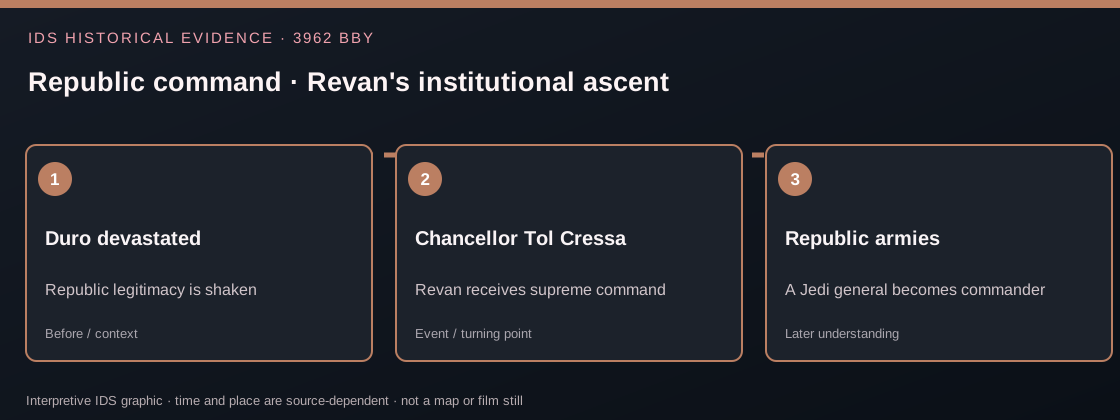
Republic command · Revan's institutional ascent
What the source establishes
After Mandalorian forces struck Duro, the Republic had to reconcile a failing military campaign with Revan's increasingly influential intervention. In the later Legends chronology, Chancellor Tol Cressa appointed Revan Supreme Commander in 3962 BBY. This was a formal office assigned after the Revanchists had already participated in fighting.
Material culture and authority
Revan's rise shows two sources of legitimacy converging. Troops and Jedi volunteers followed him because of battlefield reputation, while the Chancellor's appointment transformed practical influence into an authority recognized by the Republic. The transition increased military coordination but also concentrated responsibility.
What the evidence does not resolve
The year should not be moved back to when the first Revanchists broke with Jedi nonintervention; those are distinct milestones. No surviving source establishes every officer's personal response to the appointment.
Test your historical reading: Did Revan become Supreme Commander the first day the Revanchists entered combat?
Explanation: No. The formal 3962 BBY appointment followed earlier unauthorized or contested intervention.
Evidence trail: The Essential Guide to Warfare (2012); Knights of the Old Republic Campaign Guide (2008). Reference, notes and further bibliography →.
Sources and further reading
- The Essential Guide to Warfare.
- Knights of the Old Republic Campaign Guide.