
In 3962 BBY, the Mandalorians began the campaign they called the Mandalorian Triumph. Two major advances pushed Coreward from previously conquered territory. One prong was eventually checked at Randon; the other continued through a long chain of systems and ultimately reached Duro.
3962 BBY · Legends · Source and society
THE MANDALORIAN TRIUMPH
Event sequence and source limits
The 3962 BBY Mandalorian Triumph describes major Neo-Crusader advances toward the Core after the earlier 3963 Onslaught. Reference cartography shows more than one axis of attack. One offensive branch was halted at Randon; another passed through a chain of battles, including Commenor, and reached Duro, where devastation was extensive. The campaign’s celebratory name appears in Mandalorian political history, but its component engagements had different outcomes. A general campaign map does not prove every engagement’s troop strength or exact hour.
People, technology and institutions
Declaring a campaign a triumph shapes how supporters perceive military momentum. Named victories can also obscure suffering on occupied planets and the setbacks of individual armies. Randon demonstrates that at least one Republic defense did work, while Duro reveals the costs of those that failed. The archive should present these as multiple fronts rather than a single uninterrupted victory parade.
Sources: The Essential Atlas; The Essential Guide to Warfare, Mandalorian Wars maps. Supporting chronology →. IDS interpretations are separated from published events; event banner is original editorial art, not a published illustration.
A propaganda name for strategic momentum
Calling the campaign a 'Triumph' framed expansion as inevitable before its final goal had been reached.
Military naming can shape expectations among soldiers and civilians.
Two prongs, one objective
The campaign distributed pressure across multiple routes while converging on the Core.
The Republic had to defend many systems without knowing which route was decisive.
Anthropological assessment
The Mandalorian Triumph shows how military campaigns are also narratives.
Naming, symbolism, and claims of inevitability can be tools of war alongside ships and troops.
Old Republic / evidence and interpretation
A campaign named for victory before the outcome was known
The Mandalorian Triumph represented a coordinated advance toward the Republic's Core regions during a period when Neo-Crusader forces had accumulated experience and control of multiple frontier systems. The name expressed Mandalorian expectations and political confidence, but it is not a neutral measure of tactical success at every location. The two main lines of advance threatened different routes, forcing Republic planners to respond to several potential dangers at once. Particular engagements are better understood as parts of that network rather than as self-contained episodes with invented day-by-day precision.
The campaign combined military operations with the creation of a larger reputation. Captured worlds could support additional recruitment and supply, while reports of victories encouraged the belief that Mandalorian progress was inevitable. At the same time individual advances encountered resistance and practical limits. Some routes were stopped before achieving their objectives while others penetrated farther toward the Core. The strategic story is thus more complex than a label declaring triumph, and the record must distinguish actual conquests from later efforts to celebrate them.
Campaign maps reveal logistics, not every battle detail
A route can show how a fleet advanced and which systems were threatened without revealing the composition of every unit or the conduct of every local defender. The surviving Atlas-based record gives a stronger picture of political geography than of minute-by-minute tactics. This is why the connected event pages should preserve their evidence limitations.
Names create political expectations
Calling a series of offensives a triumph helps make victory appear inevitable to soldiers and those who might be recruited next. The message may be valuable even when fighting continues. Communities along threatened routes experience the same language as fear and pressure rather than pride.
Did every sector fall simply because the campaign was called the Triumph?
No. The name reflected Mandalorian framing. The advance contained successes, resistance and stopping points that must be described individually.
Research basis: The Essential Atlas; The Essential Guide to Warfare. Legends. Analysis is separated from direct source events. The page does not invent dialogue, casualty totals or an unsupported exact visit order.
Connected history · 3962 BBY · Legends
Campaign momentum versus command authority
The Mandalorian Triumph
The Mandalorian advance created a multi-front military problem. Its label, Triumph, is a Mandalorian framing of the campaign rather than proof that every engagement ended in victory. Republic commanders faced the problem of defending many threatened routes with incomplete knowledge of which thrust would become decisive.
Revan's elevation
The Republic's response involved a different form of power: turning Revan's military reputation into formal authority. The timing places the two developments in the same war, but does not justify assigning every individual Mandalorian battle a precise place before the appointment.
Evidence check: can we reconstruct a precise sequence for every battle?
No. Published campaign overviews and dated milestones do not supply a reliable day-by-day ordering for every engagement. A broad chronological relationship is not the same as a verified operational timetable.
Follow the Republic response: Revan's supreme command →
This comparison is historical interpretation based on the article's listed Legends sources; it does not assert an unrecorded meeting, order, or casualty figure.
Historical judgment · 3962 BBY
Test your historical judgment
Choose two answers. Receive a scored explanation with corrections and further reading guidance.
Legends · historical source review
The advance toward the Core changes Republic authority
The campaign known as the Mandalorian Triumph describes a further Neo-Crusader penetration toward the Core in 3962 BBY. Different battle routes and local outcomes eventually bring Mandalorian pressure to Duro. The public importance of such an advance is not simply the loss of an additional planet. It transforms the Republic's ability to promise that important industrial and inhabited areas can be defended.
Multiple fronts mean commanders and politicians face choices about which territories receive reinforcements. Those choices shape the relationship between the center and frontier communities. Revan's later elevation within the Republic military belongs to the response to these pressures, rather than the immediate first day of the wider Mandalorian War. Readers should compare the Triumph with the earlier Onslaught and the following counteroffensive, not collapse all three into one supposed battle.
Historical judgment: A change in the theater of war creates a new political crisis. Publisher's related original account →. Publisher stories establish the main plot; social-institutional interpretations are IDS analysis. Exact day-level chronology is not asserted.
3962 BBY · Legends · original-source review
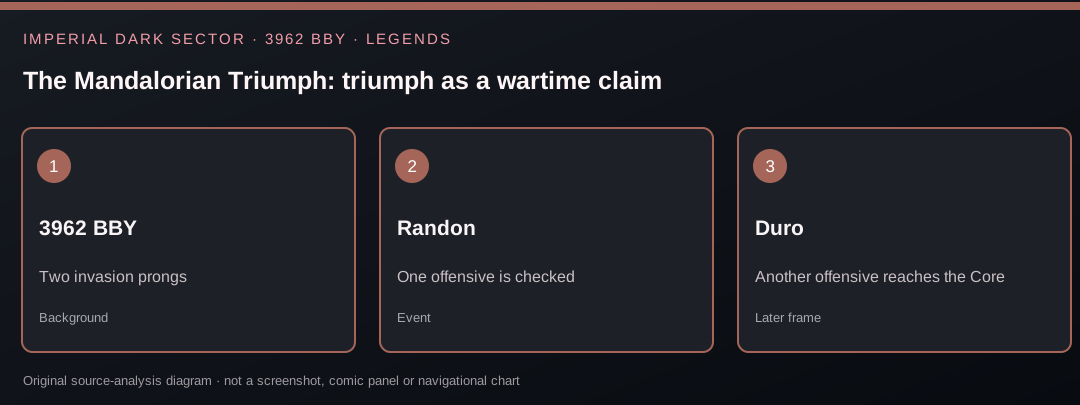
The Mandalorian Triumph: triumph as a wartime claim
What the sources establish
The Mandalorian Triumph was the name used for a sequence of advances toward the Core during 3962 BBY. Source maps trace more than one prong: one stalled near Randon while another progressed toward Duro. The title reflects Mandalorian self-presentation as much as an objective description of final military victory.
Power, identity, and society
Territorial gains connected campaigns to commercial routes and local institutions. A source map that names only systems and military movements may conceal the experiences of residents, workers and displaced communities along the route.
Evidence limits
The historical map does not identify a single unified battle or provide coordinates for each fleet at an exact time. The attacks should not be conflated with the later Republic counteroffensive or the defeat at Malachor V.
Historical check: Does the name Mandalorian Triumph mean the Mandalorians won the entire war in 3962 BBY?
Explanation: No. It describes a particular offensive. The Mandalorian Wars continued afterward.
Sources and further reading
- The Essential Atlas.
- The Essential Guide to Warfare.