
- Date
- 3962 BBY
- World
- Duro
- Outcome
- Mandalorian capture
- Republic leaders
- Revan, Malak, Meetra Surik
- Aftermath
- Revan elevated to supreme command
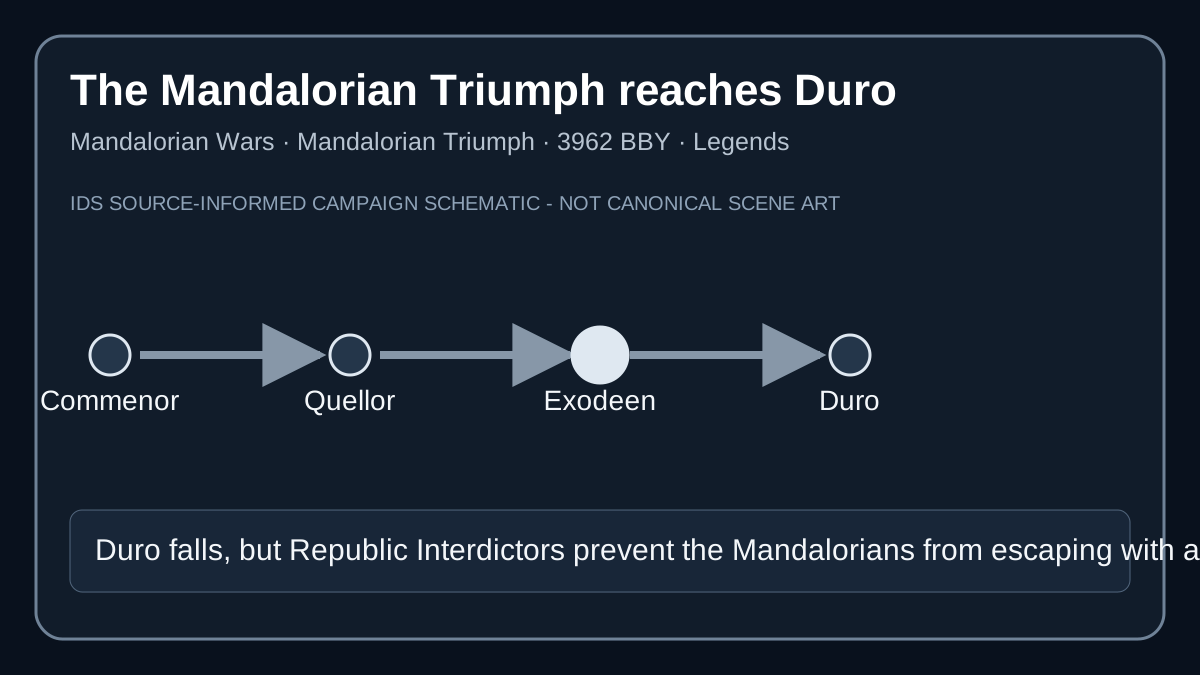
Historical narrative and evidence
The Battle of Duro was the culmination of the Mandalorian Triumph in 3962 BBY. After fighting through a chain of systems toward the Core, the Neo-Crusaders reached Duro and captured it. The assault devastated the world and its orbital settlements. Atton Rand later remembered Basilisk war droids descending on the orbital cities like meteors, a detail that gives the battle a human and visual scale missing from many of the surrounding engagements.
Duro was the objective, not an accidental endpoint
The Mandalorian Triumph was designed to push through Republic space toward Duro. The world mattered because of its location, orbital infrastructure, and shipbuilding capacity. Taking it demonstrated that the Mandalorians could reach a major Core World after a sustained campaign rather than a single isolated raid.
The attack also converted infrastructure into a battlefield. Orbital cities and shipyards were not merely background scenery. They were part of the military and economic system that made Duro valuable, which also made civilians and workers vulnerable when the Neo-Crusaders struck.
Basilisk war droids made the assault memorable
Atton's recollection of Basilisk war droids raining onto the orbital cities is one of the strongest surviving images of the battle. It communicates how Mandalorian military technology could collapse the boundary between orbital and ground combat. Attackers could move directly from space into inhabited structures with extraordinary speed.
The image also became part of survivor memory. Years later, Duro remained one of the places used to confront Meetra with what the war had cost.
Revan prevents a complete strategic disaster
Although the Mandalorians captured Duro, Republic forces under Revan, Malak, and Meetra Surik arrived with Interdictor-class cruisers and prevented the attackers from simply leaving with captured war materiel. The intervention did not erase the loss of the world, but it limited what the Mandalorians could carry away from the shipyards.
Political pressure after the disaster helped push the Republic toward giving Revan supreme military command. That decision changed the structure of the war. A Jedi who had already defied the Council was now placed at the center of Republic strategy.
Campaign sequence
The Triumph moves through a chain of systems toward Duro.
Neo-Crusaders and Basilisk war droids strike orbital infrastructure.
The Mandalorians achieve the offensive's principal objective.
Revan's force prevents the invaders from escaping with all seized materiel.
Revan's authority expands as the Republic searches for a way to reverse the war.
Anthropological assessment
Duro reveals the political importance of infrastructure. Shipyards, orbital cities, transport routes, and industrial systems are not neutral objects around which history happens. They organize power. Controlling or destroying them changes what governments can build, move, repair, and defend.
The battle also shows how military failure can reorganize institutions. The Republic responded to repeated losses by concentrating authority in Revan. That solved an immediate command problem, but it also increased dependence on a single charismatic strategist whose relationship with the Jedi Council was already strained. Duro therefore belongs in the history of both the Mandalorian Wars and the political conditions that preceded the Jedi Civil War.
Evidence check
What is firmly established?
The date or date range, location, continuity, broad combatants, outcome, and campaign placement are retained only where the cited Legends sources support them.
What has IDS deliberately not invented?
Unnamed commanders, exact force sizes, casualty totals, dialogue, tactical phases, and civilian experiences are omitted whenever the surviving sources do not establish them.
Why use a schematic instead of borrowed battle art?
For events without a verified source-specific illustration, this page uses an original labeled reconstruction rather than presenting unrelated comic or game art as though it depicts the battle.
Editorial field note · 3962 BBY · Legends
How to interpret the Duro engagement
Recorded outcome: Mandalorian devastation. The event belongs to the crisis preceding Revan's command. A single battle cannot describe every front of the war.
Historical method: Campaign maps and later summaries can establish an event without preserving individual commanders, tactical formations, civilian testimony or precise hourly timing. Detailed scene reconstruction without those sources would mislead readers.
Test the evidence: what can this entry establish?
It supports the documented event and stated outcome, but not casualty totals, spoken orders or motives of unnamed participants. Compare the references and related events before inferring broader causes.
Sources and further reading
- Star Wars: Knights of the Old Republic II: The Sith Lords (LucasArts/Obsidian, 2004), relevant dialogue, field records, and Mandalorian Wars material.
- The Essential Atlas, Daniel Wallace and Jason Fry (2009), Mandalorian Wars chronology and campaign mapping.
- The Essential Guide to Warfare, Jason Fry (2012), where applicable to later in-universe military-historical accounts.
Evidence limits: Linked publisher or Lucasfilm records identify the source editions. The map and dates in a battle reconstruction require the original book and game evidence, not the catalog synopsis; the diagram above is an IDS interpretation, not an original battle still.
Test your historical judgment
Answer both to receive a score, specific corrections, and a research takeaway.
Legends · historical source review
Industrial losses create a command crisis
Duro is an important industrial world with strategic position near the Core. The Mandalorian advance reaches the system during the campaign termed the Triumph, and the defeat demonstrates that defensive planning has failed at a much deeper location than earlier frontier raids. Republic political leaders confront the costs of allowing an enemy to threaten production and transit near a heavily connected part of the galaxy.
The event is best understood in relation to Revan's subsequent appointment as Supreme Commander, not as proof that Revan already held every element of formal command before the fight. Military emergencies create opportunities for institutions to change how authority is assigned. Yet legal appointment and personal battlefield influence are not identical. The record should also resist implying that all Duros residents or industrial workers shared one political identity merely because their world became a strategic objective.
Historical judgment: Duro's defeat precedes Revan's formal promotion. Publisher's related original account →. Publisher stories establish the main plot; social-institutional interpretations are IDS analysis. Exact day-level chronology is not asserted.