
- Date
- 3962 BBY
- Location
- Exodeen system
- Conflict
- Mandalorian Wars
- Outcome
- Mandalorian victory
- Next objective
- Duro
Historical narrative and evidence
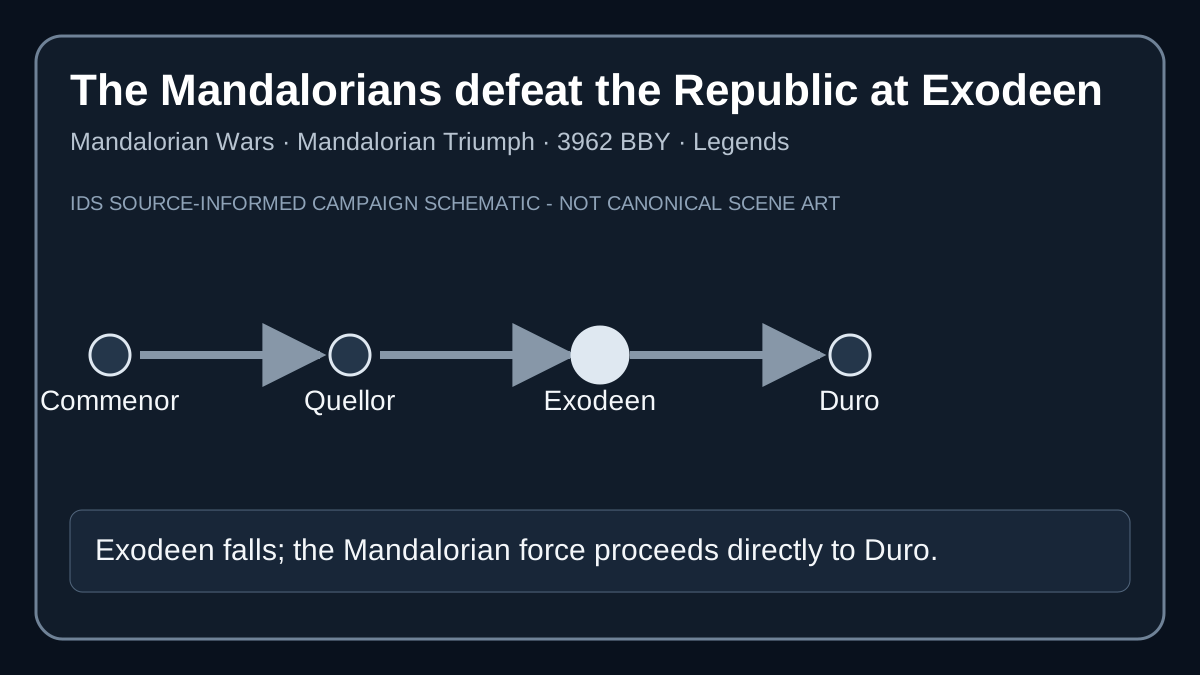
In 3962 BBY, the Mandalorian Neo-Crusaders fought the Galactic Republic in the Exodeen system as part of the Mandalorian Triumph. They had already passed through Quellor. The victory at Exodeen kept the offensive intact and placed the force on the final documented step before the attack on Duro.
A small entry with large chronological value
Exodeen is important because it fixes the order of movement immediately before Duro. Without it, later summaries can make the Mandalorian Triumph look like a single dramatic thrust. The Atlas instead shows a sequence of contested systems, each one part of the operational work required to reach the objective.
That distinction matters for the archive. Large wars are not composed only of famous battles. They are made from repeated movements, engagements, repairs, supply decisions, and local defeats that allow the next operation to occur.
Unknown details remain unknown
There is no secure source for how long the Exodeen fighting lasted, whether it centered on a planet or in space, how many ships participated, or what happened to local civilians. Those are exactly the kinds of details that fan chronologies can accidentally fill with inference.
IDS records the known event and its strategic meaning while identifying the evidentiary boundary. This keeps the page useful without converting a map symbol into a fictional battle scene.
Anthropological assessment
Exodeen shows how campaign maps compress lived events. To later historians, it can appear as a point between Quellor and Duro. To the people present, the battle would have involved institutions, fear, damaged infrastructure, orders, and local consequences that the surviving sources no longer preserve.
The gap is important. Archives are not neutral mirrors of the past. They preserve some scales of history better than others. The Mandalorian Triumph survives strongly as a strategic story, while the social history of many individual systems is thin or lost.
Evidence check
What is firmly established?
The date or date range, location, continuity, broad combatants, outcome, and campaign placement are retained only where the cited Legends sources support them.
What has IDS deliberately not invented?
Unnamed commanders, exact force sizes, casualty totals, dialogue, tactical phases, and civilian experiences are omitted whenever the surviving sources do not establish them.
Why use a schematic instead of borrowed battle art?
For events without a verified source-specific illustration, this page uses an original labeled reconstruction rather than presenting unrelated comic or game art as though it depicts the battle.
Editorial field note · 3962 BBY · Legends
How to interpret the Exodeen engagement
Recorded outcome: Mandalorian victory. The event belongs to pressure on Republic defenses. Read this outcome alongside the wider conflict rather than assuming that a single battle describes every front.
Historical method: Campaign maps and later summaries can establish a place in the war without preserving individual commanders, tactical formations, civilian testimony or a precise sequence of hours. Where the published account is limited, a detailed scene reconstruction would mislead readers.
Test the evidence: what can this entry establish?
It supports the documented event and its stated outcome. It cannot, by itself, establish casualty numbers, spoken orders or the motives of unnamed participants. Compare adjacent entries and their citations before inferring broader causes.
Explore a connected campaign event →
This field note distinguishes source-backed chronology from analytical interpretation; see the references below.
Historical interpretation · Legends
Exodeen and the route to Duro
Exodeen was one of the final documented engagements before the attack on Duro. The advance had already passed through Commenor and Quellor, leaving the Republic struggling to hold the corridor. The battle's larger significance is therefore well established as a connection between other engagements, even though there is no complete account of individual officers, fleet sizes or civilian experiences.
Research boundary: Where military history gives a sequence rather than an original scene, IDS does not invent unit strengths, individual dialogue, casualties or unrecorded local reactions.
Source literacy · Legends
Test your historical judgment
Receive your score, corrections, and an explanation of the evidence behind each question.
Sources and further reading
- The Essential Atlas, Daniel Wallace and Jason Fry (2009), Mandalorian Wars chronology and campaign mapping.
- The Essential Guide to Warfare, Jason Fry (2012), where applicable to later in-universe military-historical accounts.
About these links: Publisher and Lucasfilm records identify the referenced editions. A book description or game listing is not a scene-by-scene record of this battle; map placements, dialogue, casualty claims and historical interpretations must be checked against the original pages or gameplay.