
- Location
- Coruscant
- Codeword
- Vindication
- Manipulator
- Haazen
- Outcome
- Original Covenant collapses
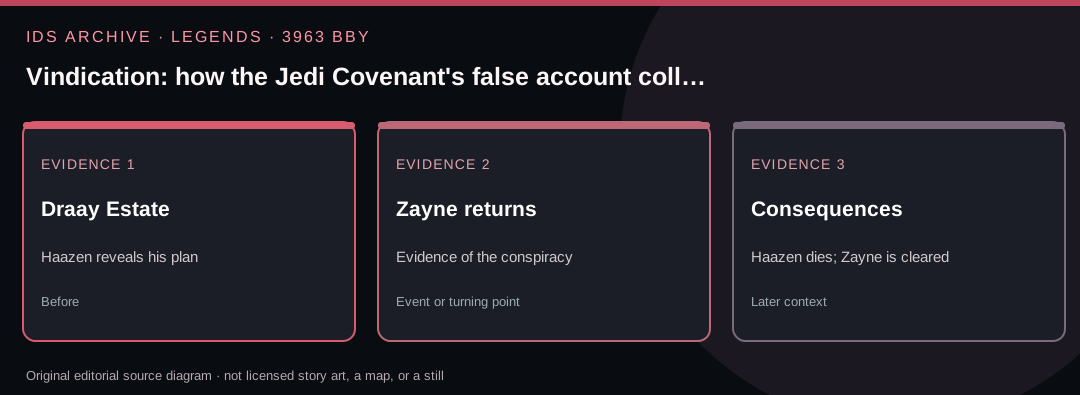
The Jedi Covenant crisis that began with the Padawan Massacre ended in 3963 BBY at the Draay Estate on Coruscant. Xamar agreed to expose the Covenant to the High Council and brought Zayne Carrick into the estate as part of a plan to rescue Krynda Draay. Haazen discovered the deception and issued the codeword 'Vindication,' activating Covenant agents against the Jedi Order itself.
The Covenant had been manipulated from inside
Haazen had helped Krynda build the organization while secretly pursuing his own agenda. Its secrecy gave him access to people, artifacts, funds, and contingency plans ordinary Jedi could not easily inspect.
The institution designed to detect hidden corruption had made itself unusually vulnerable to a hidden manipulator.
One codeword turns prevention into insurrection
Vindication was built as an emergency response to a hypothetical Sith takeover of the Jedi Council. Haazen falsely declared that the nightmare had occurred and activated the plan.
The mechanism shows the danger of contingency systems designed for worst-case scenarios when the authority to trigger them is poorly constrained.
Zayne finally clears his name and refuses Knighthood
After Haazen's defeat and the exposure of the WatchCircle's crimes, the Jedi Council formally exonerated Zayne and offered him a place in the Order as a Knight.
He refused. Being proved innocent did not restore the trust destroyed when the institution had hunted him.
The Republic replaces the true story with a safer one
Officials blamed the destruction on Mandalorian terrorists. The cover story protected institutions from scandal during wartime but erased public knowledge of a Jedi internal crisis.
Institutional recovery therefore came partly through controlled memory.
Explore this entry
Why would Covenant Jedi obey Haazen?
They believed the contingency was legitimate and that the Jedi Council itself had been compromised. The system was designed to make extraordinary obedience feel like fidelity to the Order.
Why did Zayne reject Knighthood?
Exoneration could correct the record but could not undo months of pursuit or the fact that Jedi institutions failed to protect him. His refusal is a statement about trust, not simply rank.
Anthropological assessment
Vindication shows how emergency institutions can become self-sealing. The more they expect hidden enemies, the easier it becomes to interpret oversight or disagreement as proof of infiltration.
The official cover-up adds another layer: institutions sometimes preserve legitimacy by controlling memory after a crisis rather than fully exposing how the crisis occurred.
What the comic confirms and what later memory conceals
John Jackson Miller's Vindication spans Knights of the Old Republic #32–35. The published #33 cover features Haazen, but that issue contains an extended retrospective of the conspirator's past. It is not a documentary illustration of every stage of the Draay Estate fighting. Marvel's issue record ↗ and the writer's own explanatory notes ↗.
The political consequences are distinct from the military outcome. Haazen was defeated, the Covenant's structure failed, and Zayne Carrick was exonerated. Republic authorities then substituted a publicly safer explanation that blamed the Mandalorians. This gap between events, private institutional knowledge and public memory makes Vindication a case study in the production of official history. The related source analysis companion provides the interpretive discussion without treating it as a new chronological event.
Historical evidence · Legends
Test your historical judgment
Receive a score, specific corrections, and historical explanations. These questions are based on the sources named below.
3963 BBY · Legends · evidence file
Vindication: how the Jedi Covenant's false account collapses
Published evidence
The Vindication arc brings the Covenant's activities to an end as Haazen's secret plan is revealed. Zayne Carrick confronts the group that falsely blamed him for the Padawan Massacre, and his public status eventually changes.
Institutions and culture
The plot reverses the asymmetry of the first massacre reports. A junior fugitive accused by respected Jedi authorities gradually secures evidence, allies and recognition. Institutions can revise public judgment, but the delay and dangers faced by the accused remain part of the historical record.
What remains unverified
The story's resolution should not be compressed into a single trial with invented legal proceedings. Its issue sequence, participants and later outcomes must be attributed to the source comics.
Check the historical record: Was the Padawan Massacre Zayne Carrick's own crime?
Explanation: No. The Jedi Covenant Masters murdered their own apprentices and blamed Zayne.
Sources and further reading
- Knights of the Old Republic 32–35, “Vindication.”
- Knights of the Old Republic Campaign Guide.