
- Date
- 3963 BBY
- World
- Iridonia
- Allies
- Zabrak + Republic
- Outcome
- Republic victory
- Strategic effect
- Pincer toward Coruscant disrupted
Historical narrative and evidence
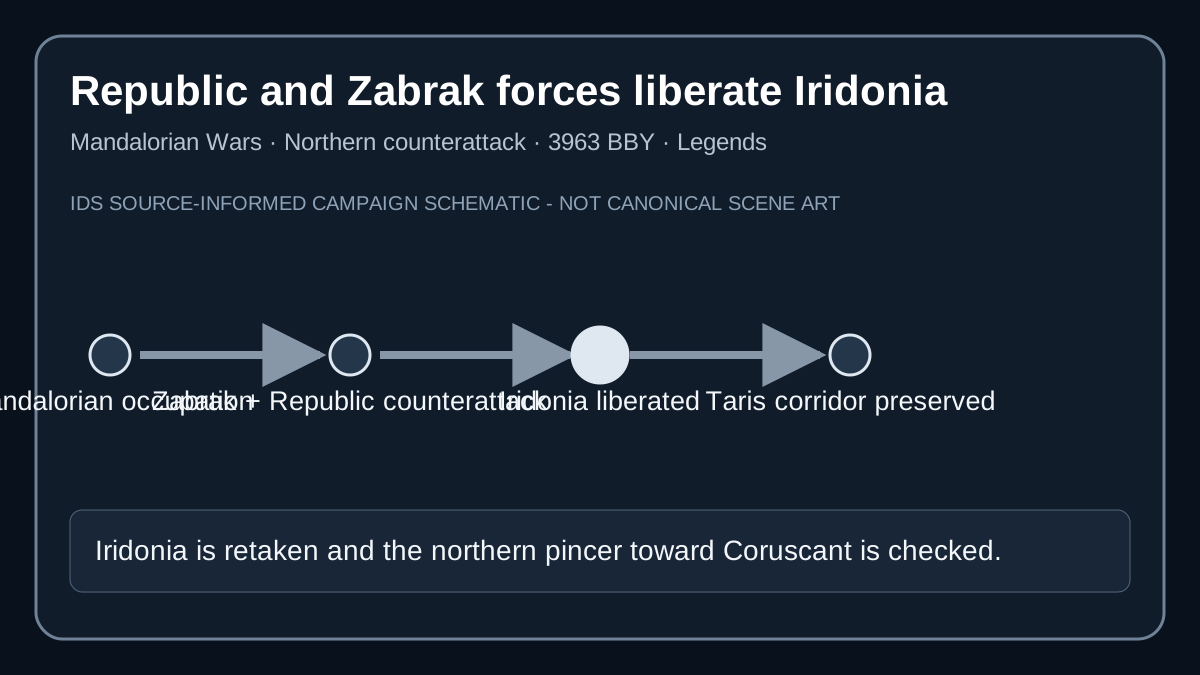
Later in 3963 BBY, Zabrak military units and Republic forces counterattacked at Iridonia and defeated the Mandalorian Neo-Crusaders. Together with the Republic recovery at Ithor, the victory helped prevent the northern invasion route from becoming a pincer against Coruscant. It also preserved a corridor through which the Republic could reinforce the embattled Taris front.
Coalition warfare reverses the first defeat
The Republic did not recover Iridonia alone. Zabrak forces were active participants. That distinction matters because it shows local and regional military capacity affecting a conflict often summarized as Republic versus Mandalorians.
The counterattack succeeded where the first defense had failed, demonstrating that early Mandalorian victories were not irreversible.
Iridonia and Ithor work as a pair
The two northern victories changed the geometry of the campaign. By preventing the Mandalorians from closing toward Coruscant from that direction, they reduced pressure on the Core and kept open a route for supporting Taris.
This is a case where local liberation and galactic strategy align. Retaking one world also changed what forces could move elsewhere.
Anthropological assessment
The second battle of Iridonia shows how alliances are built through shared danger. The Republic needed Zabrak military support, while Zabrak communities had immediate reasons to resist an invasion that had already reached their colonies and homeworld.
That relationship complicates any image of the Republic as a single military actor. Political survival depended on member and allied communities contributing their own people, knowledge, and institutions.
Evidence check
What is firmly established?
The date or range, continuity, broad combatants, outcome, and campaign placement are included only where the sources below support them.
What has IDS deliberately not invented?
Unnamed commanders, exact force sizes, casualty totals, tactical phases, dialogue, and civilian experiences remain unknown unless a cited source establishes them.
Why use a schematic?
The visual is an original IDS reconstruction used where verified event-specific artwork is unavailable or rights status is unclear. It is labeled so it cannot be mistaken for canonical scene art.
Defeat, counterattack, and coalition resistance
The Mandalorians initially gained the advantage on Iridonia, but Republic and Zabrak forces later retook the world in the same campaign year. These are distinct battles with opposite outcomes. The second engagement is important because the recovery of the Zabrak homeworld is part of a wider northern reversal that included Ithor. It blocked an attempted pincer against the Republic's Coreward defenses without ending the Mandalorian Wars as a whole.
The coalition demonstrates a difference between simply counting Republic victories and recognizing local military participation. The Zabrak defended their own homeworld; Republic support mattered, but the campaign cannot be reduced to decisions taken by distant commanders alone. Neither The Essential Atlas nor a later military summary supplies complete civilian accounts or exact casualty figures for this battle.
Compare the earlier Iridonia defeat → · Compare the Ithor counteroffensive →.
Historical evidence · Legends
Test your historical judgment
Receive a score, specific corrections, and historical explanations. These questions are based on the sources named below.
Sources and further reading
- The Essential Guide to Warfare (2012), Vilnau Teupt's later summary of Iridonia and Ithor.
- The Essential Atlas (2009), campaign framework.