
- Date
- 3963 BBY
- World
- Ithor
- Allies
- Republic + Zabrak units
- Outcome
- Republic counterattack victory
- Strategic effect
- Northern pincer disrupted
Historical narrative and evidence
The battle for Ithor in 3963 BBY began badly for the Republic. Mandalorian forces moving along the northern invasion corridor gained the advantage, threatening a world that mattered both for its location and for the agricultural and medical resources associated with Ithor. Republic forces then counterattacked with Zabrak military support and reversed the outcome.
Local allies alter the balance
The Zabrak role matters because it prevents the war from being reduced to a two-sided contest between a centralized Republic and a unified Mandalorian enemy. Regional military forces had their own interests in preventing Neo-Crusader expansion and could contribute capabilities the overstretched Republic needed.
The victory therefore depended on coalition warfare. Republic authority alone did not produce the result. Support from societies directly threatened by the invasion changed what the government could accomplish.
Ithor was more than territory
Ithor's agricultural, botanical, and medical importance gave the world logistical value. During a prolonged war, food and medicine can matter as much as weapons. Preserving access to those resources helped sustain forces elsewhere, including the contested Taris front.
The battle also threatened Ithorian society, whose cultural relationship to ecology and protected natural environments makes invasion especially significant. The sources do not provide a detailed civilian account of this battle, so IDS does not invent one, but the strategic value of Ithor cannot be separated from the living systems that made the world valuable.
A pincer toward the Core fails
Later historical summaries state that victories at Ithor and Iridonia prevented the Mandalorians from completing a northern pincer against Coruscant. They also preserved a corridor through which the Republic could reinforce Taris. That makes Ithor one of the more consequential Republic successes of the early invasion.
Anthropological assessment
Ithor demonstrates how alliances distribute sovereignty during crisis. The Republic could claim to defend member worlds, but in practice its survival depended on regional partners willing to commit their own forces. Protection therefore flowed in more than one direction.
The battle also shows why infrastructure includes ecological and medical systems. A world can be strategically important because it produces the conditions that let other communities survive. Defending Ithor meant defending a network of food, medicine, knowledge, and transport as well as a position on a map.
Evidence check
What is documented?
The date or range, continuity, broad combatants, outcome, and campaign placement come from the sources listed below. More specific details appear only when the cited story or reference work supplies them.
What is deliberately left unknown?
IDS does not add unnamed commanders, fleet sizes, casualty totals, tactical maneuvers, dialogue, or civilian experiences unless a source establishes them.
Why is the visual a schematic?
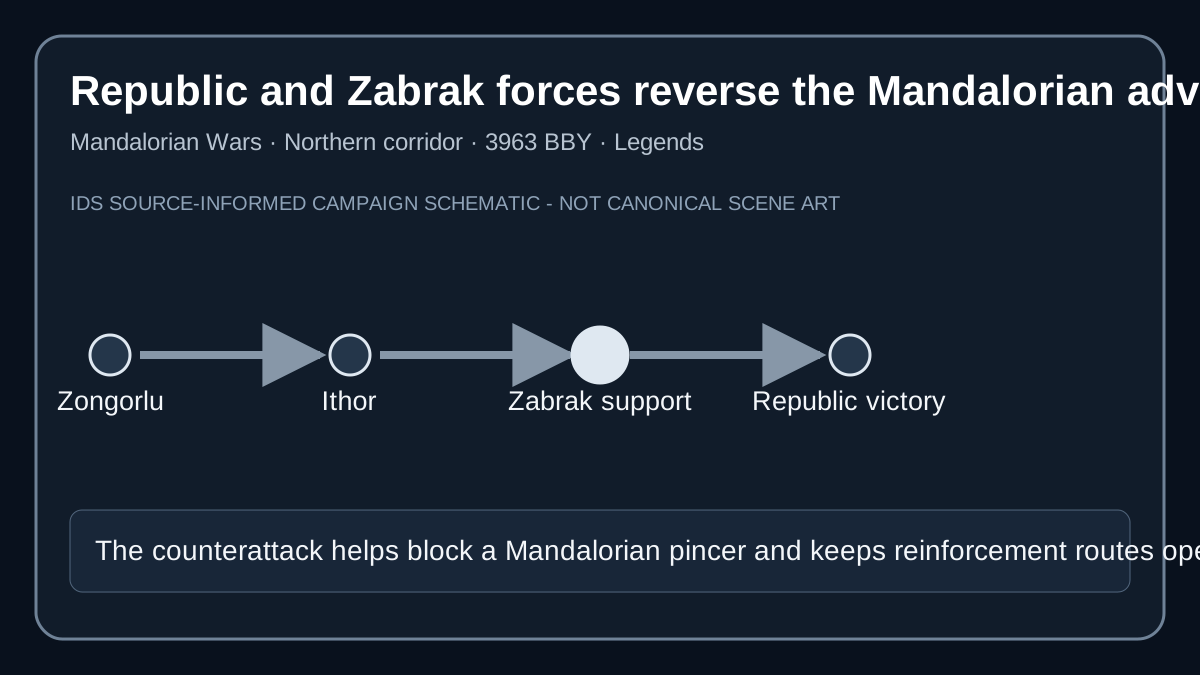
It is an original IDS reconstruction used where verified event-specific artwork is unavailable or rights status is unclear. The diagram is labeled so it cannot be mistaken for canonical scene art.
Historical judgment · Legends · Source literacy
Test your interpretation of this battle
Answer both questions for a score, specific corrections and an explanation of what the record can establish.
Source method: This assessment follows the references in this entry. A later campaign map can document a system and a result without documenting conversations, exact numbers or undocumented motives.
3963 BBY · Legends · Evidence file
Ithor: coalition defense interrupts the northern invasion
What sources establish
Republic and allied Zabrak forces fought the Mandalorian Neo-Crusaders in the Ithor system during the 3963 BBY Onslaught. The Mandalorians initially threatened Ithor, but the defenders eventually reversed the battle's outcome. The victory was notable because many other systems fell that year. Ithor also had broader ecological and agricultural significance within the galaxy, although the campaign references do not supply detailed Ithorian civilian testimony from this specific engagement.
Anthropological interpretation
Alliance warfare involves interests beyond those of the central Republic government. Zabrak forces had reasons to fight an invasion that had already struck their colonies, while Ithorians valued a homeworld with distinctive ecological and social traditions. Military planners might describe such a system in terms of logistical and agricultural value, whereas its inhabitants could value protected environments and community continuity. These are not mutually exclusive, but they should not be collapsed into a single 'strategic' meaning. Preserving the coalition's role makes the war's political geography more accurate.
Chronology and evidence limits
The available campaign account does not provide an exhaustive list of defending units or verify exact civilian losses. Ithor's local victory did not stop the wider Mandalorian offensive.
Test your historical judgment: Did Mandalorian forces win every 3963 BBY battle on the northern corridor?
Correction and explanation: No. Republic and Zabrak forces successfully reversed the situation at Ithor.
Sources: The Essential Atlas; Mandalorian Wars campaign history. Reference bibliography ↗. Original printed-page verification remains open.
Sources and further reading
- The Essential Guide to Warfare (2012), Vilnau Teupt's later historical summary.
- Knights of the Old Republic Campaign Guide (2008), Ithor and Old Sith Wars context.
- The Essential Atlas (2009), campaign geography.
About these links: Publisher and Lucasfilm records identify the referenced editions. A book description or game listing is not a scene-by-scene record of this battle; map placements, dialogue, casualty claims and historical interpretations must be checked against the original pages or gameplay.