
- Date
- 3963 BBY
- World
- Ord Mantell
- Role
- Ordnance / Regional Depot
- Outcome
- Mandalorian victory
- Next
- Iridonia
Historical narrative and evidence
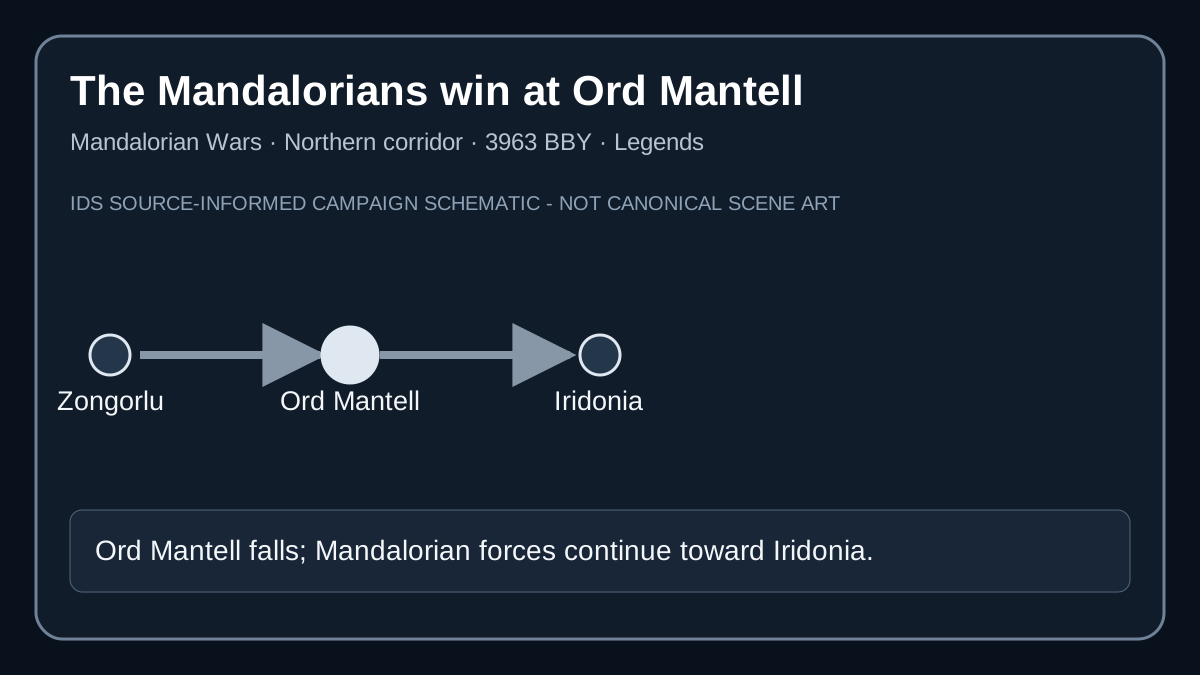
The Mandalorians attacked Ord Mantell in 3963 BBY after breaking through the Zongorlu system. The battle belonged to the northern invasion corridor of the Coreward Onslaught. The Neo-Crusaders defeated Republic forces on the world and then continued toward Iridonia.
A depot world sits inside the invasion route
Ord Mantell's military value did not depend only on defending its population. As a depot world, it belonged to the Republic's logistical system. Such places support fleets and armies by storing, repairing, routing, or distributing matériel.
When the Mandalorians won there, they threatened more than local political control. They disrupted part of the network that made Republic military movement possible.
The northern campaign branches
The route through Zongorlu did not produce one simple line of advance. Mandalorian pressure extended toward Ithor, Ord Mantell, and the Zabrak worlds. That forced the Republic and its regional allies to decide where to concentrate limited forces.
Ord Mantell fell even while Republic and Zabrak counterattacks succeeded elsewhere. The mixed results show why campaign maps should be read as simultaneous pressures rather than a single front moving uniformly inward.
Anthropological assessment
Ord Mantell shows how logistics turns ordinary infrastructure into a military objective. Depots, repair sites, and transport hubs rarely carry the symbolic attention of capitals, but states cannot wage war without them.
The battle also reveals how central governments depend on peripheral worlds. A Republic may describe Ord Mantell as part of a vast political whole, yet the immediate significance of the world in wartime comes from the material work performed there. Sovereignty is sustained by warehouses, routes, labor, maintenance, and local security as much as by Senate law.
Evidence check
What is documented?
The date or range, continuity, broad combatants, outcome, and campaign placement come from the sources listed below. More specific details appear only when the cited story or reference work supplies them.
What is deliberately left unknown?
IDS does not add unnamed commanders, fleet sizes, casualty totals, tactical maneuvers, dialogue, or civilian experiences unless a source establishes them.
Why is the visual a schematic?
It is an original IDS reconstruction used where verified event-specific artwork is unavailable or rights status is unclear. The diagram is labeled so it cannot be mistaken for canonical scene art.
Historical judgment · Legends · Source literacy
Test your interpretation of this battle
Answer two source-based questions. Review your score, corrections, and a specific explanation for each response.
Research note: Legends campaign maps and later summaries may establish an event's location and outcome without preserving a full eyewitness account. Interpretations are distinguished from attested details above.
3963 BBY · Legends · Historical source file
Ord Mantell: the Onslaught strikes a Republic logistical network
Source-supported history
In 3963 BBY, Mandalorian forces attacked and defeated Republic forces at Ord Mantell after passing through the Zongorlu corridor. The defeat belonged to the northern offensive and threatened routes used by a Republic military already responding to simultaneous attacks elsewhere. The world had significance as a depot and movement center, not merely as a planet that appears next in a list of battles. The source does not preserve a comprehensive operation report naming every unit.
Institutions, culture and material life
Supply nodes connect distant operations. The ability to repair ships, store equipment, distribute provisions and relay route data allows an army to exist beyond the place where it is presently fighting. An attack at such a node can therefore change what is possible on several fronts at once. Military institutions treat transportation and maintenance as logistical concerns, but they are also forms of material life maintained by workers, traders and specialists. The historical record gives us more information about the invasion route than about their experiences. It is important to acknowledge that absence while discussing why the depot mattered.
What is uncertain
The evidence supports Mandalorian success and the invasion sequence, not a precise casualty figure or the named commander of a battle invented for dramatic effect.
Test the evidence: Is the only historical importance of a depot world's capture its local combat result?
Explanation: No. The loss can weaken supply and transit elsewhere, though specific downstream losses require evidence.
Source: The Essential Atlas, Mandalorian Onslaught route; Ord Mantell Legends references. Bibliography and event notes ↗. Primary pagination still requires verification.
Sources and further reading
- The Essential Atlas (2009), campaign route.
- The Essential Guide to Warfare (2012), later Mandalorian Wars historical summary.
About these links: Publisher and Lucasfilm records identify the referenced editions. A book description or game listing is not a scene-by-scene record of this battle; map placements, dialogue, casualty claims and historical interpretations must be checked against the original pages or gameplay.