
- Year
- 3963 BBY
- Campaign
- Northern/Zabrak theater
- Outcome
- Multiple colonies overrun
- Continuity
- Legends
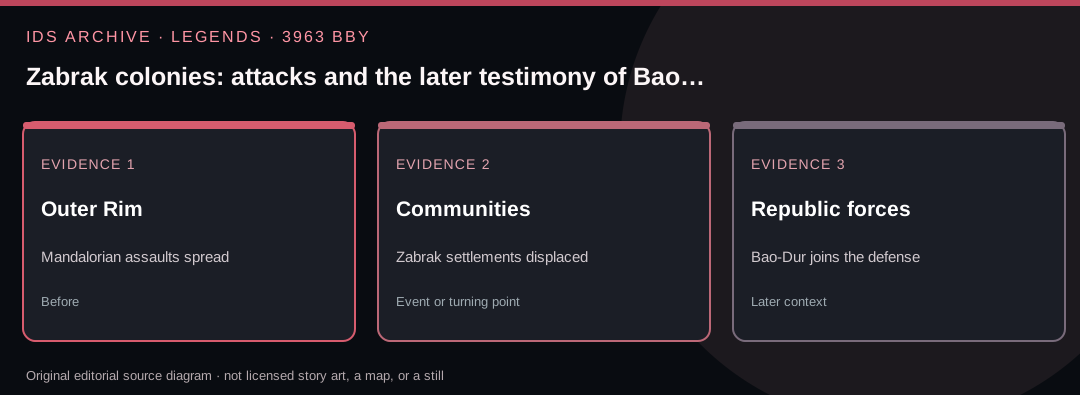
During the northern invasion, Mandalorian forces attacked Zabrak colonies scattered across the Outer Rim. Several worlds fell. News of the attacks reached Iridonia and motivated many Zabraks, including the technician Bao-Dur, to join the Republic military.
Diaspora ties turn distant war into local war
Iridonians understood attacks on offworld Zabrak colonies as violence against their wider people.
Kinship and species identity connected separate planets politically.
Vengeance becomes a recruitment force
Bao-Dur later remembered joining not only to protect others but because he hated the Mandalorians.
War mobilization can be driven by moral injury as much as strategic obligation.
How this battle fits the Onslaught
Attacks on dispersed Zabrak colonies turned a distant Republic war into a shared Zabrak crisis and helped mobilize Bao-Dur and other Iridonians.
Read beside the neighboring battles, this entry helps reconstruct the invasion as a moving network of routes, supply pressures, contested systems, and local populations rather than a string of disconnected names.
Explore this campaign stop
How can attacks on colonies mobilize a homeworld?
Diaspora ties create political relationships across distance. Violence against related communities can be understood as violence against the wider people.
Why is the source note so prominent?
Several 3963 engagements are preserved mainly through later campaign maps and reference chronology. IDS separates what those sources actually establish from tactical details they do not preserve.
Anthropological assessment
The attacks show how diaspora communities transform geographically distant violence into shared political identity.
News of harm to related communities can mobilize people who were not themselves directly attacked.
3963 BBY · Legends · evidence file
Zabrak colonies: attacks and the later testimony of Bao-Dur
Published evidence
Legends material associates Mandalorian attacks on Zabrak colonies with the expansion of the war. Bao-Dur's service as a Republic technician follows from the wider destruction the conflict caused. The 3963 BBY entry is an editorial chronology placement, not a dated mission record shown in a cutscene.
Institutions and culture
A war's expansion also changes the lives of technicians and non-Jedi volunteers. Communities under attack often enter an archive only through the later careers of survivors, making it important to distinguish the colonies' destruction from the battle histories of famous Jedi.
What remains unverified
The published record does not support a census of every destroyed colony, exact troop totals or a scene-accurate portrait of Bao-Dur on the original day of attack. The chronology is Legends-only.
Check the historical record: Does Bao-Dur's later role establish the exact date of every Zabrak colony attack?
Explanation: No. His testimony supports the conflict's consequences but not a dated list of all attacks.
3963 BBY · Legends · Evidence file
Bao-Dur remembers a war that reached Zabrak colonies first
What sources establish
Mandalorian Neo-Crusaders attacked Zabrak colonies across the Outer Rim during the 3963 BBY Onslaught. Multiple colonies fell and news traveled to Iridonia, helping motivate Zabraks to enlist in the Republic military. Bao-Dur, who later served as a Republic technician, recalled the attacks and admitted that anger at the Mandalorians influenced his decision. His testimony gives an individual perspective unavailable from a campaign map that only labels systems captured or defended.
Anthropological interpretation
Zabrak communities were spread across several inhabited planets while retaining connections to Iridonia. Violence in distant colonies could therefore be felt as an attack on a wider people, even by individuals living far from the front. Bao-Dur's recollection illustrates the relationship among diaspora identity, transmitted news and military recruitment. It should not be generalized into a claim that every Zabrak joined for revenge. The response also complicates the image of a conflict involving only two political blocs: Zabrak soldiers had their own interests and memories while fighting alongside the Republic.
Chronology and evidence limits
The source does not identify all attacked colonies, the casualties on every world or a single shared motive for Zabrak enlistment. Bao-Dur speaks years after the events.
Test your historical judgment: Did Bao-Dur describe joining the army without feelings of anger or vengeance?
Correction and explanation: No. His later recollection specifically includes anger at the Mandalorians.
Sources: Knights of the Old Republic II: The Sith Lords, Bao-Dur dialogue; The Essential Atlas. Reference bibliography ↗. Original printed-page verification remains open.
Sources and further reading
- Knights of the Old Republic II: The Sith Lords.
- The Essential Guide to Warfare.